This was a 4-day weekend visit by Whizzair from Birmingham. Krakow is the most visited city in Poland.
This picture is St Mary’s Basilica on the Main Market Square, it is famous for its bugle call sounded on the hour from a window on the high tower.
The exquisite interior of St. Mary's Basilica with its star flecked ceiling
St. Mary's Basilica
Cloth Hall
The other main building in the Main Market Square is the Cloth Hall – seen here as an end-on view with the interior arcades visible.
Wieliczka Salt Mine
One of the top attractions in the area is the Wieliczka Salt Mine. The mine ceased salt production in 1962 and is now a Unesco World Heritage site since 1978. The visit to the mine takes several hours and goes down 380 wooden stairs to a depth of 135m.
Seen here is a picture of the Chapel of St Kinga which is a church made in one of the chambers. It measures 54m by 18m and 12m high and Mass is held here every Sunday morning – although accessed via the lift and not the stairs!
Wieliczka Salt Mine
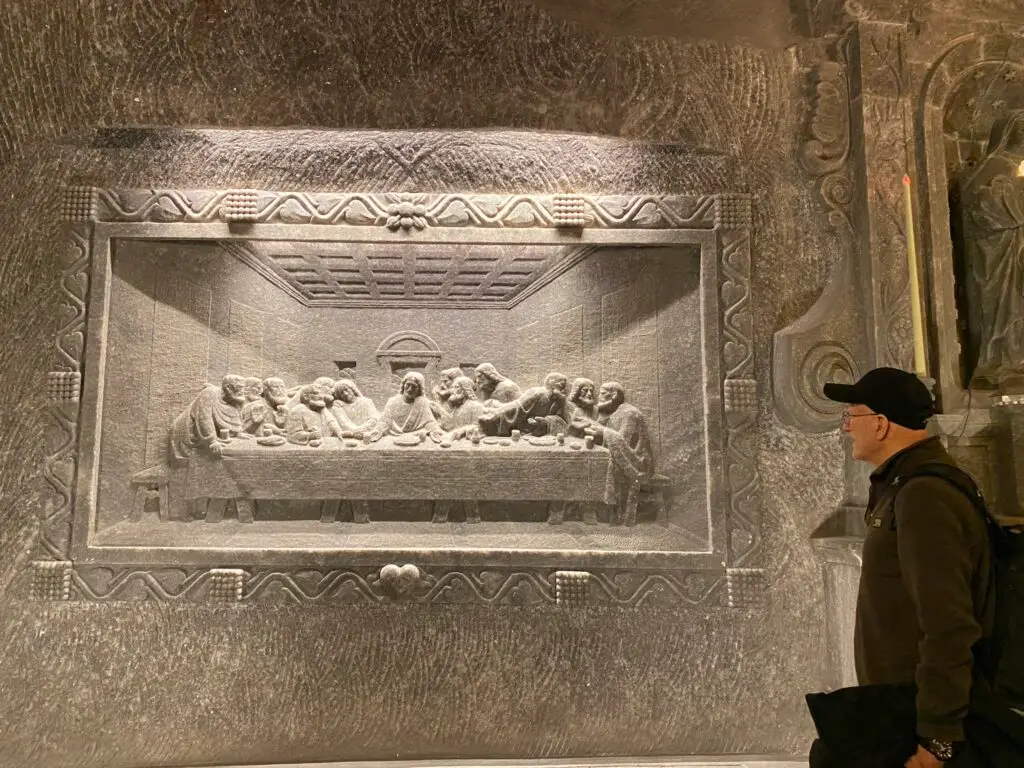
Every element of the Church is made of salt and it took more than 30 years to finish. This is ‘the last supper’ carved out of the salt rock on the church wall.
Wieliczka Salt Mine
The mine consists of chambers where the salt was excavated and which were formed by a sea that existed 14 million years ago.
The chambers are connected by corridors, so the way the miners worked was to excavate a chamber and then tunnel through the non-salt rock looking for the next chamber.
Auschwitz memorial and museum
The Auschwitz memorial and museum is about 70 km west of Krakow
Auschwitz memorial and museum
Auschwitz memorial and museum
Hans Frank was a German politician, war criminal and lawyer who served as head of the General Government in German–occupied Poland during the Second World War.
From his office in the comandeered Wawel castle adorned with stolen artwork on the walls, he signed off the death warants of millions of Jews. He was hanged from the gallows in 1946.
Auschwitz memorial and museum
Birkenau was an extension of Auschwitz when the capacity needed to be greatly extended and is situated just a few kilometers away.
Birkenau was orginally a Polish village called Oswiecim until the Nazis called one day and told all the inhabitants that they had 2 hours to vacate or else they would be shot.
Auschwitz memorial and museum
About half of the original buildings were destroyed by the Nazis who were anxious to erase their crimes when they had to evacuate the camp before the advance of the Soviet army in 1945.
As can be seen here, only the smokestacks of the original Polish houses were left.
Auschwitz memorial and museum
These are some of the buildings that the Nazis did not have time to destroy. The Nazis force marched 58,000 of the prisoners out to the West in the hope of taking the evidence of their crimes away from the camp, however they were so weak that they all died, so that when the Soviets arrived they found the fields and roads littered with 58,000 corpses.
The Soviets discovered a further 9,000 prisoners still in the camp that had been too weak even to move.
Auschwitz memorial and museum
These are the remains of the gas chamber and incineration ovens that the Nazis dynamited in the final hours.
For a time it was a mystery what they had done with all the ashes of millions of bodies.
The mystery was solved when it was realised that that a team of Jews had to break up the bones of the incinerated bodies until they were fine enough to go through a sieve, and then every day a fleet of lorries would take the ashes out into the coutryside always to a different place to be dumped in the rivers and streams.
Auschwitz memorial and museum
This was where summary executions took place for misdemeanors such as smiling at a guard or not obeying an order quickly enough, or especially if there was an escape then a mass execution would take place.
The wood fiber padding was for health and safety regulations to protect the guards from possible injury due to ricocheting bullets.
Auschwitz memorial and museum
Auschwitz memorial and museum
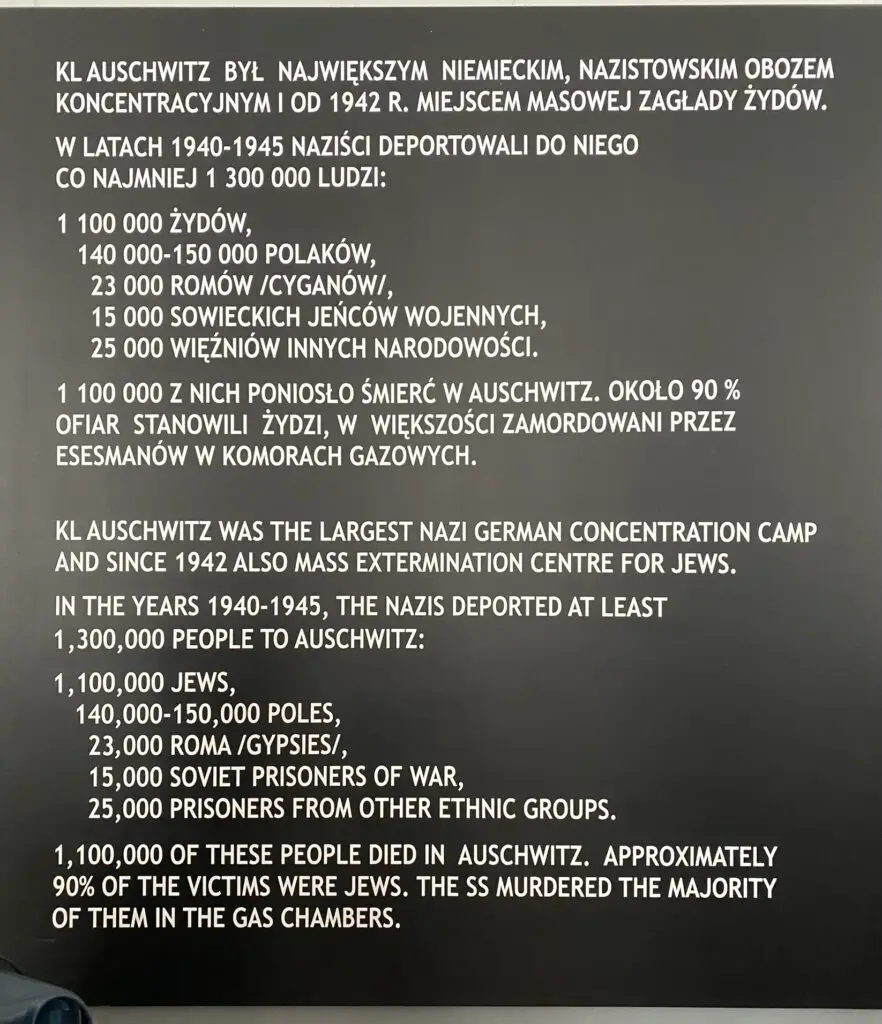
The camp commandant was called Rudolf Hoss, and it was he who introduced the pesticide Zyklon B to be used in gas chambers, where more than a million people were killed.
He was brought back to the scene of his crimes in 1947 and hanged from this specially erected gallows.
Auschwitz memorial and museum
Auschwitz memorial and museum
Auschwitz memorial and museum - the camp orchestra
Auschwitz memorial and museum
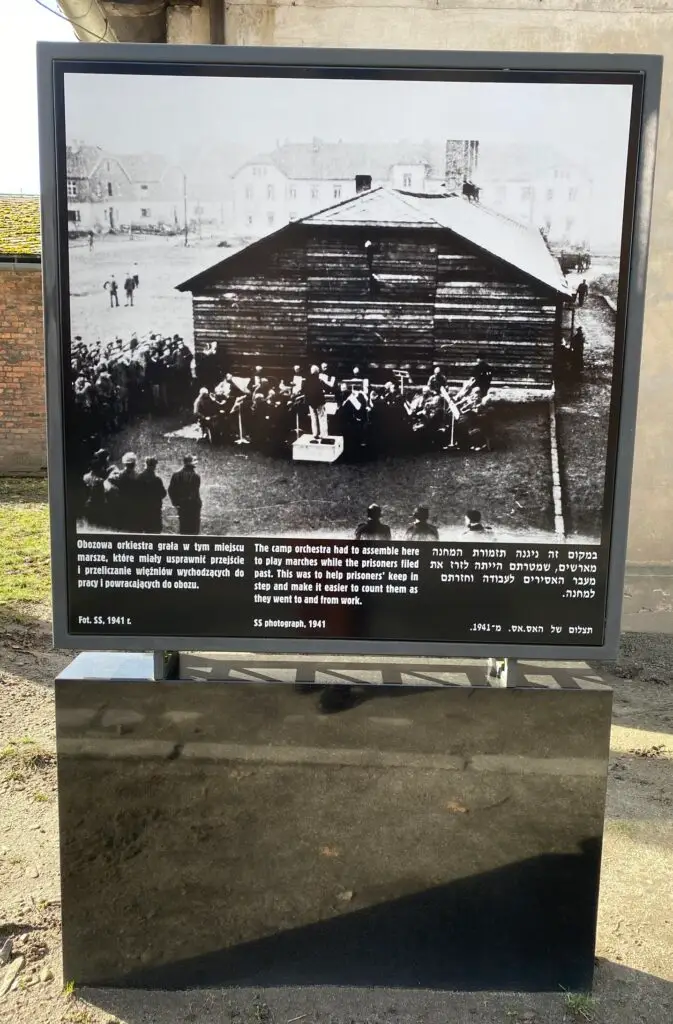
Every day, the camp orchestra would accompany the exhausted inmates to their long day of hard labor with lively marching tunes.
At the end of the day, the same spirited marching tunes would accompany them back while they carried the bodies of those who had died during the day. Because the prisoners had to march in step to the tune, this made it easier for the guards to count the numbers.
Auschwitz memorial and museum
Auschwitz memorial and museum
After the camp was liberated, a cache of photos that had not been destroyed and that had been taken by one of the SS guards was discovered in his desk drawer.
Auschwitz memorial and museum
Auschwitz memorial and museum
Oscar Schindler factory
The Oscar Schindler factory is situated just south of the Vistula river about a mile outside the city center. It is also just outside the old Jewish ghetto.
Oscar Schindler factory
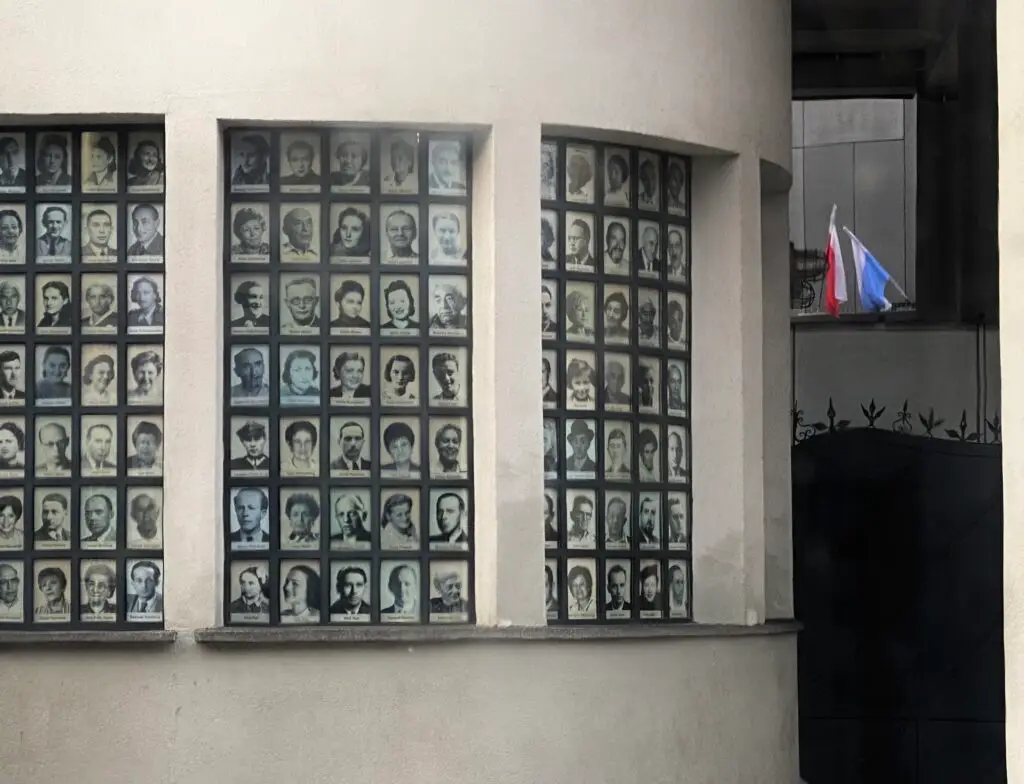
This is one of the windows of the factory which has now been filled in with pictures of some of the employees that he saved. To the right of the window can be seen part of the factory gate.
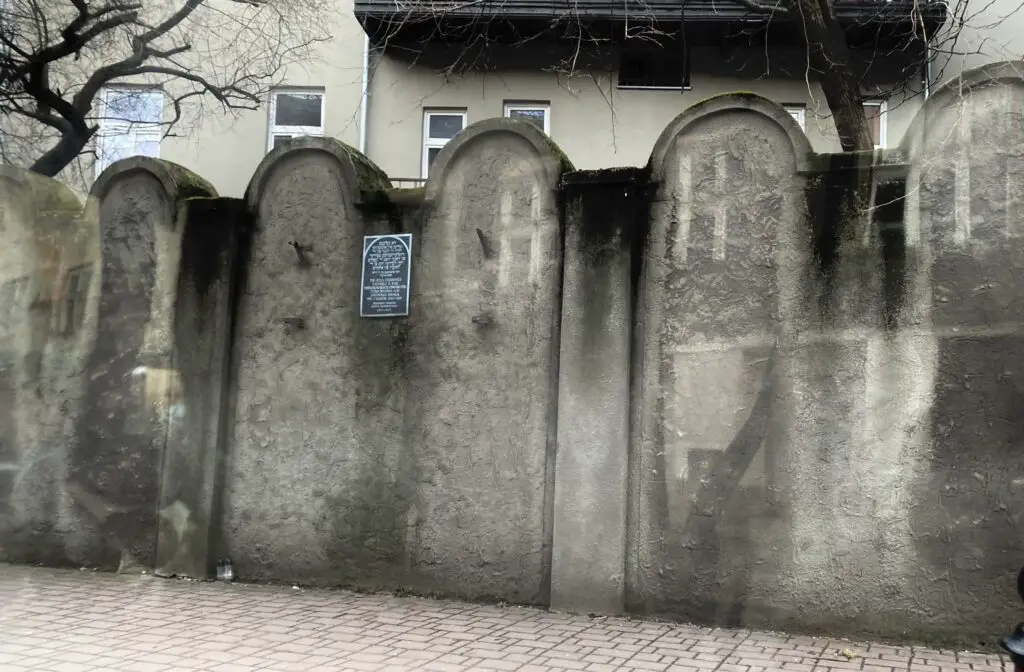
Jewish Ghetto Wall
This is the only surviving part of the Jewish ghetto wall. The Jewish ghetto was just outside of Schindler’s factory, and each day, his workers would travel from the ghetto to the factory and back. To pass outside the ghetto, the workers needed a ‘blauschein’, which was a special blue paper attachment to their ID card.
The ghetto wall was purposely modeled by the Nazis on the shape of Jewish tombstones. At the time, barbed wire would have also been added to the wall.
In October 1942, the ghetto was closed and the thousands that remained were either shot on the spot or shipped off to the extermination camp of Belzec where they were murdered with diesel fumes, or to Plaszow concentration camp which was erected on the site of two destroyed Jewish cemetaries at the edge of Krakow.
Paszow came under the command of the brutal SS Hauptsturmbandfuhrer Amon Goth in February 1943 when the number of inmates grew from two thousand to twenty-five thousand. Many died here from starvation, disease, or beatings. Also, Goth himself murdered prisoners on a daily basis and kept two huge fierce dogs, a Great Dane and an Alsation, trained to tear inmates apart upon command.
Goth was extradited to Poland and executed by hanging in September 1946.
Before the Nazi invasion of Poland, there was a Jewish population of approximately 65,000 in Kazimierz, which was almost like a separate town within Krakow. Its Jewish and Christian population coexisted and prospered for many centuries. Today, however, there are only a few hundred Jews left in Kazimierz.
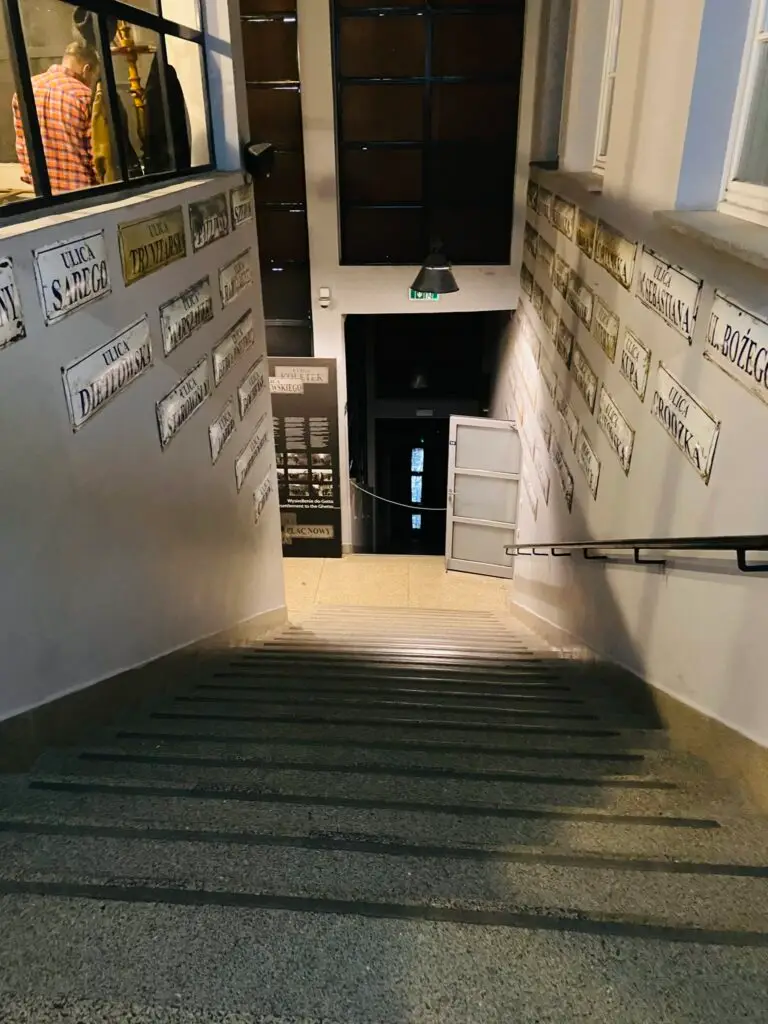
Oscar Schindler factory
These are the actual stairs (looking down) to Oscar Schindlers office that appear in the film ‘Schindlers list’.
Oscar Schindler factory
Oscar Schindler did not initially set out to save lives, viewing the Jews from the ghetto as just a cheap source of labour in order to maximise his profits from his factory making enamalled pots and pans for the German war effort.
However he ended up spending his entire considerable fortune in bribes to Amon Goth who was the ghetto commandant in order to save 1100 lives.
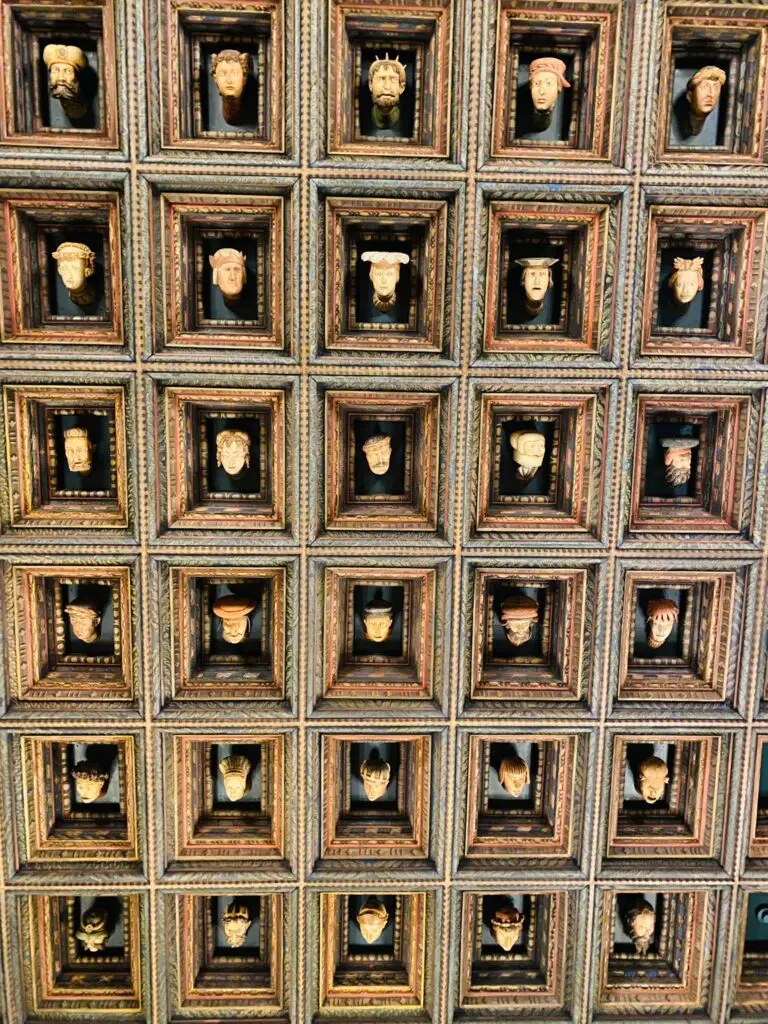
Wawel Castle
The Hall of Deputies in the Wawel castle state rooms has this fantastic coffered ceiling with 30 individually carved and painted wooden heads.
Czartoryski Museum
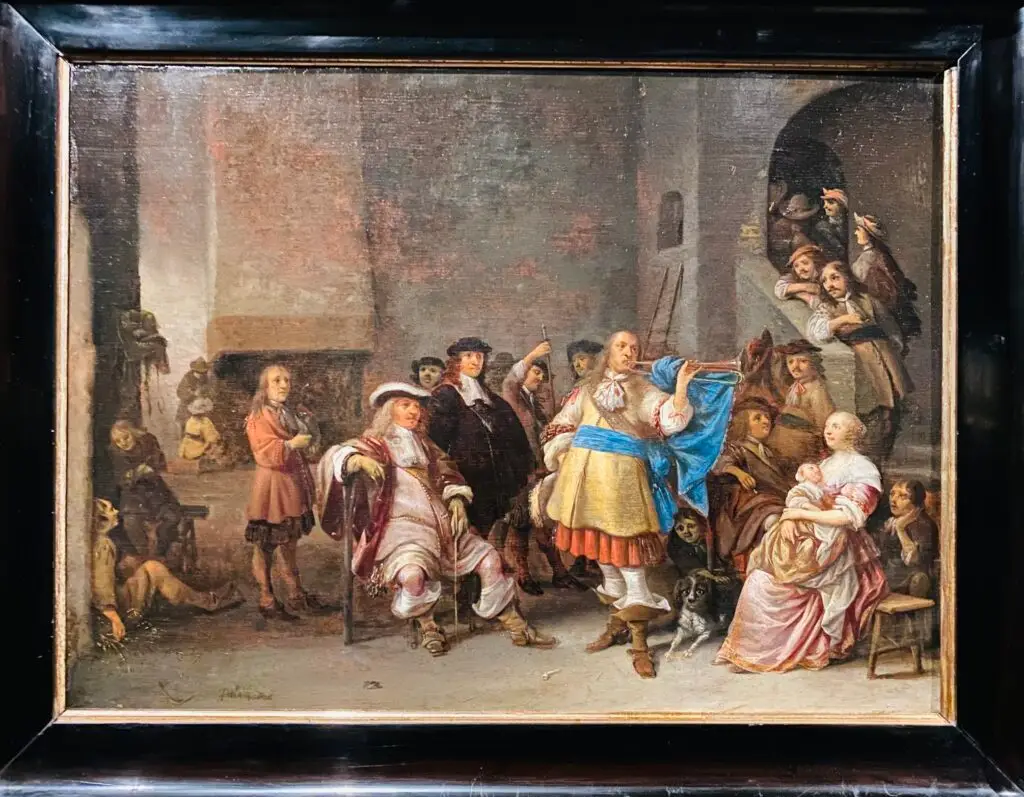
The Czartoryski Museum boasts the city’s richest art collection
Czartoryski Museum
‘The Good Samaritan’ (Rembrandt) – Czartoryski museum
Czartoryski museum
Czartoryski Museum
This is probably the most famous painting in the Czartoryski museum which is ‘portrait of a Lady with an Ermine’ by Leonardo Da Vinci from 15th century.
It is valued at $2 billion and has a special room to itself behind bullet proof glass. Thankfully it was one of the recovered pieces after being stolen by the Nazis.
Czartoryski Museum
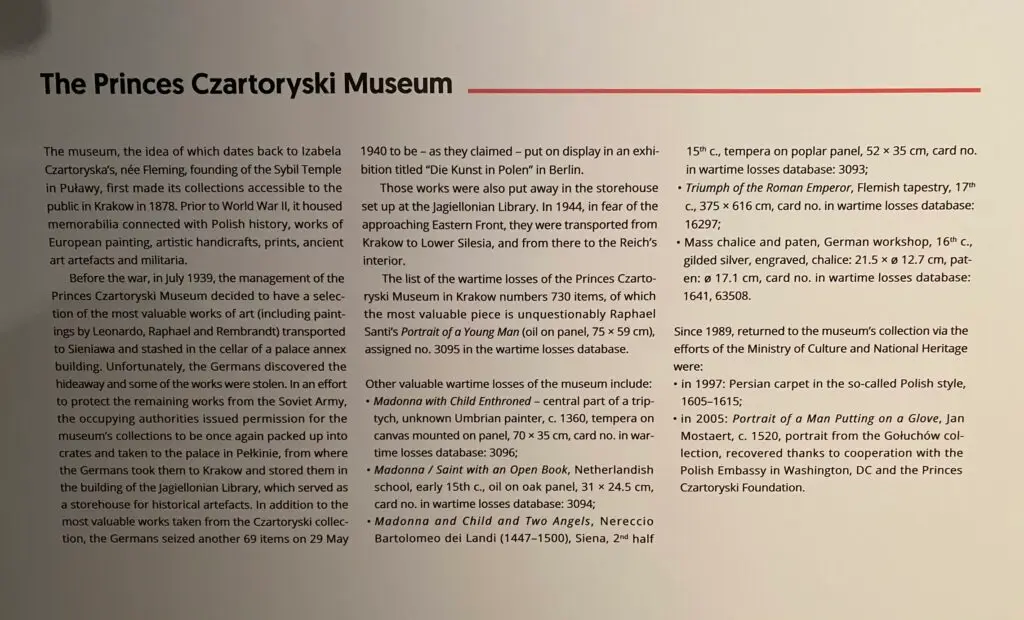
Unfortunately many pieces of art were never recovered.
Czartoryski Museum
This details some of the most valuable wartime losses.