Vietnam,Cambodia,Laos Dec 23 – Jan 24

In early December ’23 we left for 5 weeks travelling through Vietnam, Cambodia, and Laos. 

This was self organised just booking travel and accommodation through local operators or directly as we went along with a largely flexible itinerary.  The only thing we booked before we left was the first hotel accommodation in Hanoi and the Outward and return flights to and from Hanoi and internal flights from Da Nang (Vietnam) to Saigon, Siem Reap (Cambodia) to Vientiane (Laos), and Vientiane to Hanoi.

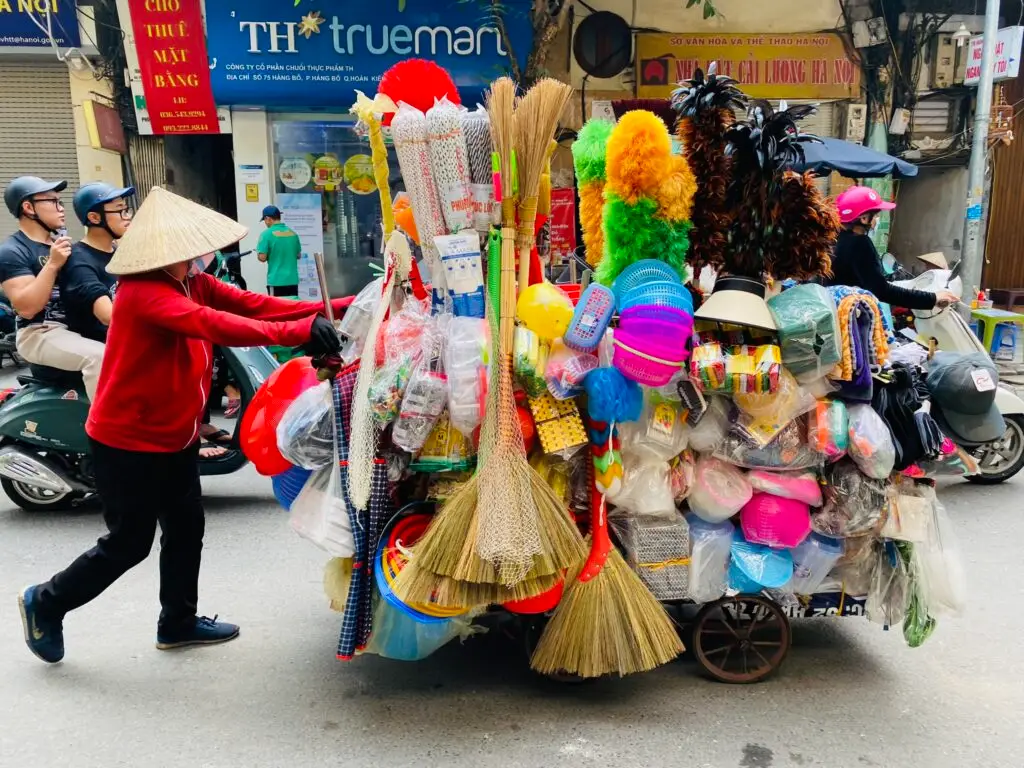
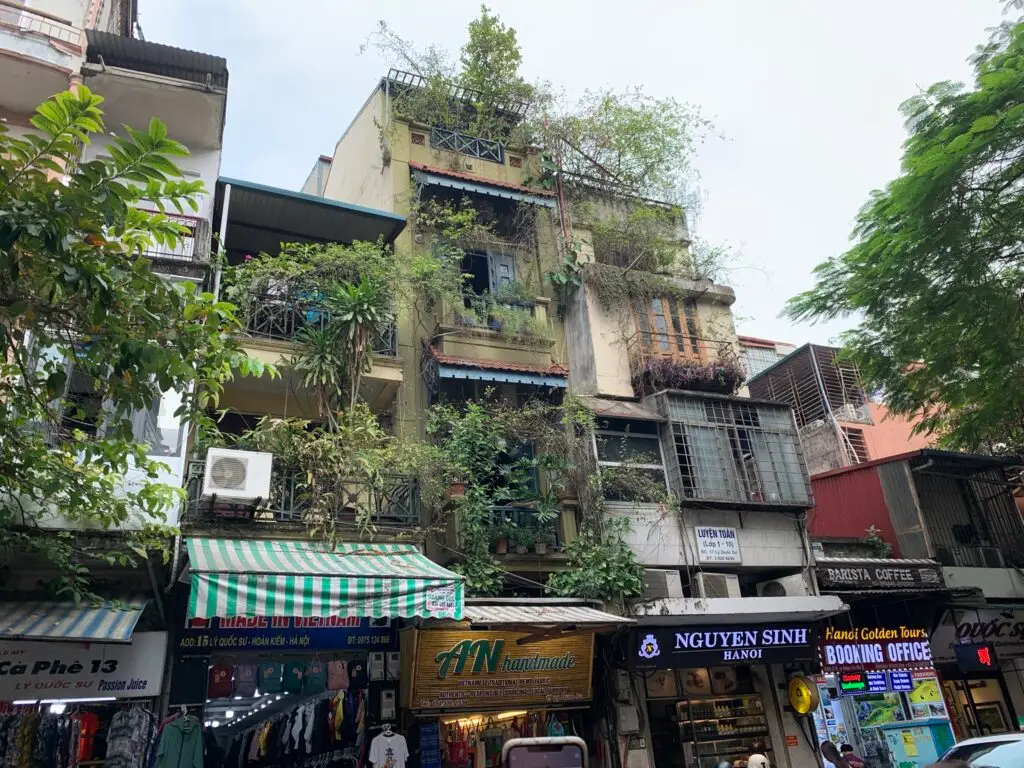
The first impression of central Hanoi was chaotic.  The sreets are rammed with motorbikes sometimes carrying 4 people including infants.  Wearing of helmets appears to be optional and there are no rules of the road i.e. red traffic lights and pedestrian crossing are simply ignored which makes crossing the street a nerve-wracking experience!

All life happens out on the street.  This is a video of a street food restaurant doing the washing up.

Hanoi street scene
Hanoi street scene
Hanoi street scene
Hanoi street scene

We visited the famous Hanoi street train.

This is actually an inhabited alley in central Hanoi and they have just put an active train track straight down it with trains from Saigon coming through several times a day!  The locals have converted their dwellings into cafes so they can charge the tourists to sit and watch a train thunder through just inches from their nose.

We came across this street dancing one evening just by chance. 

This is nothing to do with tourists but just the way that the locals entertain themselves.  We spoke to the lady in black and apparently she is 76 years old!

Hoa Lo Prison museum

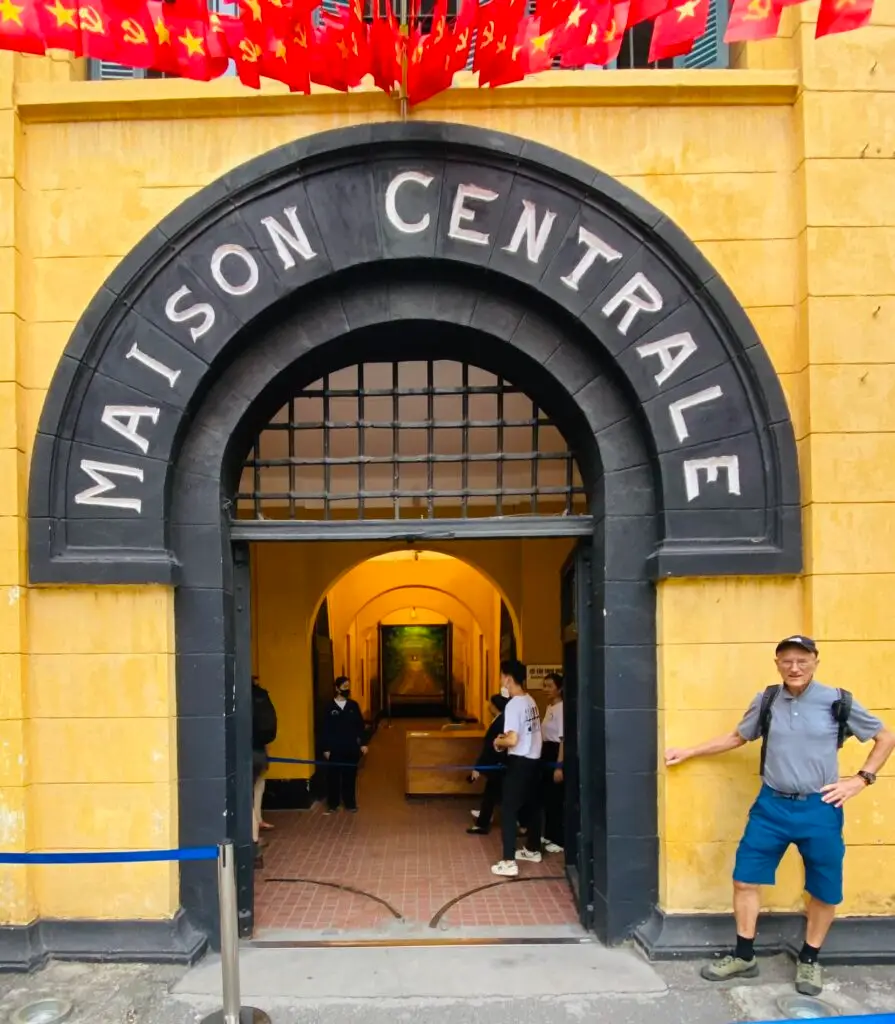
We visited the famous Hoa Lo Prison Museum. 

This former prison was built by the French between 1898 – 1901 and used up to the mid 1950’s to incarcerate Vietnamese communist revolutionaries who were struggling for independence from France.  The prisoners were tortured by the French before being executed by guillotine. According to the memoirs ‘Unforgettable time’ written by female prisoners during 1939 – 1945 there was a time when 40 prisoners died in a month from starvation diet. 

By 1954 more than 2000 prisoners were held here in subhuman conditions when the capacity was designed for 600.

The prison was later used by the Vietnamese themselves to incarcerate downed American pilots during the American war – when it was renamed the ‘Hanoi Hilton’.  The museum is keen to contrast the inhumane torture dealt out by the French with the way the Vietnamese treated the Americans in captivity – it shows the Americans reading books and playing chess for example.

Hoa Lo Prison museum

This is a famous photograph from 1908 which shows the subhuman conditions the French kept the prisoners in.

Hoa Lo Prison museum

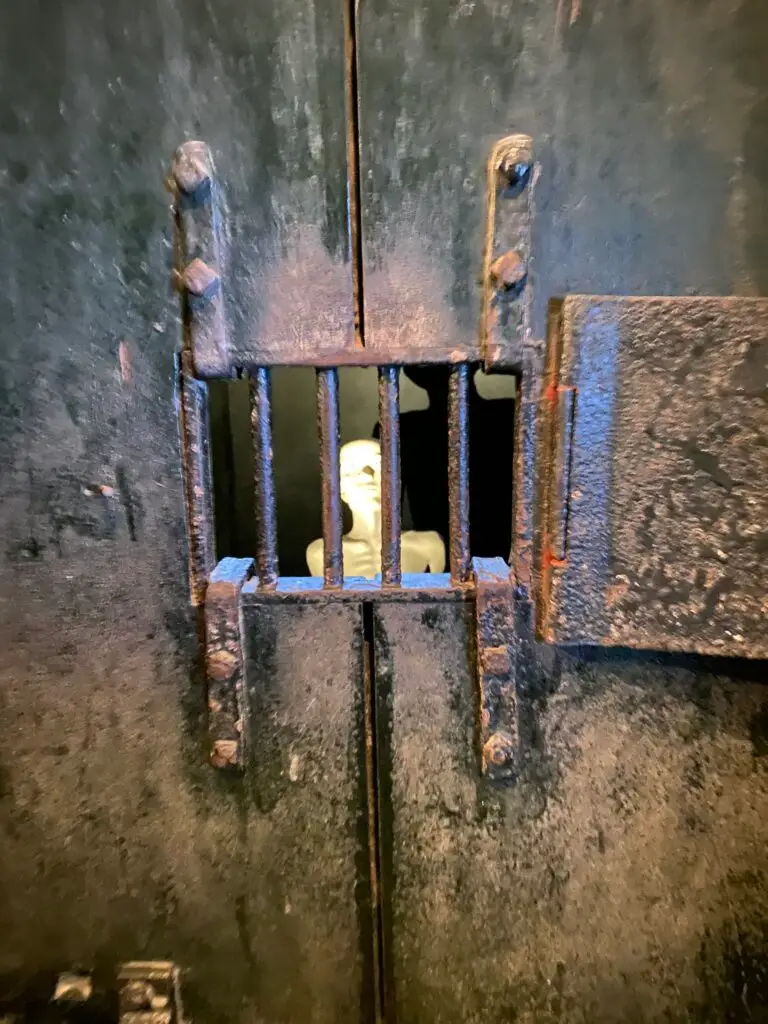
This is one of the actual condemned cells where the French kept death row prisoners.

These cells were completely isolated from the outside world to prevent prisoners from communicating with each other, with walls 0.4 meters thick. The cell was three meters high, and the area of the room was five square meters. Both interior and exterior walls were painted with black tar to make the prisoner feel gloomy and cold. Prisoners here were shackled all day long, not even freed to use the toilet. The cell door was opened just twice a day to enable guards to bring in food and water. 

According to prison regulations, prisoners sentenced to death were detained here for a minimum of ten months from the day of being sentenced at the court of Assizes, during which time they could lodge an appeal.  However, in cases where the French considered the prisoner dangerous, or simply to eliminate some inmates, they would often execute them after two or three days.

In spite of living in a cell and dealing with such closeness to death, the Vietnamese Communists retained the will to fight. They wrote books, compiled materials to broadcast national revolution, and composed poems revealing spirits of optimism, patriotism, devotion, and contribution to the national liberation revolution.

Hoa Lo Prison museum

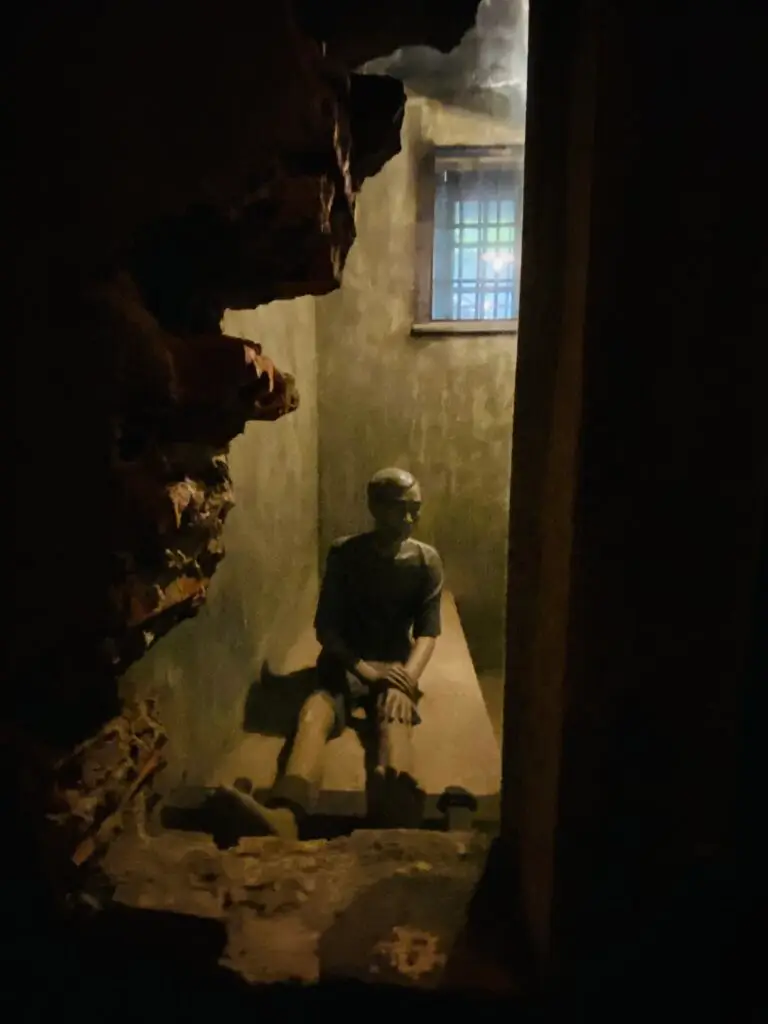
This is the dungeon where the French confined prisoners who broke the regulations. 

These prisoners were kept separately and put in stocks and had to eat and relieve themselves on the spot.  The prisoner was shackled by the ankles at the top of a slab sloping downwards to the head.  This meant that prisoners confined here became puffed with oedema and their eyes became clouded over. 

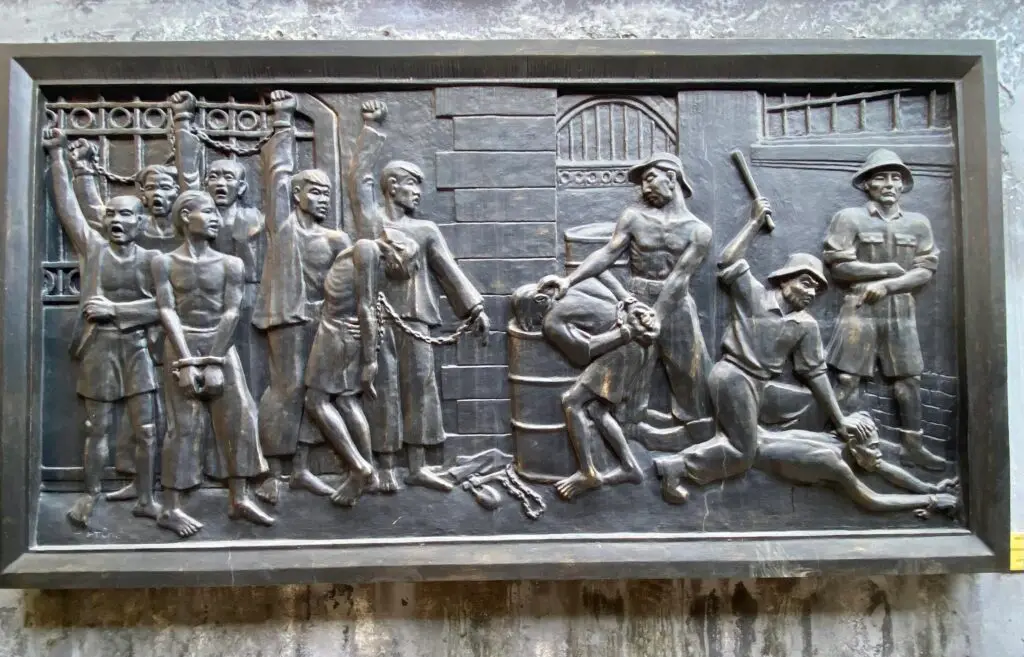
There were other forms of torture illustrated in the museum used by the French, such as electrocution and putting in a barrel of water with a lid on before beating the side with a stick in order to burst the prisoners ear drums.

In 1932 comrade Truong Chinh (former General Secretary of the Vietnamese communist party), was imprisoned here after he lead political prisoners on an organised meeting in the prison to celebrate labour day March 1st.

This gruesome relic in the museum is the actual guillotine – the choice execution method adopted by the French.  At the time it was situated out in the yard where there is now this granite memorial shown in the video.

Hoa Lo Prison museum

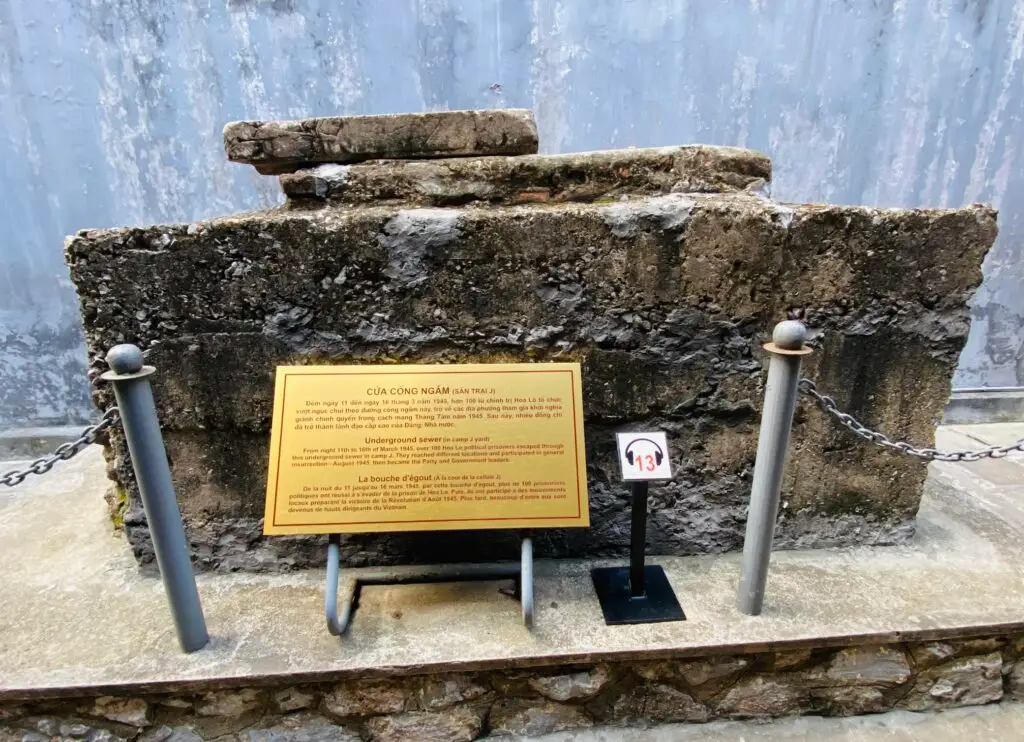
Between 11th – 16th March 1945, over 100 Hoa Lo political prisoners escaped through this entrance to an underground sewer in camp J. 

Their escape had been prepared over time by sawing through an iron grill in the sewer.  The escapees were able to help in the  August 1945 revolution launched by the Viet Minh and led by Ho Chi Minh.  Many of the escapees subsequently became party and government leaders.

Hoa Lo Prison Museum
Hoa Lo Prison museum

These castings in the museum seek to illustrate some of the inhumane brutality meted out to the Vietnamese Hoa lo prisoners by the French.

Incredibly, in order to justify their repressive rule over this Buddhist peace-loving people, the French claimed that it was their responsibility to “civilize” this backward, uncultured, and impoverished region. The truth, of course, was that French imperialism was driven by the need for resources, raw materials, and cheap labor.

The Vietnamese finally defeated the French in the battle of Dien Bien Phu in 1954 – marking the end of the French colonial experiment. Thereafter, the prison came under the authority of the Democratic Republic of Vietnam and served as an education center for revolutionary doctrine and activity.

Halong Bay

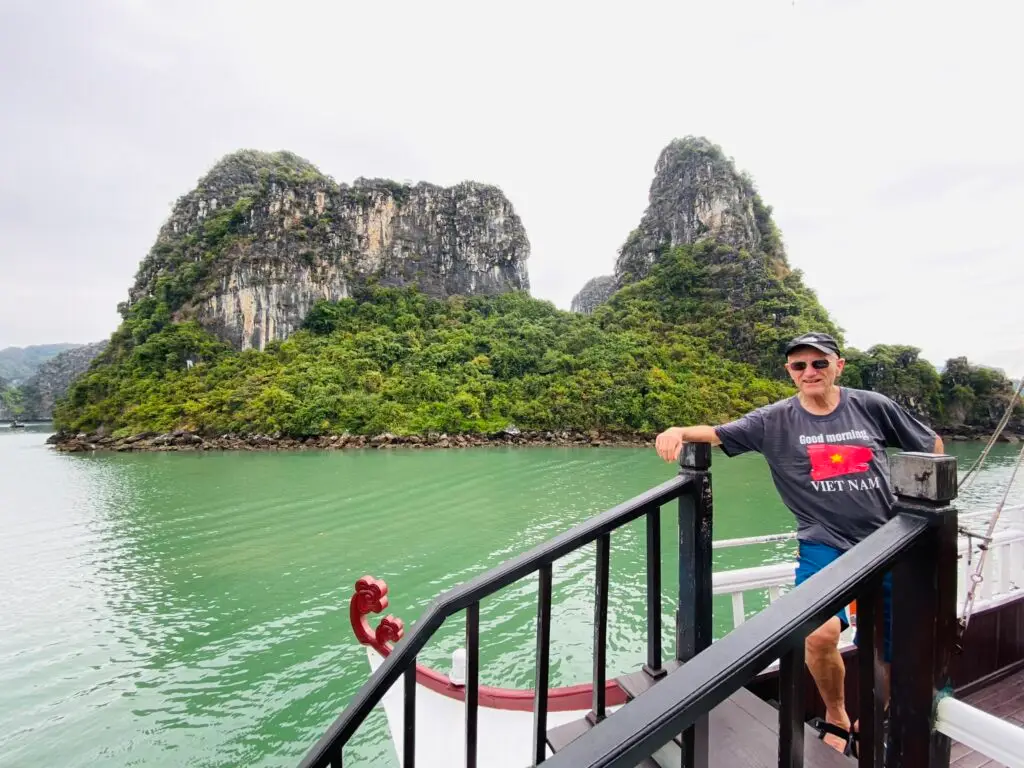
From Hanoi, we went to Halong Bay where we stayed for a night on a beautiful wooden Chinese junk to tour around the bay.

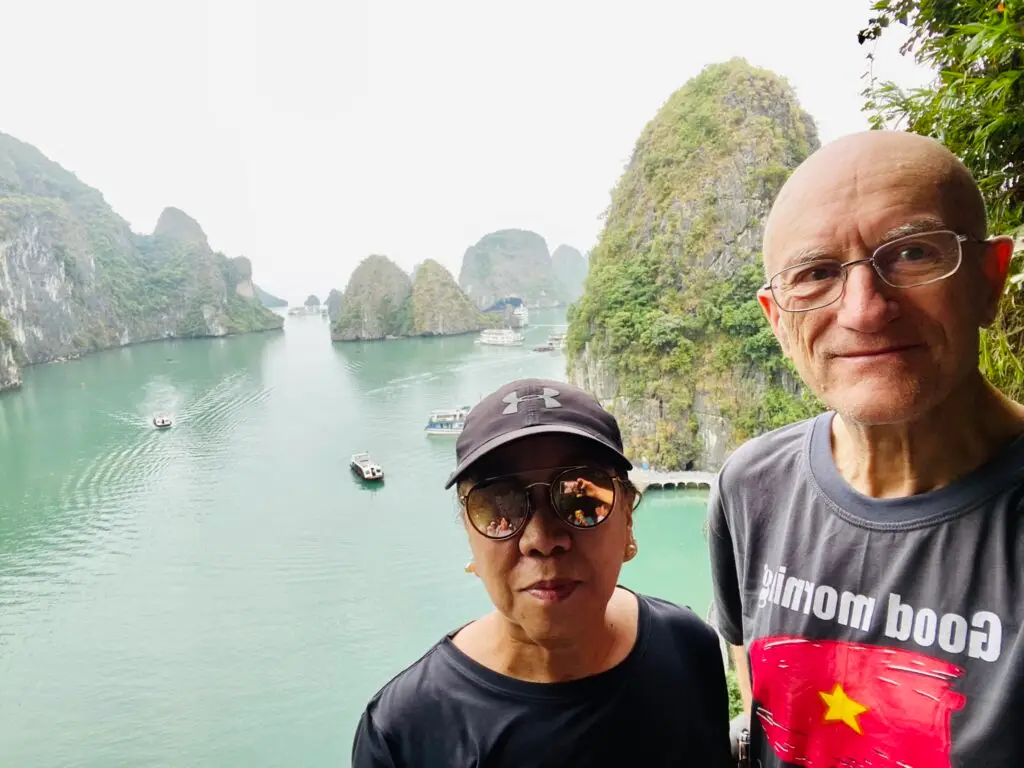
Halong Bay is a protected UNESCO World Heritage center composed of thousands of limestone islands towering above the emerald-green waters of the Gulf of Tonkin.

Halong Bay
Halong Bay
Halong Bay
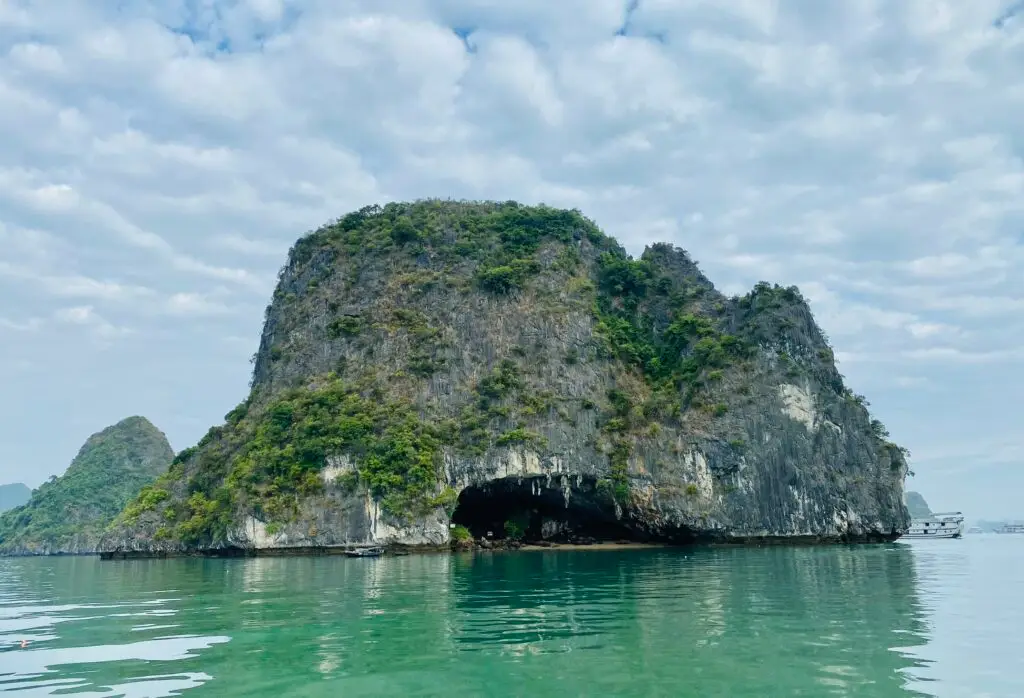
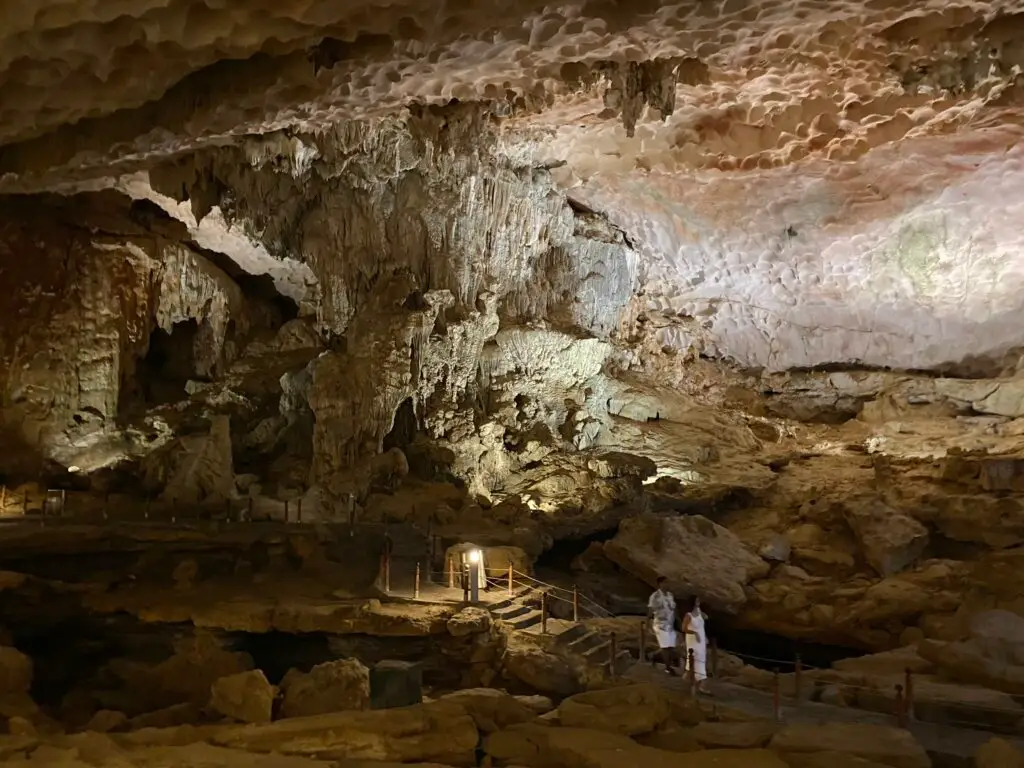
The islands contain many caves, some of which can be visited as tourist attractions. This is one of the larger ones called Hang Sung Sot.
Ninh Binh
Tam Coc

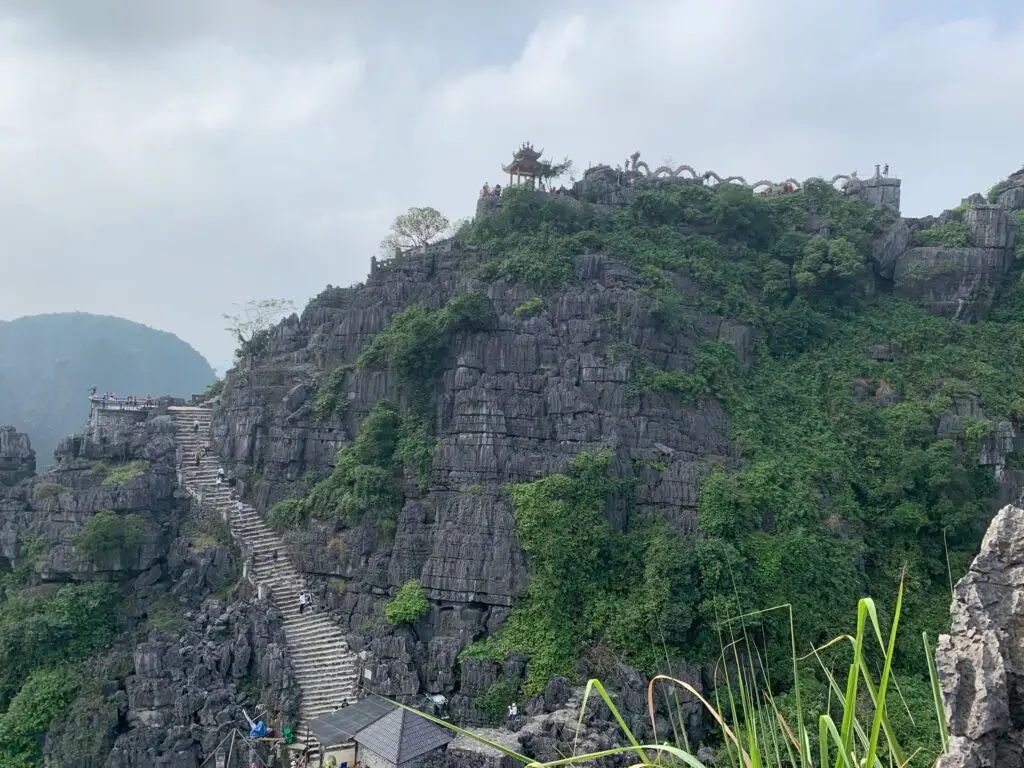
We travelled south by bus to Ninh Binh and then a taxi to the village of Tam Coc just outside the town, in order to visit Hang Mua peak. 

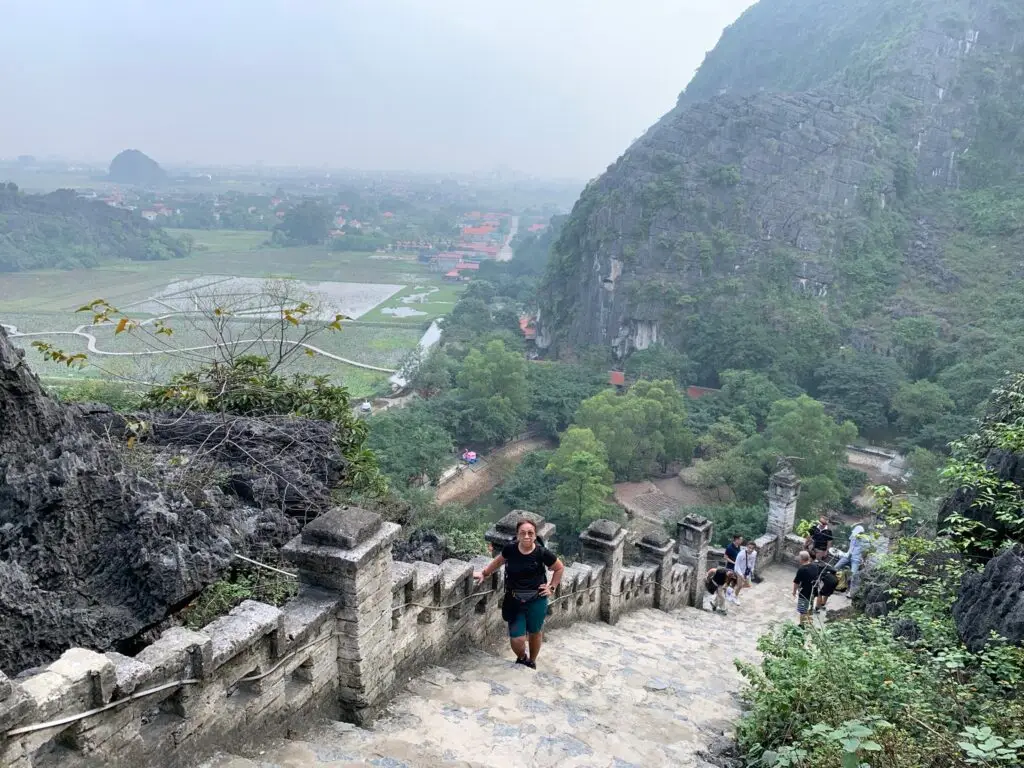
There are actually two peaks, this is the view from the higher one called lying dragon peak towards the other slightly lower one.

Tam Coc

This is the other one – called ‘lying dragon mountain’.  You can actually get right up to the dragon on the summit.

There are 486 steps to climb up!
Tam Coc - Be river

We took a rowing boat trip up the Be River in order to admire the Karst scenery, which included going through two river caves. 

The locals queue up for the opportunity to row tourists up the river and back for an hour and a half – (using their feet!) – just to earn some tips (there is no set price).  The tipping system can be awkward as you never know how much to give, but she seemed very happy with the 300,000 Dong  (about £10) we gave her which included buying an embroidery handicraft. 

This is the embroidery handicraft which we bought

Hue

Hue

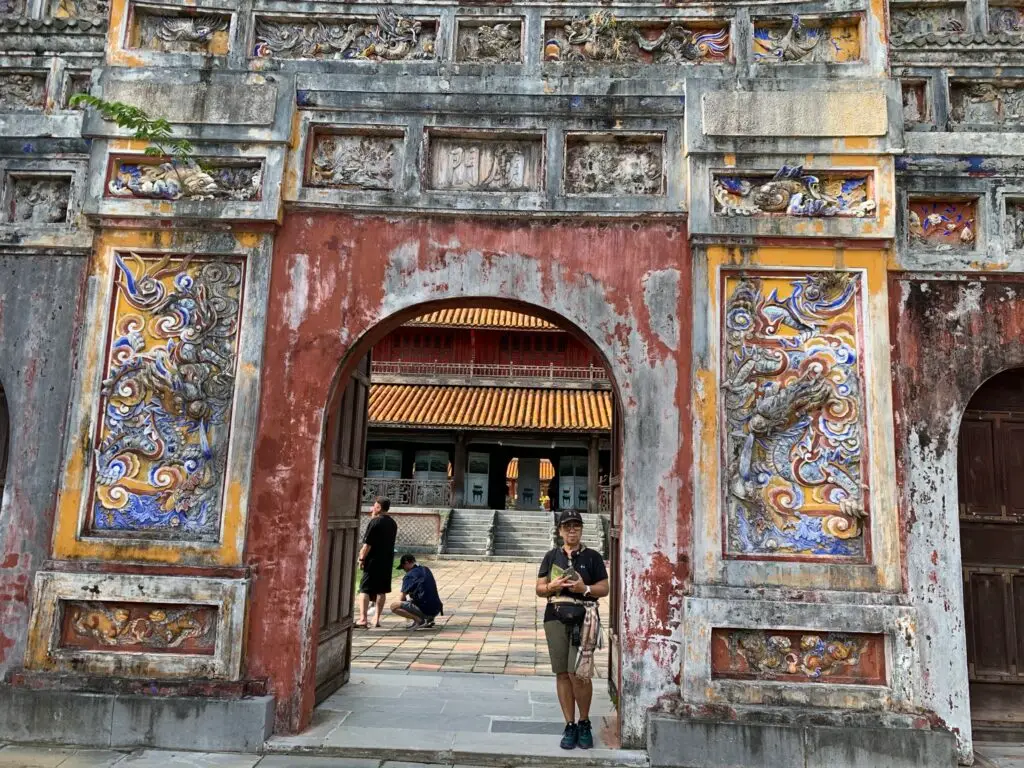
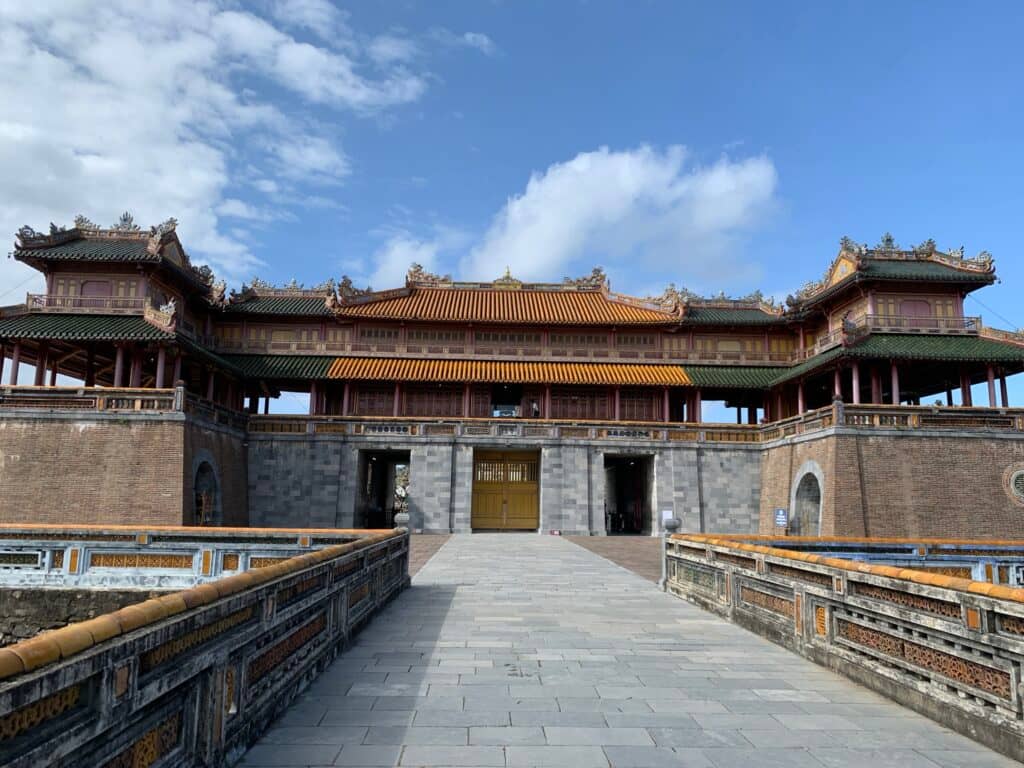
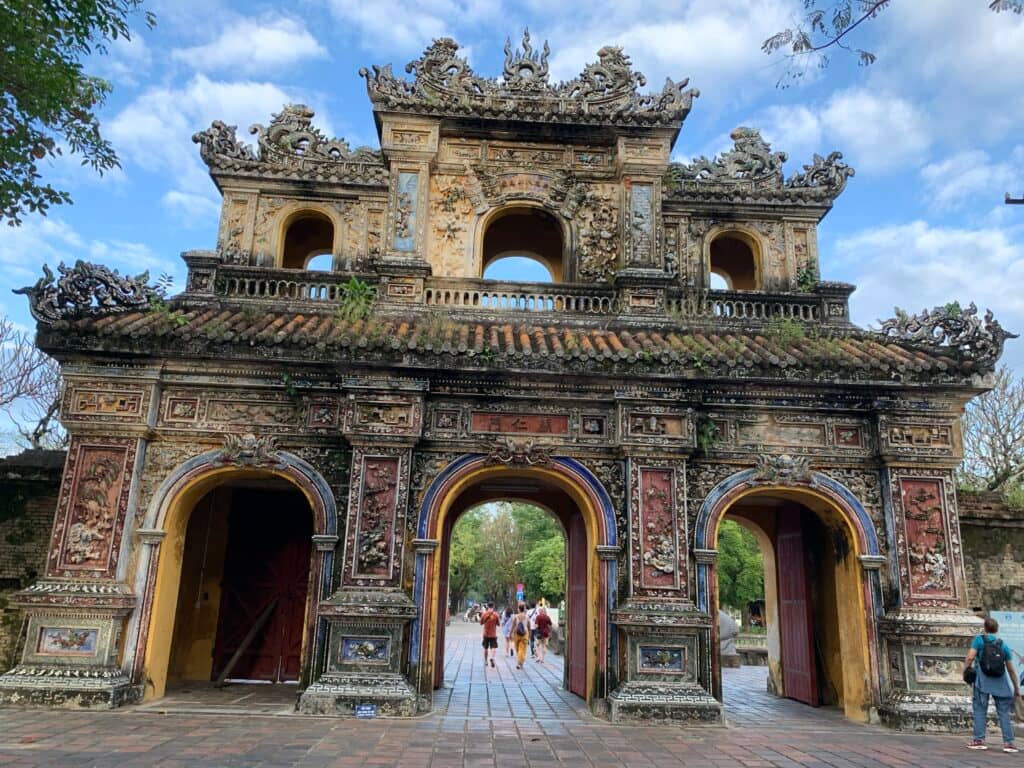
We caught the overnight train from Ninh Binh to Hue.  Hue was the national capital from 1802 to 1945 and is now a World Heritage site due to the palaces, tombs, and pagodas left from the era of the Nguyen dynasty emperors.  A major attraction is the Citadel, which encompasses the old imperial city.

Unfortunately, during the Battle of Hue in 1968 when the Americans fought to retake Hue after losing it during the Tet Offensive, much of the city, including the Citadel and its priceless palaces, was reduced to rubble.  The way this was carried out was with indiscriminate carpet bombing from B-52s.

These nine dynastic urns were cast between 1835 and 1836 and were each dedicated to one Nguyen sovereign.
Hue Citadel
Hue Imperial City
Hue Imperial city

We came across this group of traditional musicians whilst walking around the imperial palace who were performing for the public.

Bizarrely, this instrument has just one string and no frets!

Another traditional instrument.

Hue

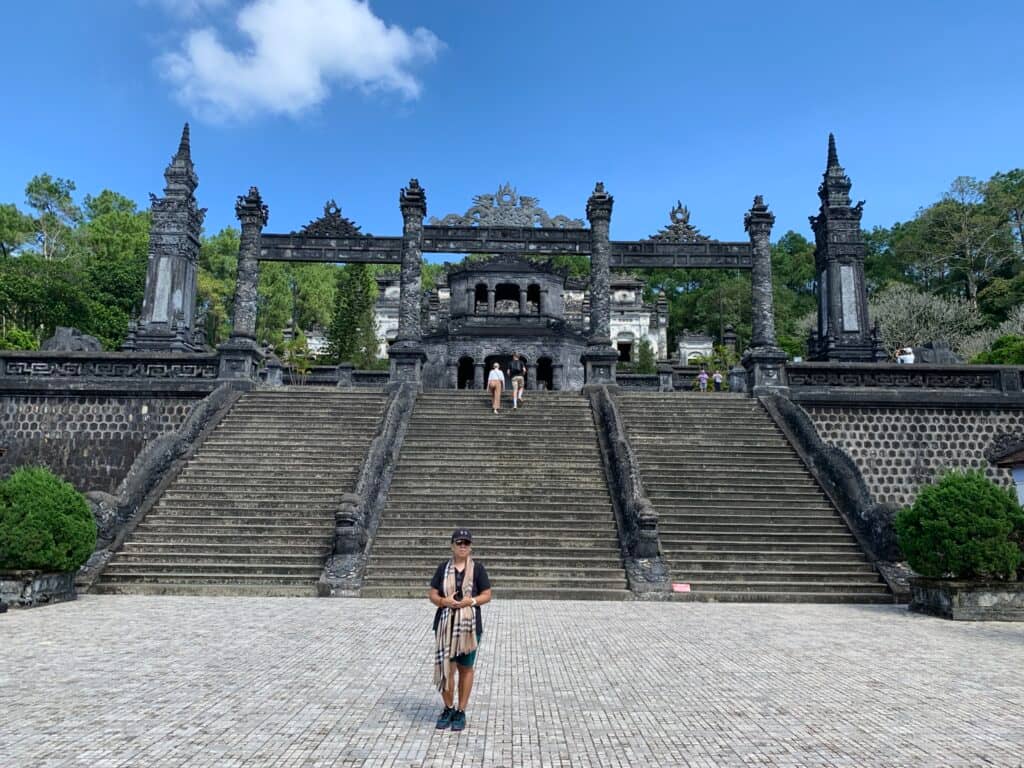
South of Hue are the extravagant mausoleums of the Nguyen dynasty emperors who ruled from 1802 – 1945.  There are many tombs of which this is just one. 

The whole site is the tomb of just one emperor!  The enormous expense and forced labour of the Tu Duc tomb spawned a coup plot which had to be suppressed. 

Tu Duc himself lived a life of imperial luxury and carnal excess, with 104 wives and countless concubines (though no offspring).

Hue

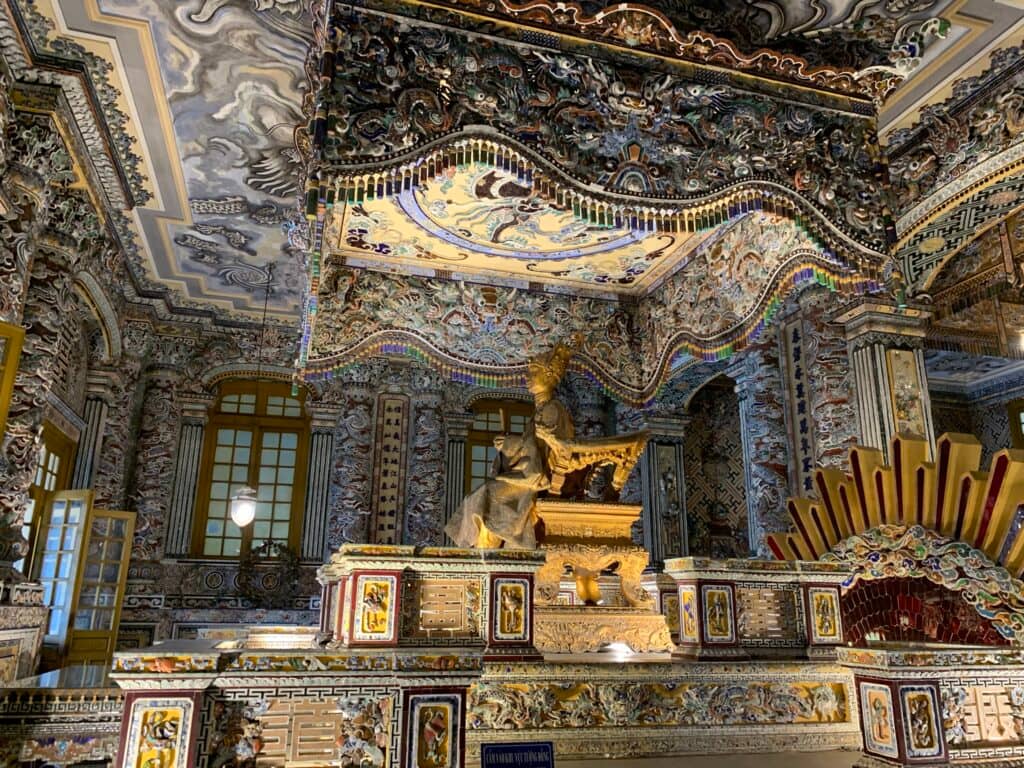
This is the flamboyant tomb of Khai Dinh which took 11 years to construct.  Khai Dinh was the penultimate emperor of Vietnam from 1916 to 1925 and was widely seen as a puppet to the French.

Hue

Family tree of the Nguyen dynasty emperors

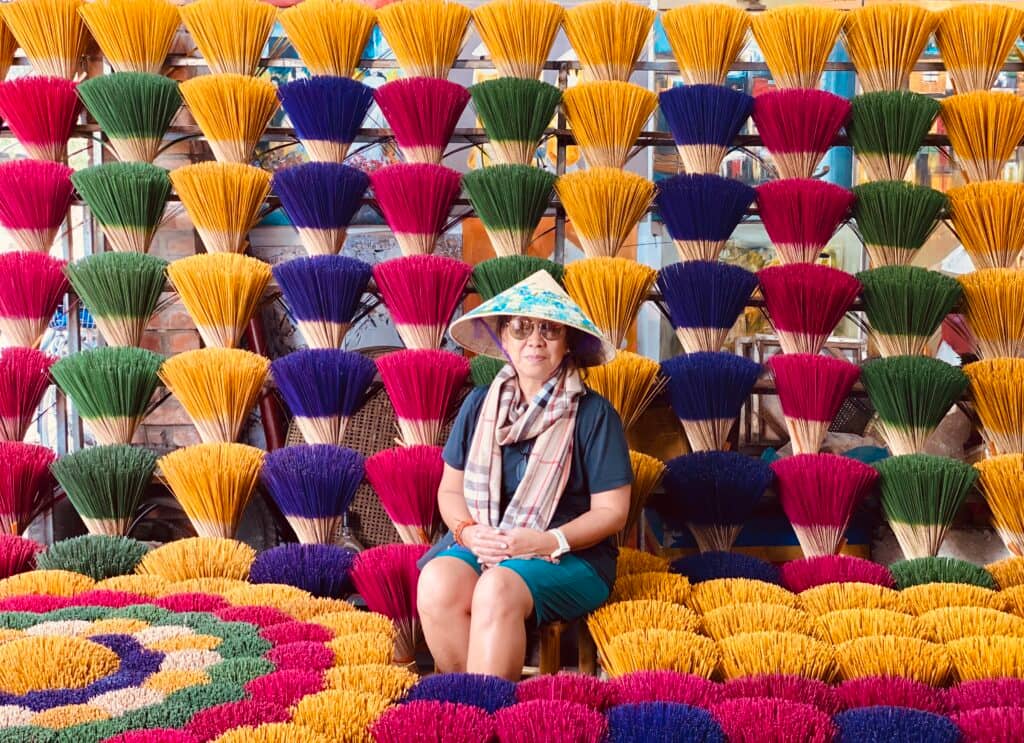
Around the area of the tombs, there are many handicraft shops where you can buy such things as incense sticks and Vietnamese peasant hats

DMZ tour

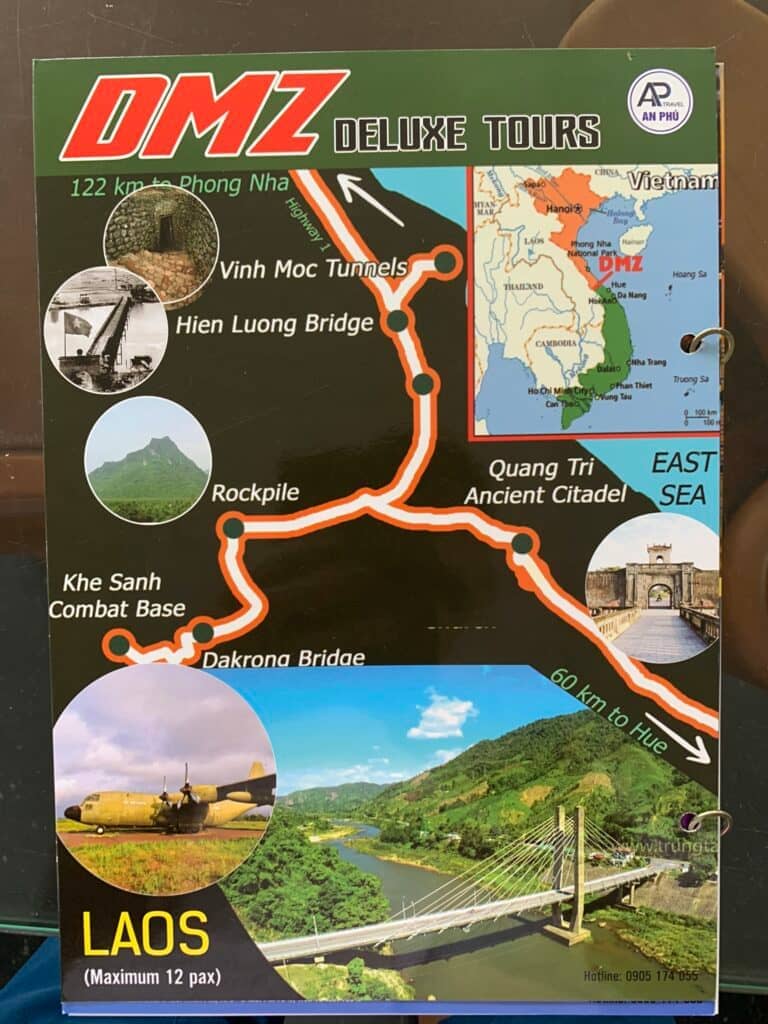
We went on a DMZ tour by minivan out from Hue.

The Domino Theory

The Domino theory was prominent in the United States from the 1950’s to the 1980’s and suggested that if one country came under communist influence then the surrounding countries would follow.  In particular with regard to Vietnam, the fear was that communist victory would be swiftly followed by Laos, Cambodia, Thailand, Malaysia, Indonesia, Burma, and India.

This theory was used by the United States administration to justify blocking the free Vietnamese elections scheduled by the 1956 Geneva Conference when it became clear that Ho Chi Minh would win.  It therefore installed an oppressive and corrupt leader (Ngo Dinh Diem) so that they could invade, and through military force seek to impose upon these people on the other side of the world what it considered was the election result that they really wanted but just did not know it.

The results of this catastrophic intervention are still visible today 60 years later in forced relocation of villages in order to enable carpet bombing of ancient cities, mass graves of the dead soldiers from the civil war, scarred forests still recovering from agent orange poisoning, unexploded ordinance hazard, and mutilated survivors.  A generation of American youth was ordered across the world to kill and die for a cause unworthy of their bravery.

Finally In the spring of 1995, despite having been a strong proponent of it during his time in office, former US Secretary of Defense Robert McNamara said he believed the domino theory to have been a mistake. “I think we were wrong. I do not believe that Vietnam was that important to the communists. I don’t believe that its loss would have led – it didn’t lead – to Communist control of Asia.”

DMZ

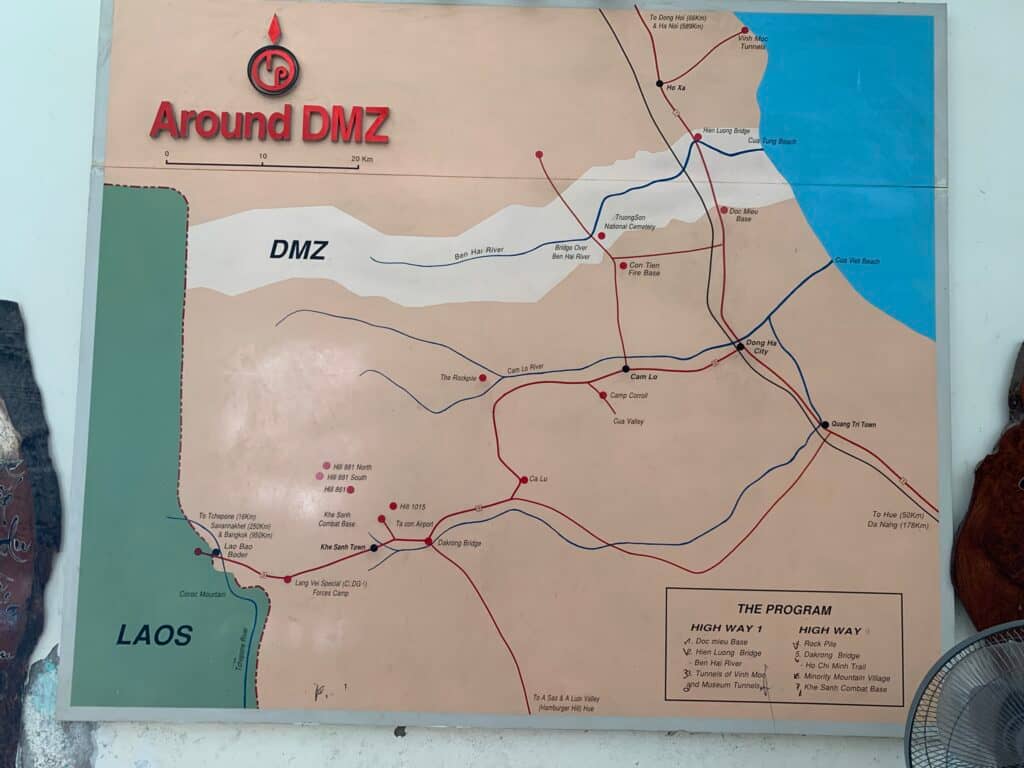
From 1954 to 1975 the Ben Hai river (crossed by the Hien Luong bridge) acted as a buffer between North and South Vietnam.  The area just south of the DMZ was the scene of of some of the bloodiest battles in America’s first TV war, turning Quang Tri, the Rockpile, Khe Sanh, Lang Vay, and Hamburger Hill into household names.

DMZ tour - Quang Tri Citadel

The Quang Tri Citadel is a historical site from the 19th century, originally used by the Nguyen Dynasty, then by the French as a prison, and most recently by the Americans for military defence. The monument is in the center of the Citadel, and it is mostly remembered for the Second Battle of Quang Tri when the American-supported AVRN (Army of the Republic of Vietnam) took back ground lost to a North Vietnamese offense earlier that year.

The battle lasted for over two months, from June 28 to September 16, 1972. It was one of the first military confrontations in which North Vietnam utilized conventional warfare tactics, including large artillery, tanks, and troops from several heavily armed divisions.

The victory came at a cost of 7,756 ARVN casualties and 20 US service members, while North Vietnam suffered nearly 18,000 casualties. Due to the battle’s brutality and high casualty rate, the locals consider the Ancient Citadel a “Spiritual Land,” believed to contain ordnance and the blood and bones of soldiers from both sides.

DMZ tour - Quang Tri Citadel

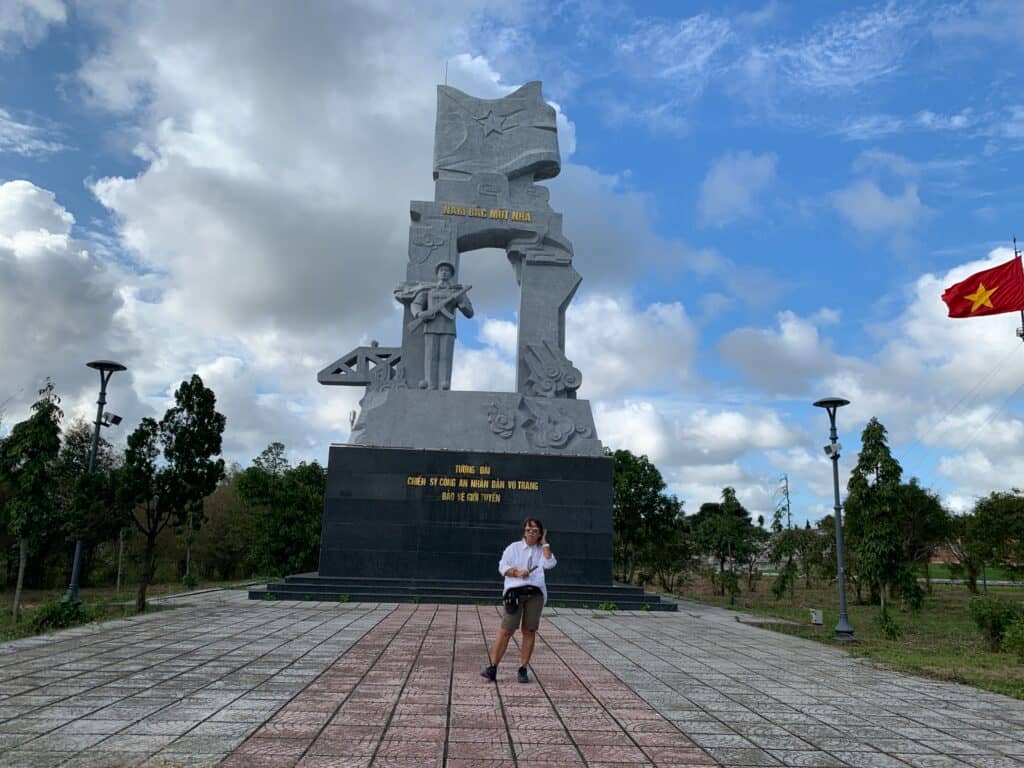
This monument is also in the Citadel park, and is to commemorate the Paris peace agreement signed on January 27, 1973, to establish peace in Vietnam and end the Vietnam War.

The agreement’s provisions were immediately and frequently broken by both North and South Vietnamese forces with no official response from the United States.  Open fighting broke out in March 1973, and North Vietnamese offensives enlarged their territory by the end of the year. 

Two years later, a massive North Vietnamese offensive conquered South Vietnam on April 30, 1975, and the two countries, which had been separated since 1954, united once more on July 2, 1976, as the Socialist Republic of Vietnam.

The tour then took us through the mountains along the famous highway 9 which runs roughly along the 17th parallel in order to visit the Khe Sanh Combat base.
DMZ tour - Khe Sanh

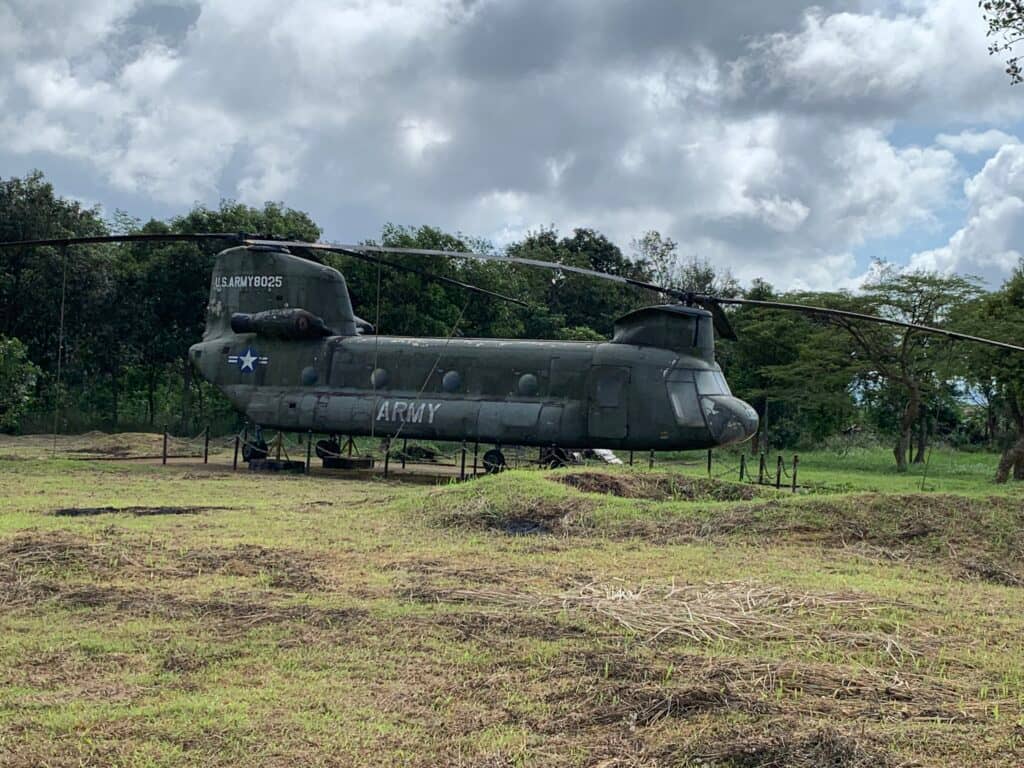
Today Khe Sanh is eerily peaceful with a small museum and a few military hardware relics on display.  In 1968, however, it was the site of the bloodiest battle of the war when in spite of the use of 1000kg bombs, white phosphorus shells, napalm, mortars, and endless artillery rounds, desperate American forces could not stop the base being overrun  by the North Vietnamese army (NVA).

About 500 Americans, 10,000 NVA, and uncounted civilian bystanders died around the remote highland base.

After Khe Sanh was evacuated in July 1968, the North Vietnamese continued their efforts to take the entire province.

Our guide for Cu Chi, later on when we were in Saigon, explained that the reason that the Americans lost to the North Vietnamese was that the Vietnamese were fighting to re-unite their country and drive out the foreign invaders, whereas the Americans were half way around the world from their homes fighting against this vague thing called Communism which they had nothing to do with and did not want to know about anyway.

DMZ tour - Khe Sanh

This exhibit in the museum shows how the NVA transported ammunition and weapons along the Ho Chi Minh trail.  In spite of millions of tons of bombs dropped by the Americans as well as agent orange defoliant, the trail was never out of action for more than a few days. 

DMZ tour - Ben Hai

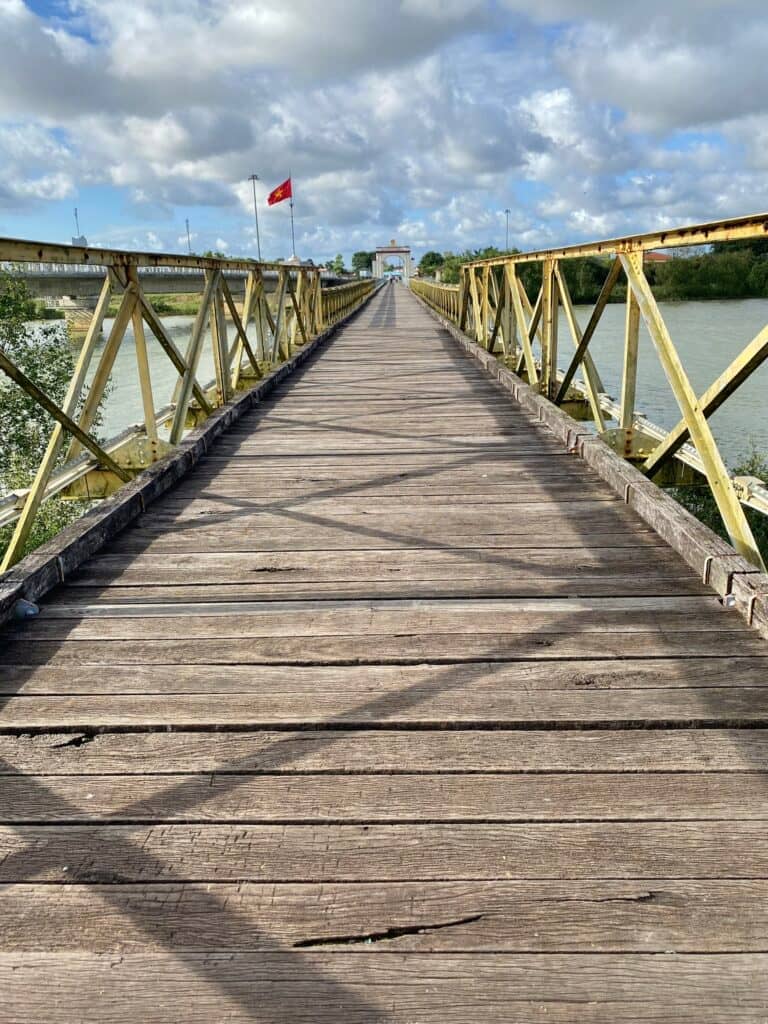
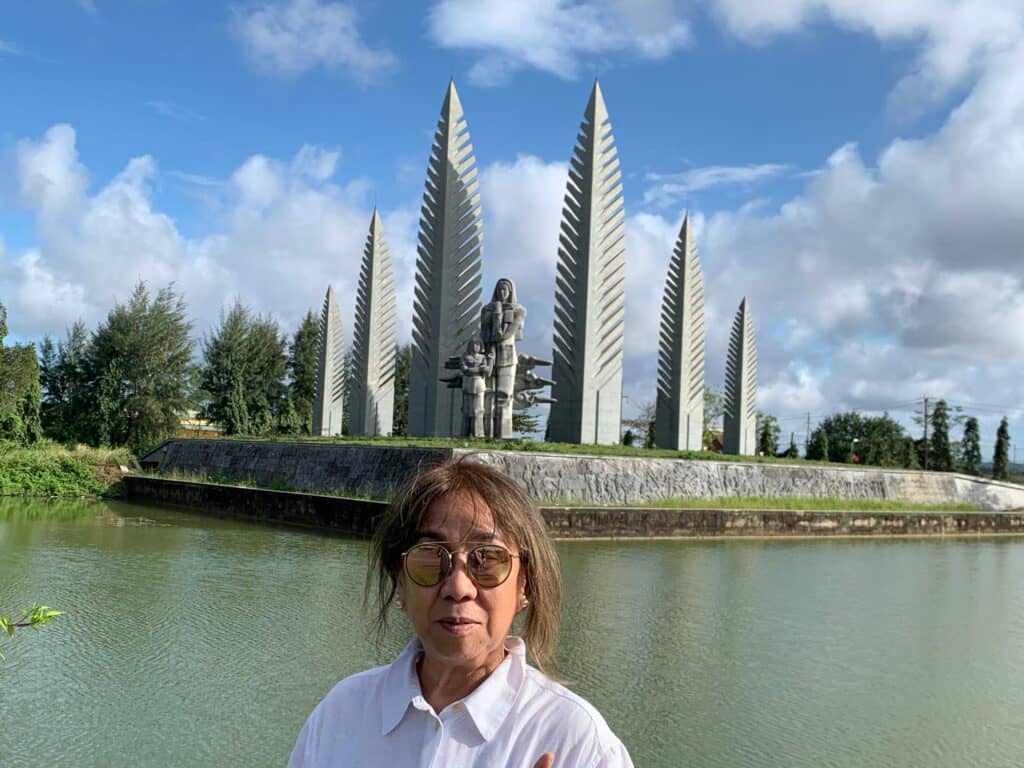
We continued on to the Ben Hai river, to inspect the grandiose reunification monument situated on the river’s southern bank.  The monuments stylised palm leaves oddly resemble missiles, but the focus of the monument is the mother and children statue looking across to the northern bank awaiting the return of their soldier father.

This is the Hien Luong Bridge today. This bridge joins the two monuments
DMZ tour - Ben Hai

Across the bridge on the northern bank and looking back is the other half of the monument featuring the soldier father who waits to return to his family.

DMZ tour - Vinh Moc tunnels

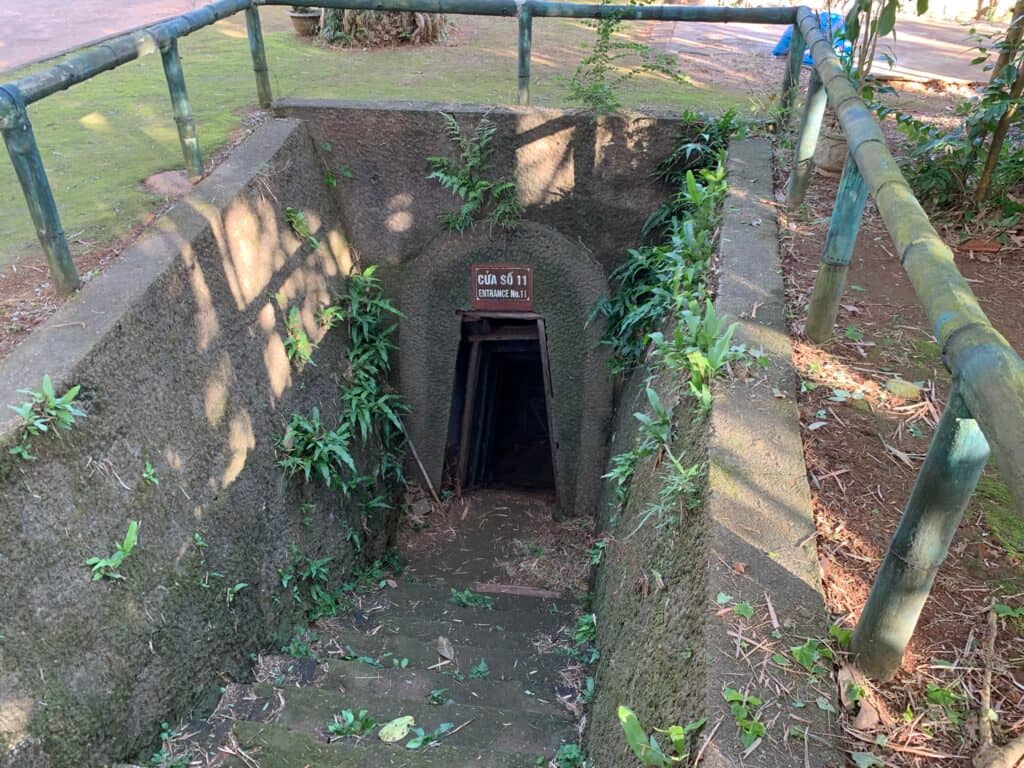
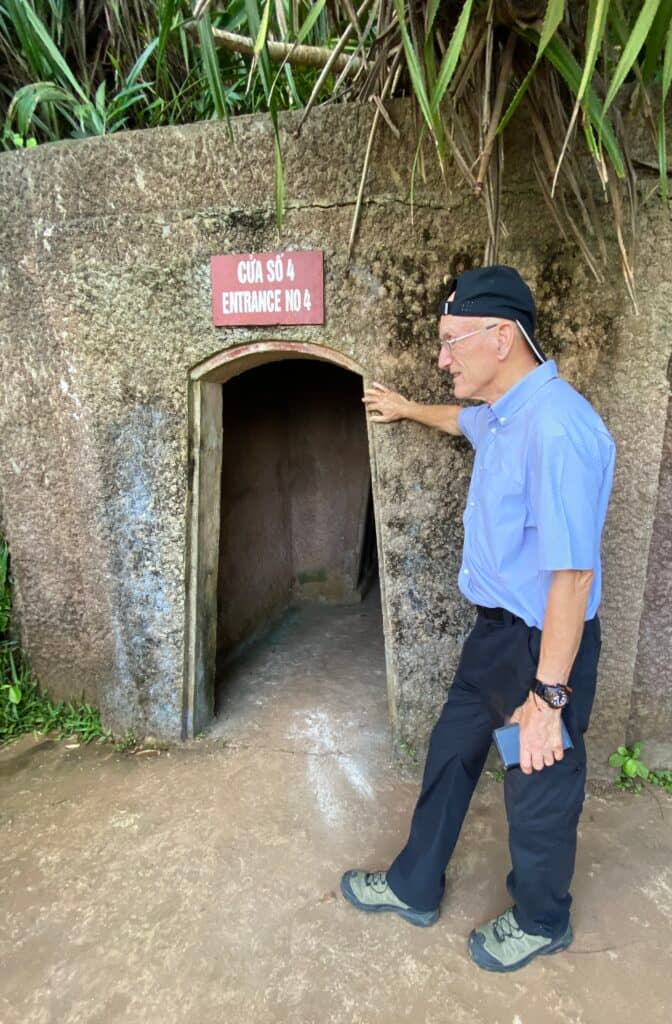
We continued on to visit the Vinh Moc tunnels, where an entire North Vietnamese coastal village of more than 90 families disappeared underground in response to unremitting American bombing.  The tunnels are composed of three levels and run for almost 2km.

DMZ tour - Vinh Moc tunnels

This is a section that we visited. The ceiling is low, so you have to walk stooped down very low!

DMZ tour - Vinh Moc tunnels

After what seemd like a very long time, we emerged at this exit on the beach.

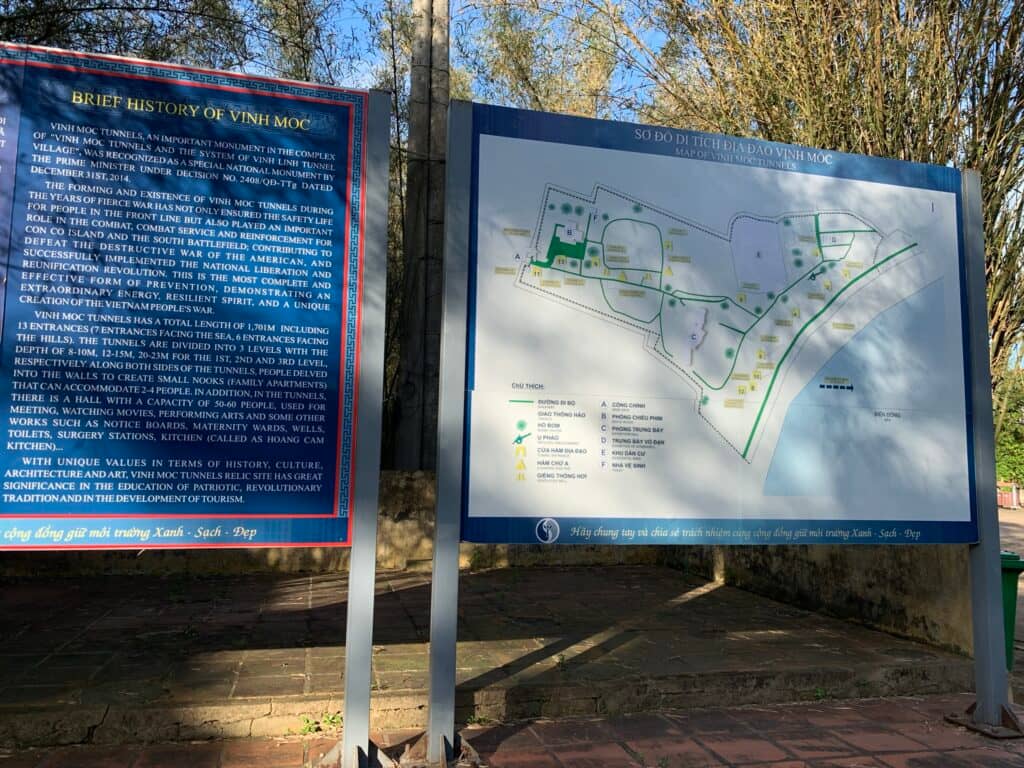
Map and description of the Vinh Moc tunnels. Part of tunnels can be visited and our guide took us on an underground tour.
Langco Bay

We stopped at Langco bay on our way to Hoi An.  The houses here are built inside boats to protect them from water level rise.

Hoi An

Hoi An, situated on the coast at the mouth of the Thu Bon river, is another Unesco World heritage site due to its pagodas, temples, historic houses, and museums.  This also makes it very touristy with thriving market place, souvenir shops, and restaurants. 

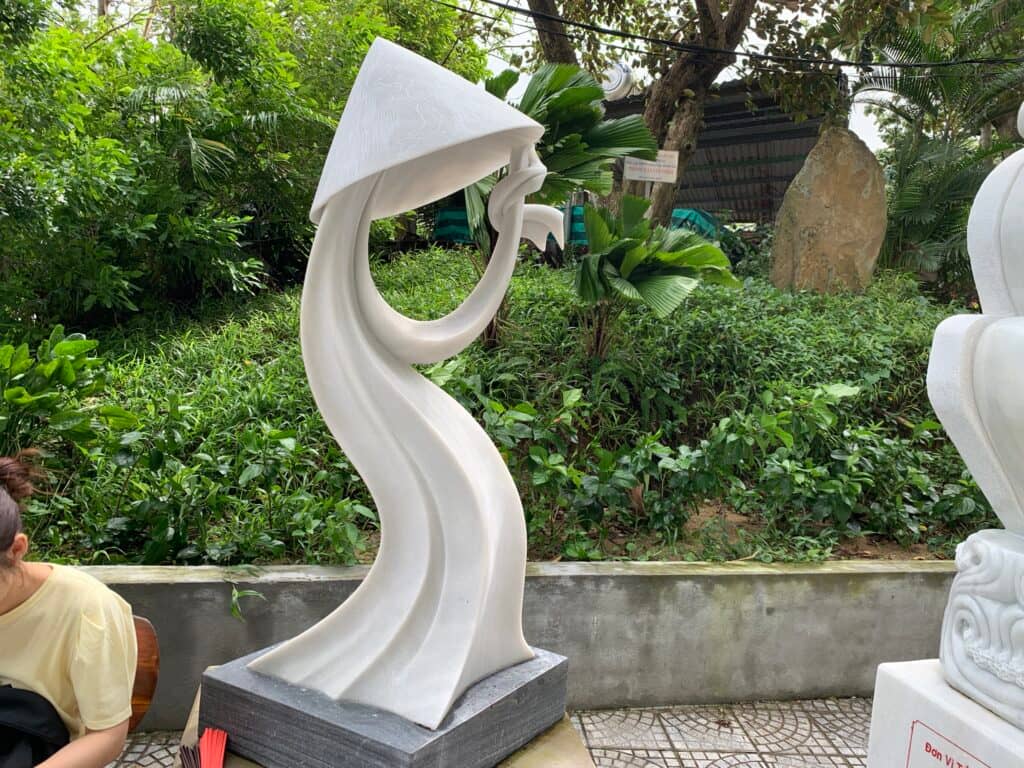
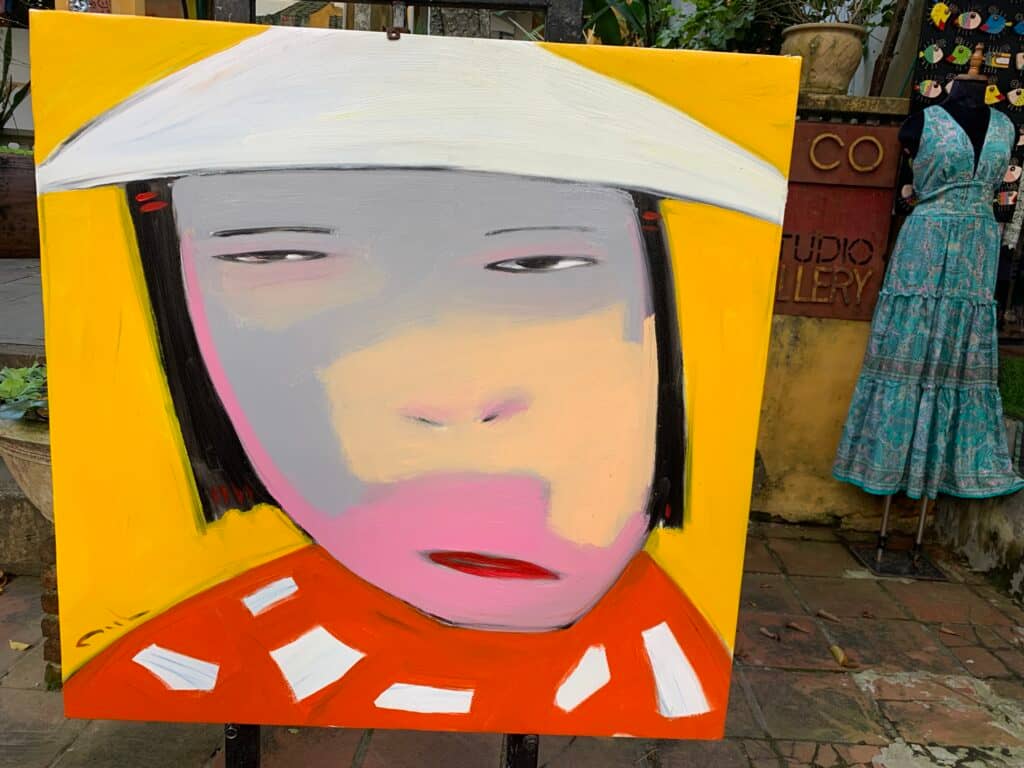
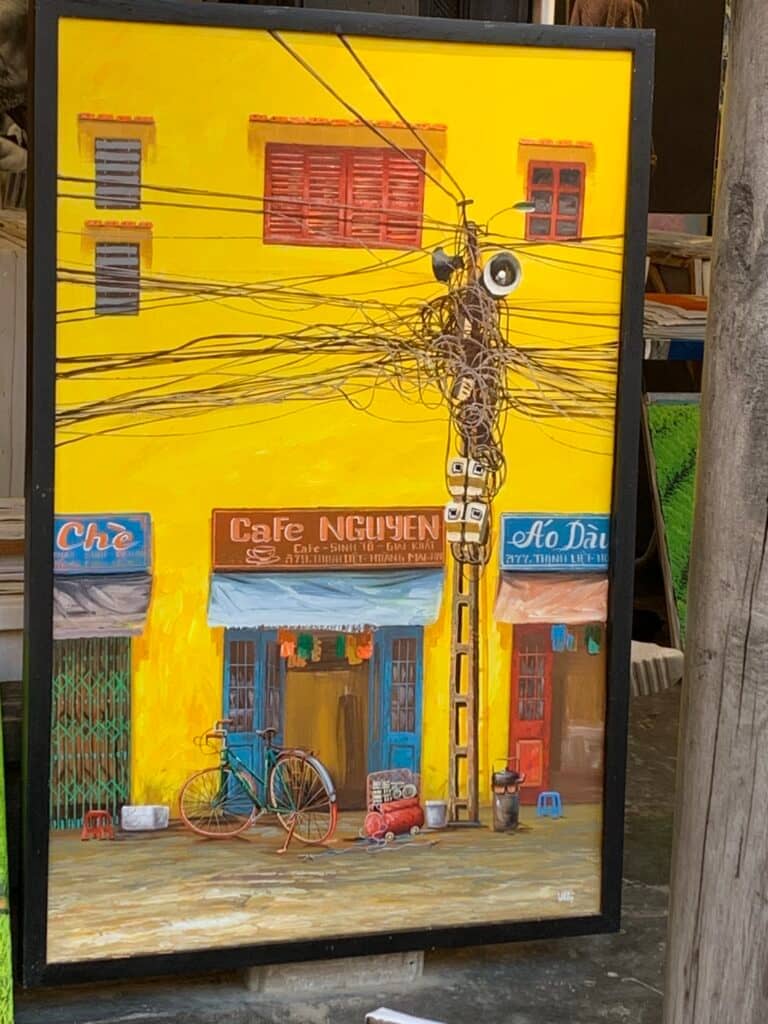
This is some art work which caught my eye.

Hoi An
Hoi An
Hoi An
Hoi An
Hoi An

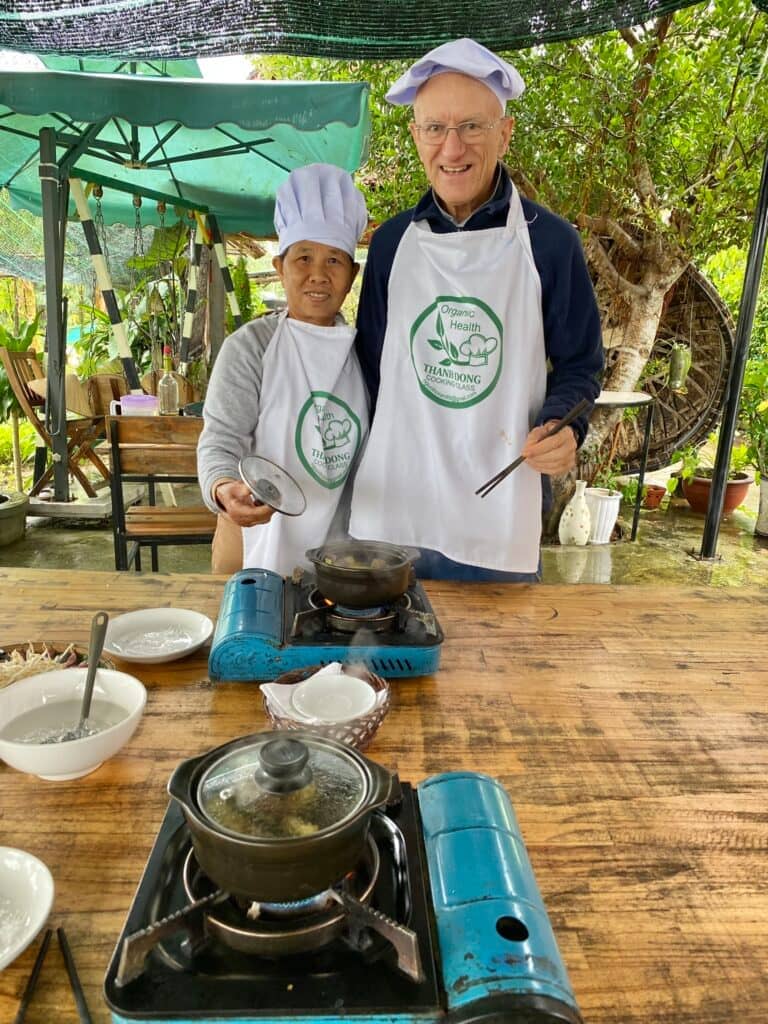
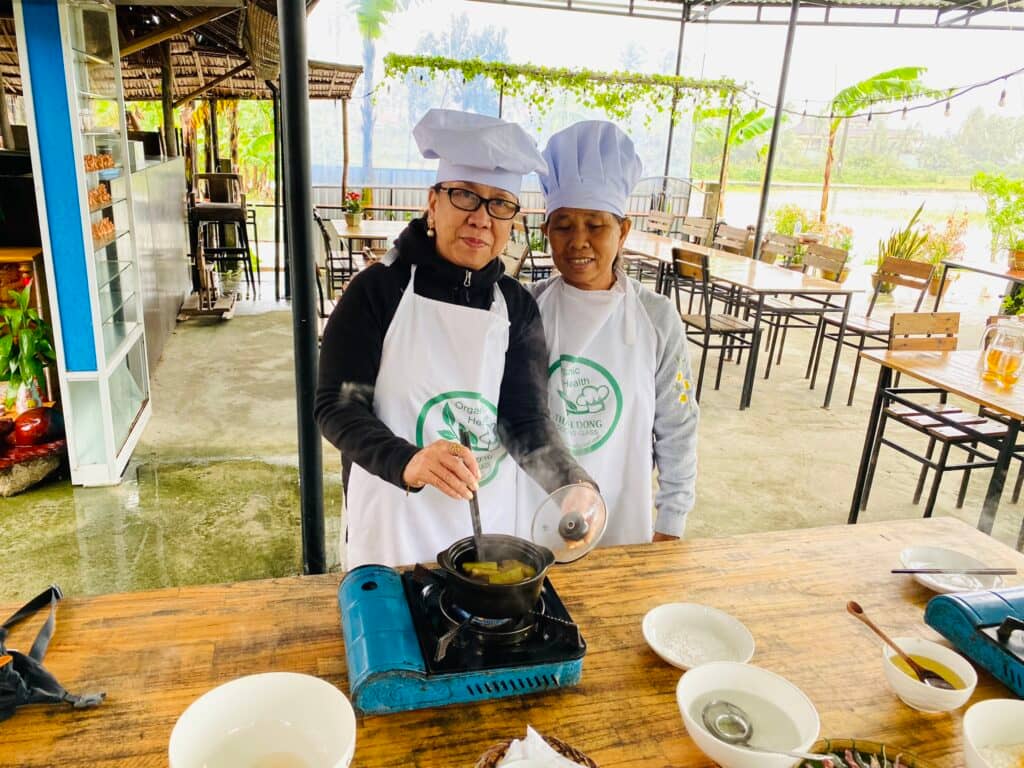
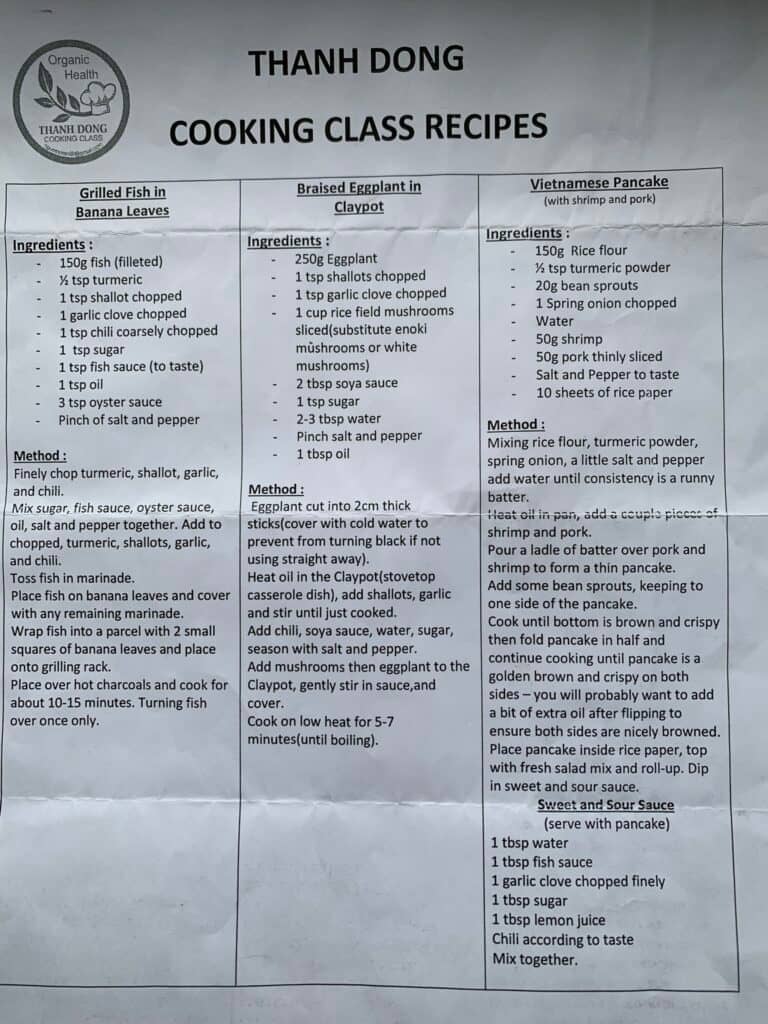
Next door to our hotel in Hoi An there was an organic farm and one day we took a cookery class.

(Vietnamese people tend to be fairly small!)

Hoi An cookery class
This is what we each prepared (and had for our lunch)

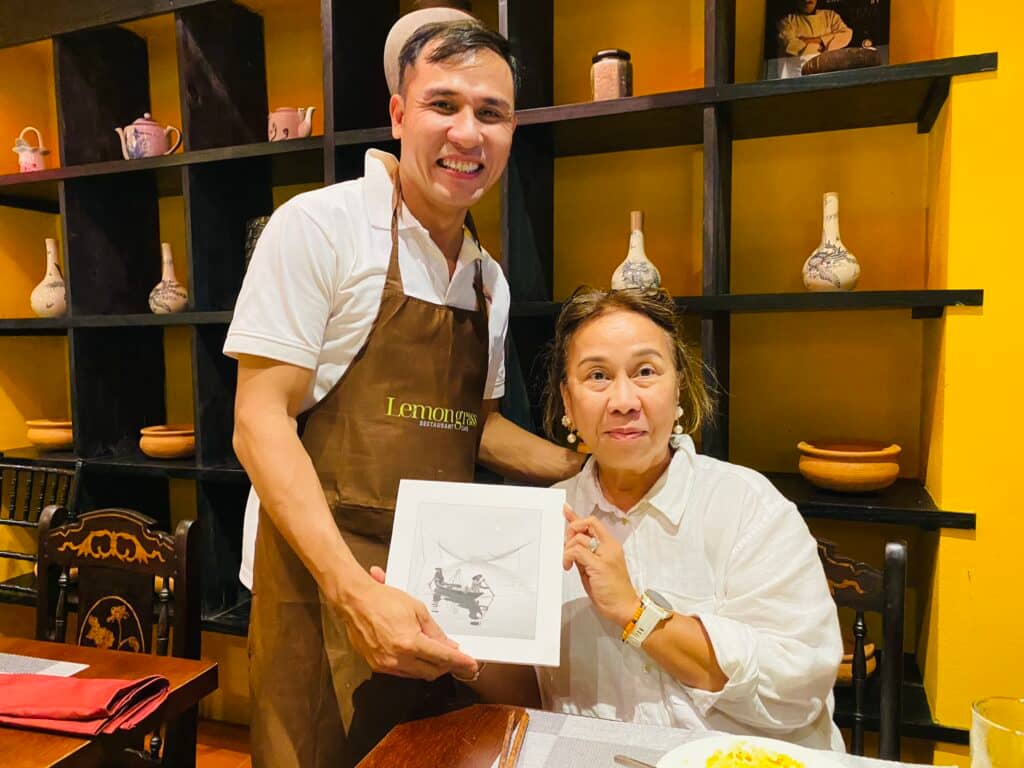
The owner of our hotel in Hoi An is a famous Vietnamese photographer (Giang Nguyen).  He also owns the lemongrass restaurant in town and he presented me with one of his pictures when we visited.

My Son

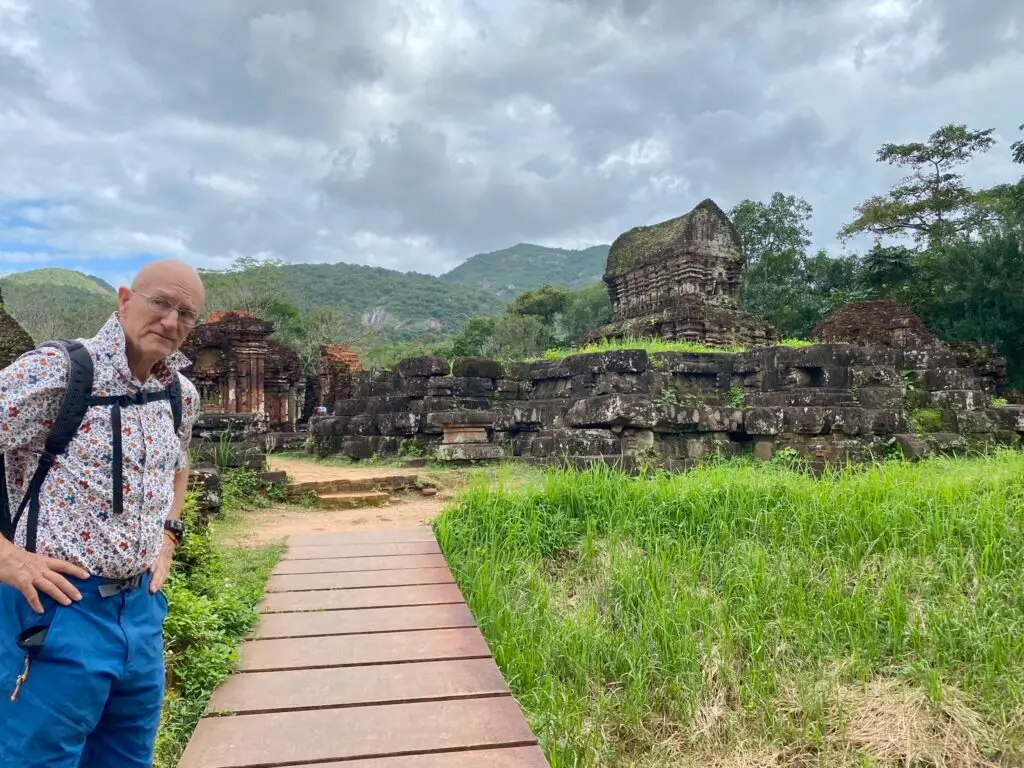
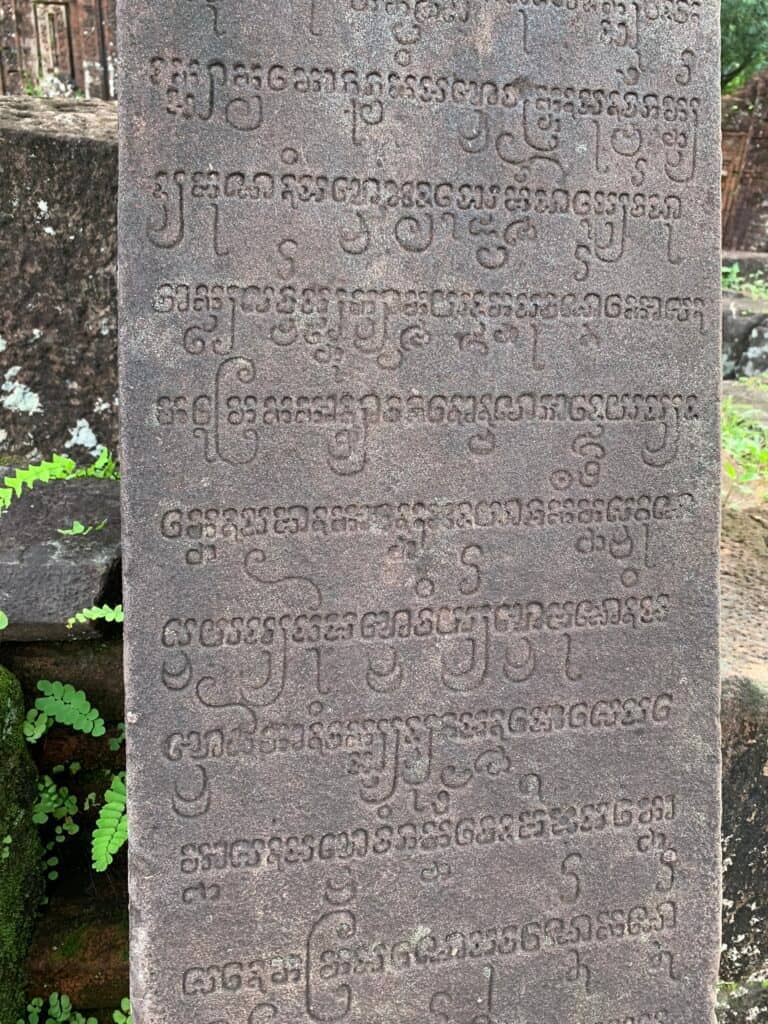
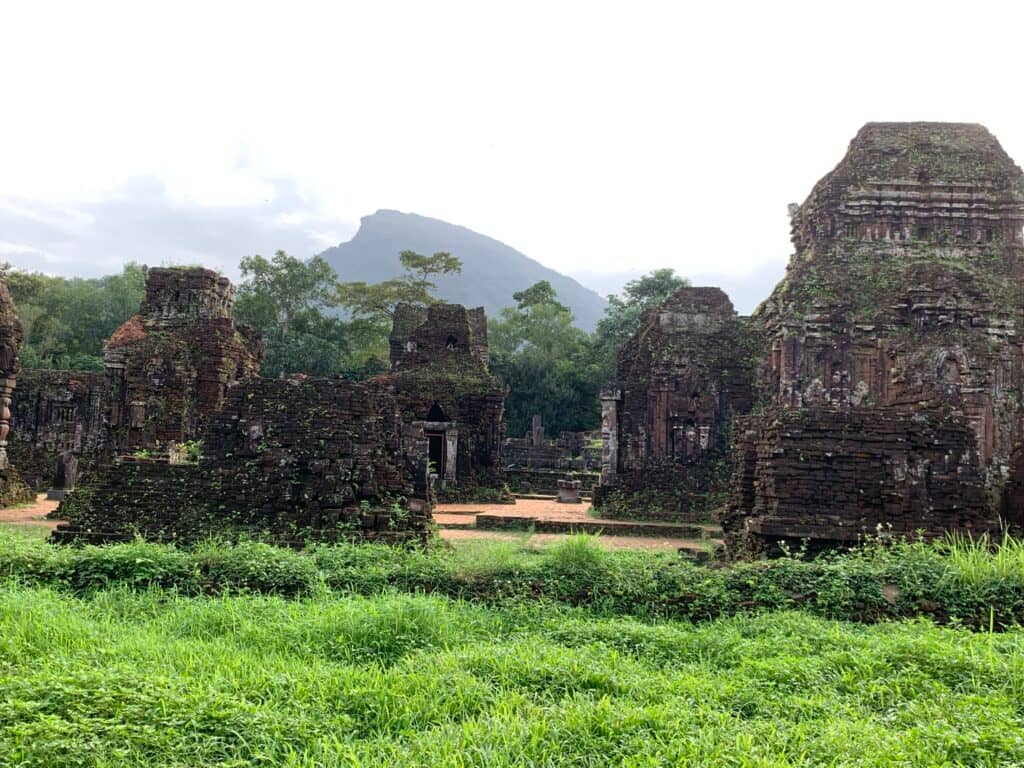
We went on an excursion to My Son which is 55km south west of Hoi An, and has the most important remains of the ancient Cham empire.

My Son
My Son
My Son
My Son
My Son
My Son

Unfortunately, the all-too-familiar evidence of American B-52 carpet bombing was visible even here, with damaged temples and bomb craters still present after 50 years.

Saigon

By plane next, from Da Nang to Saigon

Saigon

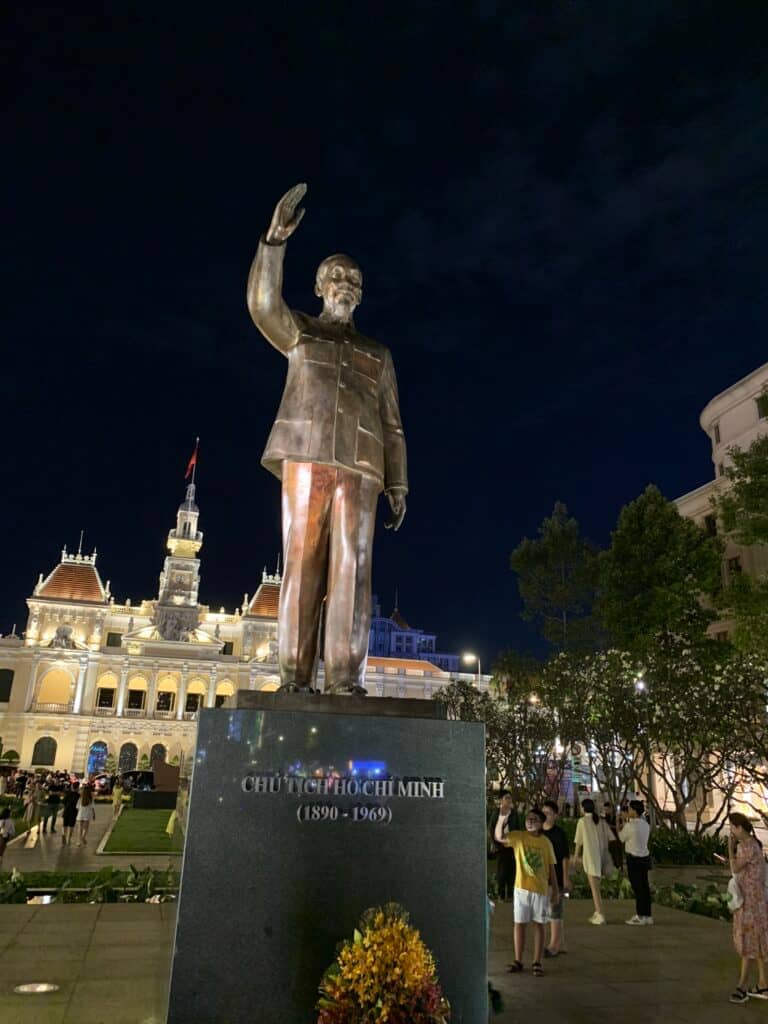
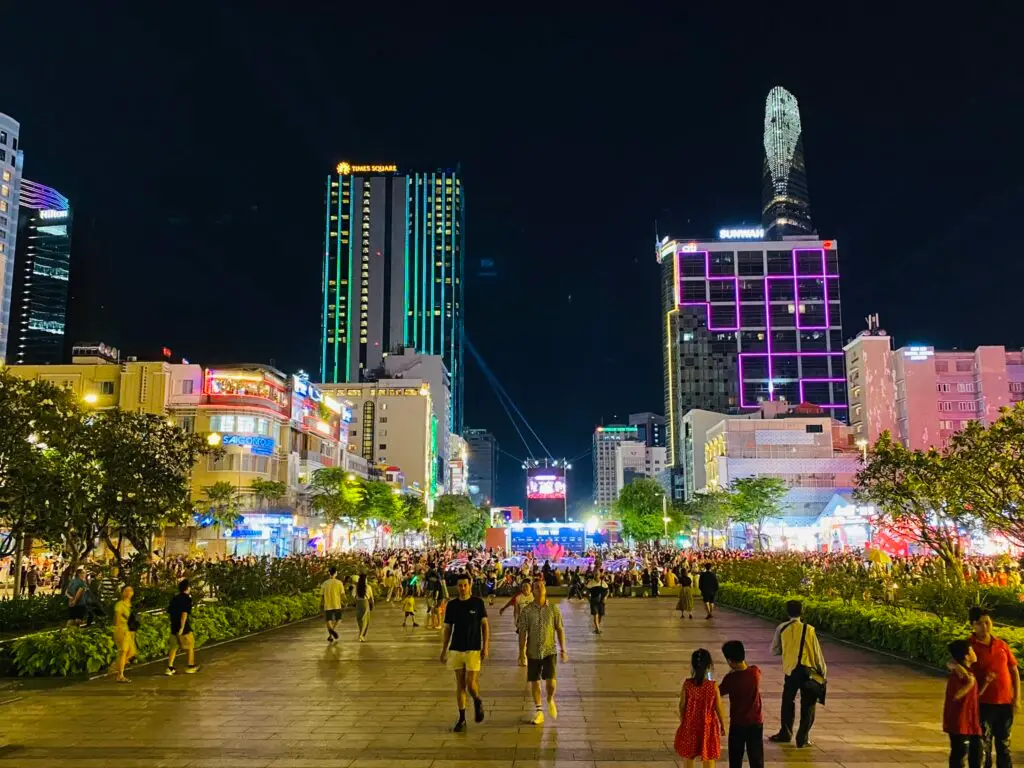
Saigon is now officially known as Ho Chi Minh City (HCMC) with a population of over 9 million (and 6 million motorcycles!).  However, the city center’s first district is still known as Saigon. We arrived on the 24th, known as Christmas Eve in Europe but called Christmas in Saigon. Unaware of this, we walked to a central area – known as “walking street” because traffic is prohibited at night. This area was in full party mode, with huge crowds, dazzling lighting, all kinds of street stalls, food shops, and live music performances. There was no discernable police presence that I was aware of, but somehow I still felt safe in this area.

At the end of the walking street, there is a statue of Ho Chi Minh, which sparked my curiosity about his thoughts on the frenzy of capitalism that he was observing.

Walking street in Saigon

Richard is pictured with some street performance artists. The video shows a sample of the chaotic traffic.

Saigon

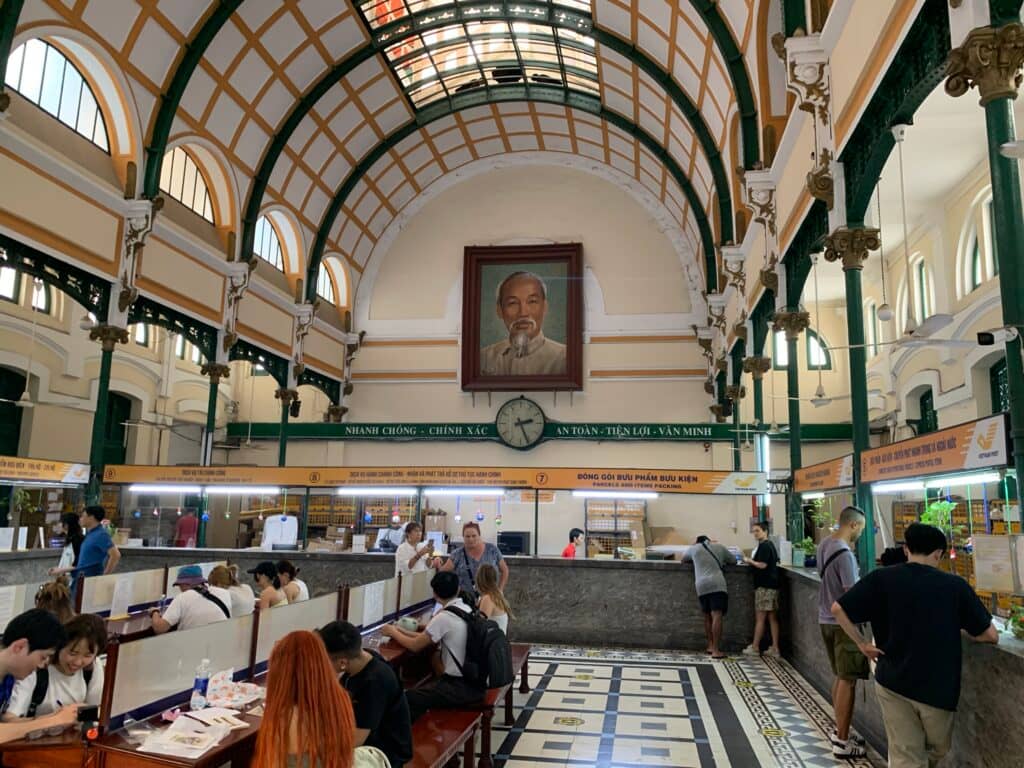
The city’s iconic post office from the French Colonial era is a classic example of the period’s architecture. It was constructed between 1886 and 1891. The hall is ornately designed with a barrel-vaulted ceiling, and a mosaic of Ho Chi Minh is displayed prominently at the end.

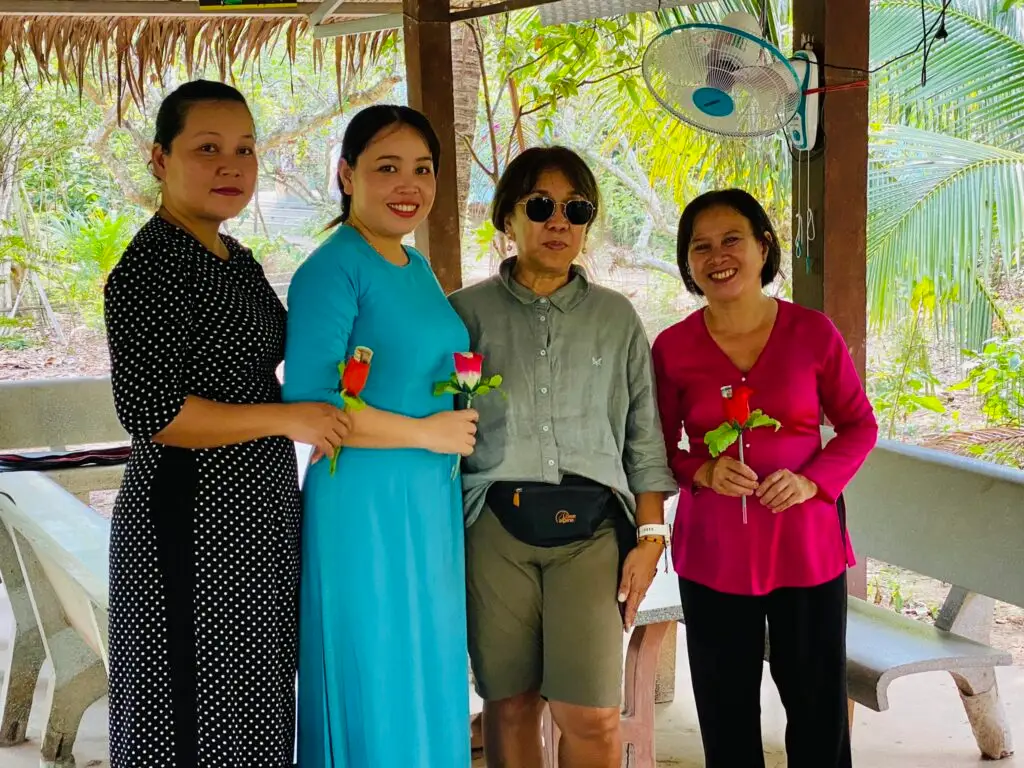
This picture was taken with some local musicians who entertained us on a boat trip to the Mekong Delta

Cu Chi

We took an excursion from Saigon, about 35 km north to Cu Chi, to an area known as the ‘Iron Triangle’ because so many millions of tons of bombs were dropped in this small area. Cu Chi was a major Viet Cong base from which they eventually launched a successful attack to take Saigon in the Tet Offensive. Indeed, one can visit today the underground conference room in Cu Chi where the 1968 Tet Offensive was planned.

At its peak, the tunnel system stretched from the South Vietnamese capital to the Cambodian border, and in the district of Cu Chi alone, more than 250 km of tunnels honeycombed the ground. The tunnels were dug by peasants and villagers with rudimentary tools – often fashioned from bits of shrapnel left from the bombing, transporting tons of excess mud to the Saigon River or rice fields at night.

Some people spent much of their life underground, and the Cu Chi tunnels grew to house entire underground villages with living quarters, kitchens, ordnance factories, hospitals, and bomb shelters.

Throughout the war, the tunnels in and around Củ Chi proved to be a source of frustration for the U.S. military in Saigon, and huge resources were expended to try to destroy them. By 1969, B-52s were freed from bombing North Vietnam and started “carpet bombing” Củ Chi and the rest of the Iron Triangle, dropping 30-ton loads in one mission and turning the lush jungle into a pock-marked moonscape.

It is estimated that every square meter of Cu Chi took 3 tons of bombs. The Americans trained special ‘tunnel rats’ (often Filipinos because of their small size) to attempt to infiltrate the tunnels and also brought in hundreds of German Shepherd dogs to sniff out the entrances.

In spite of all the bombs, the tunnel rats, the dogs, and at one point, 30,000 troops during the 1967 ‘Operation Cedar Falls’, nothing brought about the desired success.

Our guide showed us how the Viet Cong took unexploded bombs and, in underground workshops working by candlelight, they re-fashioned them into landmines to use back on the Americans. When troops found a tunnel, they would often underestimate its size, and exploring was hazardous due to booby traps. Throwing a grenade down an entrance to seal it off proved ineffective because of the design of the tunnels and the strategic use of trap doors and air filtration systems.

Our guide told us that the dogs were put off scent by lining the entrance with chili, washing in the same soap as the US soldiers, or laying out scraps of their uniforms. He said that most of the dogs ended up being eaten.

By 1965, the Viet Cong had become so well-entrenched in the area that it was in the unique position of being able to control where and when battles would take place. Conditions for the Viet Cong inside the tunnels were not easy, however; heat and lack of oxygen was overbearing; it was rife with rats, snakes, and scorpions; and malaria proved deadly for many.

In all, at least 45,000 Vietnamese men and women are said to have died defending the Cu Chi tunnels over the course of the Vietnam War.

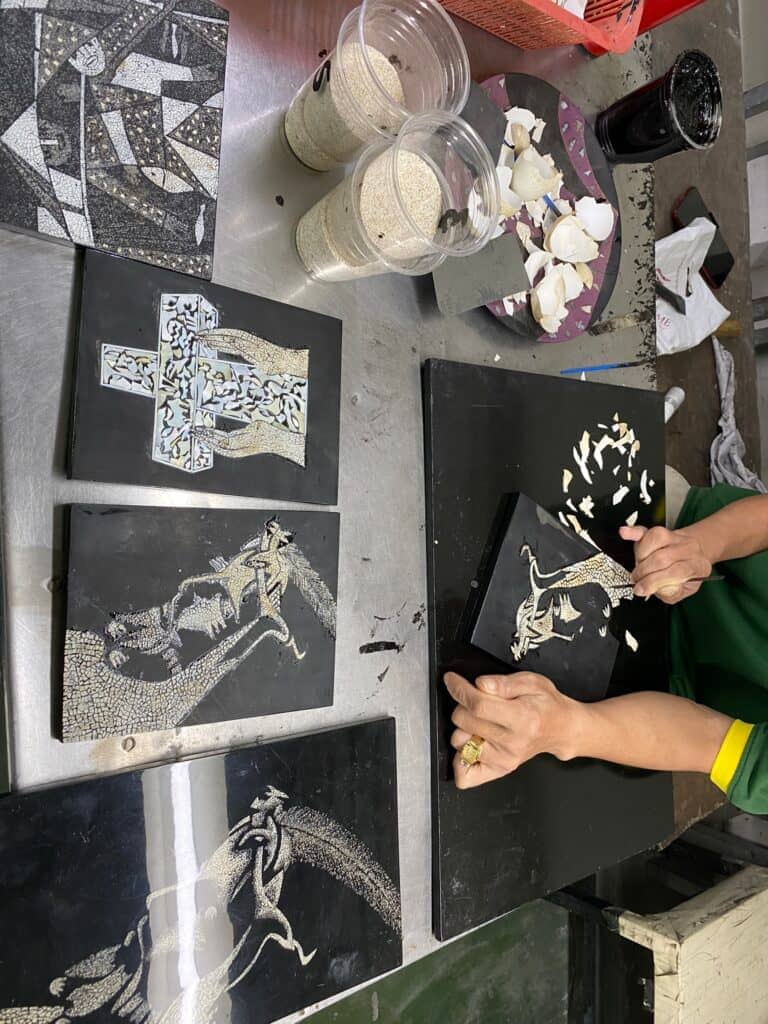
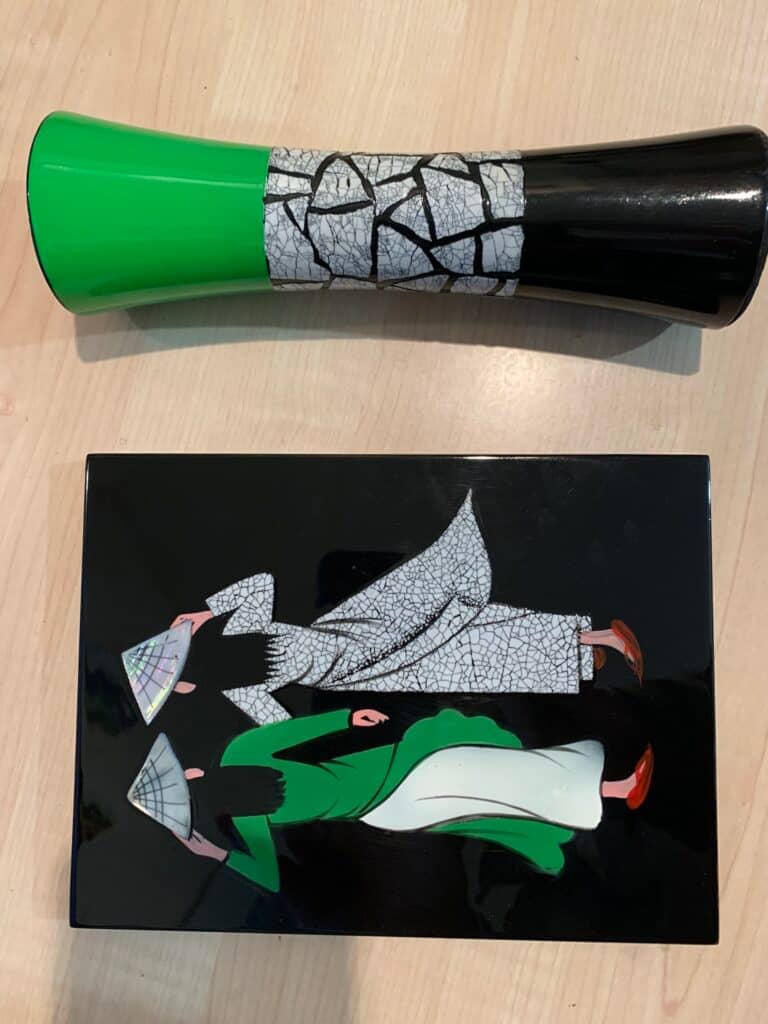
The area still contains unexploded ordnance (UXO), which injures local people when it explodes. On our way to Cu Chi, we stopped at a factory where people disabled by UXO make artwork from eggshell and resin to sell to tourists and make a living.

This is a picture and and vase which we bought at the factory for disabled victims of UXO

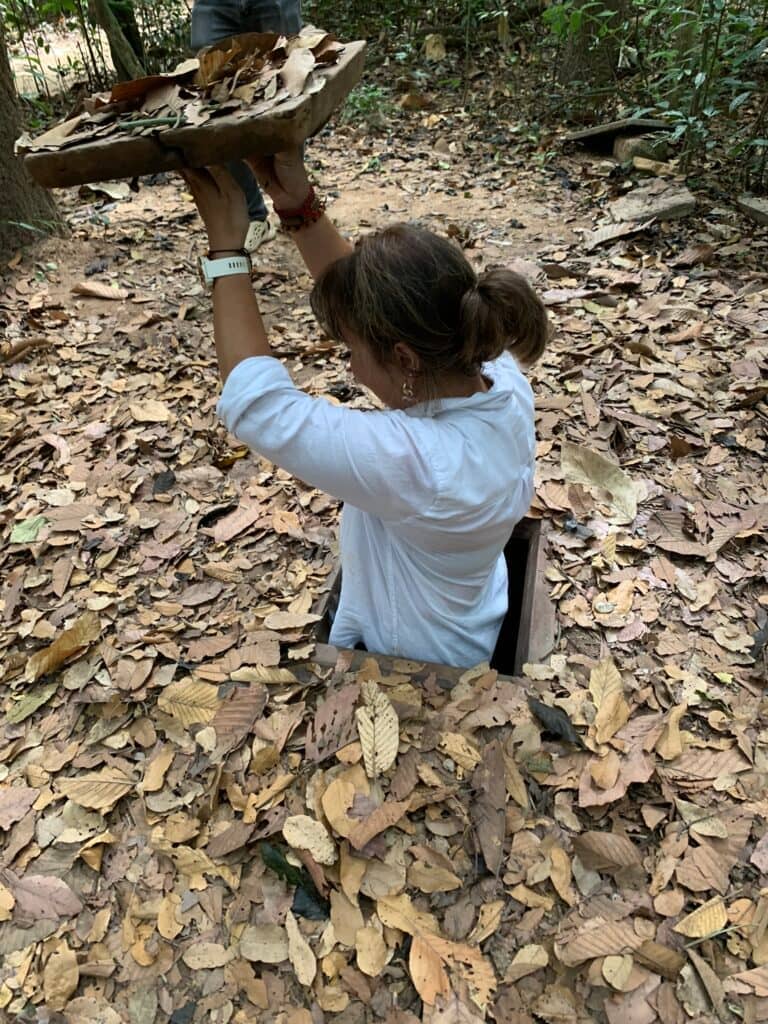
A tunnel entrance (Cu Chi)
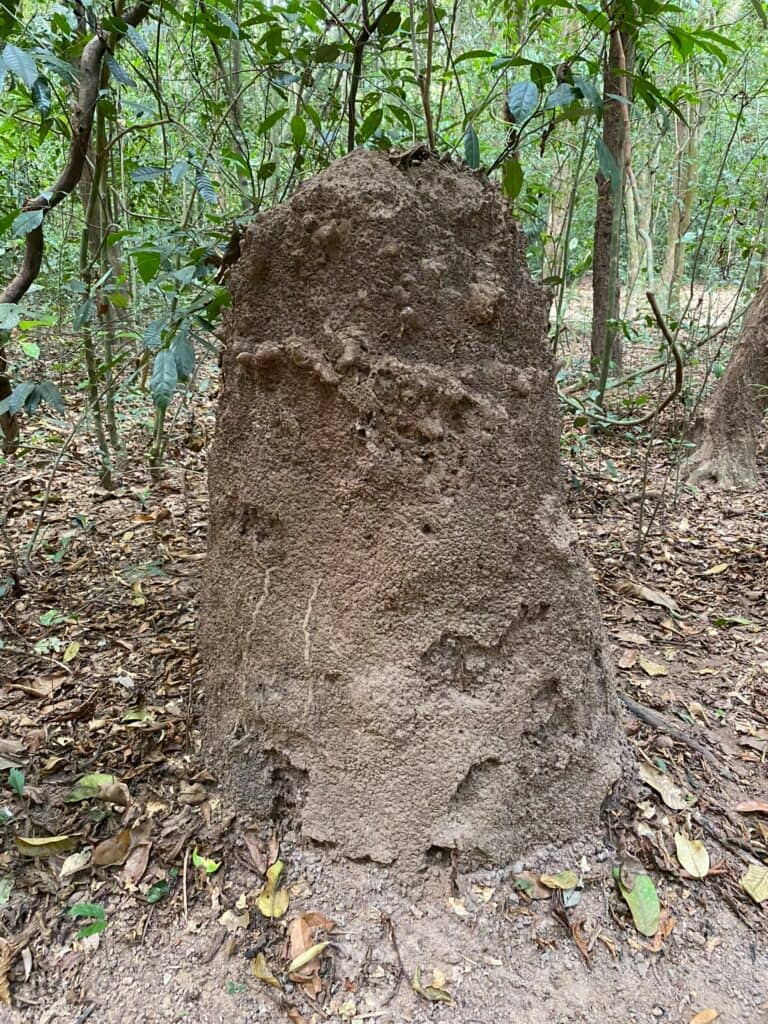
The tunnelers fashioned ventilation shafts disguised as termite mounds
This is a hole from which a gun attack could be mounted.

This is a working model to demonstrate how a booby trap worked.

Phnom Penh - Cambodia

Phnom Penh is a roughly 6 hr bus journey along highway 1, closely following the course of the Mekong River towards the end. 

At the border everyone gets out of the bus and walks through customs to get their passport stamped with a visa.  Since the fall of Phnom Penh in 1975 during the Cambodian civil war, the city has risen from the ashes.  It now has a fast-growing population of over two million with cafe culture, a glistening new skyline, pungent smelling markets, and whizzing motorbikes like any other city in Indo-China.

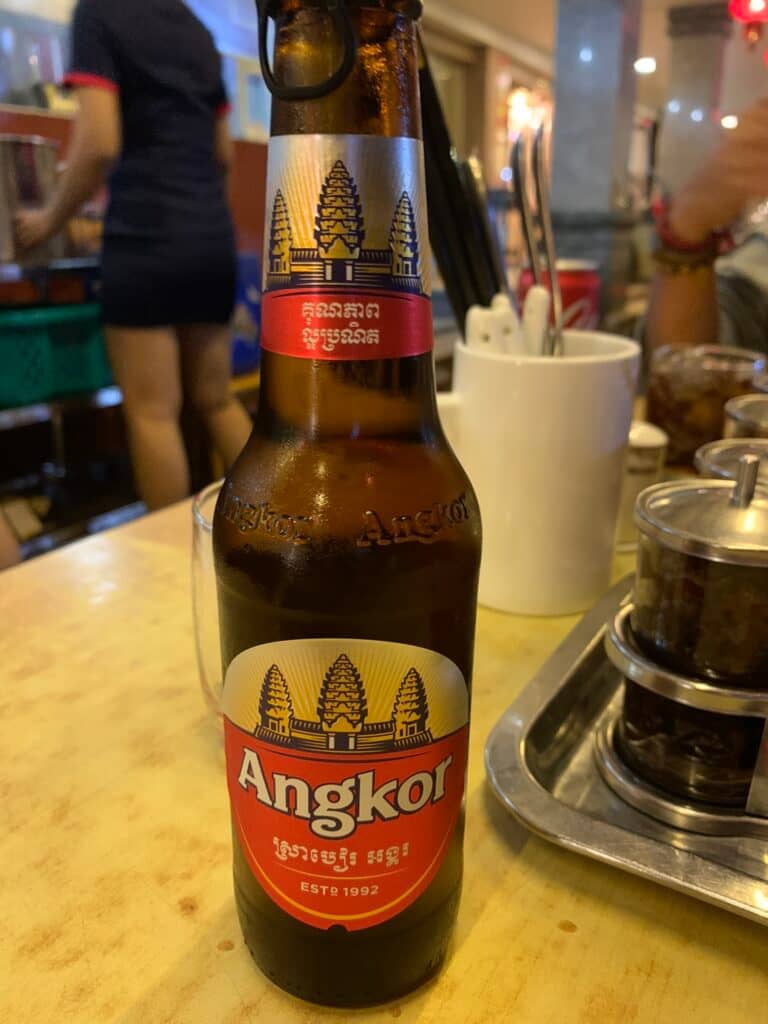
The local beer is called Angkor, after the name of the ancient Capital of the Khmer empire of 9th - 15th century

Phnom Penh Killing Fields Tour

The Killing Fields Tour is in two parts: the Tuol Sleng genocide museum, which is inside the city, and about 7 km further on the killing fields of Choeung Ek.

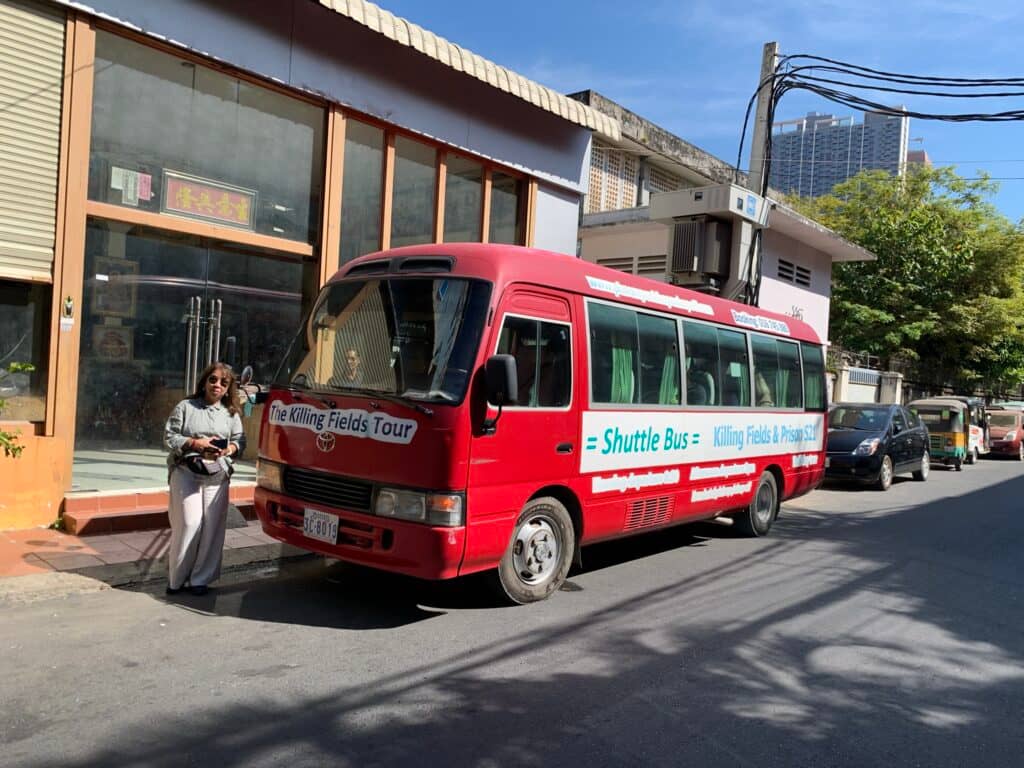
They picked us up from our hotel in this bus and during the journey they played a video about the Cambodian civil war.
The Cambodian Genocide

The second Indochina war (1955-1975) was caused by the spill over of the Vietnam war into Cambodia, and also consumed neighbouring Laos.  The North Vietnam peoples army of Vietnam (PAVN) wanted to protect its base areas and sanctuaries in eastern Cambodia, and the Americans wanted to protect its ally South Vietnam and to prevent the spread of communism to Cambodia.  This they did by assisting the Cambodian central government with a massive U.S. aerial bombing campaign and direct material and financial aid. 

This was president Nixon’s secret war which only became public knowledge in 1969 prompting international protest.

Prince Sihanouk who was the Cambodian head of state at the time, was opposed to the PAVN involvement in Cambodia but did very little to stop it.   PAVN support combined with domestic resistance resulted in the rise of the Khmer Rouge – Cambodia’s very own home grown ant-government communists – who launched a nationwide insurgency in 1968.

In 1970 Sihanouk was deposed by the Cambodian National Assembly after wide scale protests in the capital against the presence of PAVN troops in the country and a pro-American government under Premier Lon Nol was put in power.  Sihanouk then joined forces with his former enemy the Khmer Rouge in order to fight back which gave the Khmer Rouge movement legitimacy because he was still nominally was head of state.  Sihanouk spent much of his time with the Khmer Rouge under house arrest however.
In 1975 large parts of the North-eastern third of the country were under the control of the Khmer Rouge.  This point in history – which the Khmer Rouge designated as ‘year zero’ – and with huge economic support from the Chinese Communist Party and Mao Zedong, marked the start of the Cambodian Genocide – one of the bloodiest in history – with up to 1 in 4 of the population, (or 2 million people) killed between 1975 – 1979.

General secretary Pol Pot had decided that the Mao version of communism in China was wrong because Mao supported people in cities, whereas Pol Pot decided that the only way to a true socialist republic was to make everybody work on the land.  Thus the Khmer Rouge abolished money (reverting to the barter system), and emptied every city, town, village, and hamlet – forcing Cambodians to relocate to labor camps in the countryside, where mass executions, forced labour, physical abuse, malnutrition, and disease were rampant.

To hide their crimes from the outside world, they then sealed the county’s borders with fields of landmines.

As the genocide progressed, the Khmer Rouge in their paranoia started turning upon themselves and their fellow communist North Vietnamese by incursions across the Vietnamese border to massacre villages, which finally prompted the Vietnamese military to invade in 1978.  The Khmer Rouge regime then collapsed within days and Pol Pot together with 100,000 of his followers fled to the jungles of the Thai border region.

But even then, the Khmer Rouge was seen by many in the West as a powerful challenge to Vietnamese influence in Cambodia, and  the U.S. and other Western countries supported them with military assistance.  Incredibly, From 1979-1990, the Khmer Rouge held a seat in the U.N. General Assembly as the legitimate representative of Cambodia.  When Pol Pot died in 1998, he was only just about to face the possibility of trial before the world.

Tuol Sleng (S21) genocide museum

Due to the radically different vision of the way they wanted to transform the country, the Khmer Rouge felt threatened by anyone connected with present society.  The only people they trusted were illiterate peasants and any one else – especially educated or wearing spectacles or even with soft hands was brought to detention and torture centers of which the largest in the country was Security Prison 21 (S-21). 

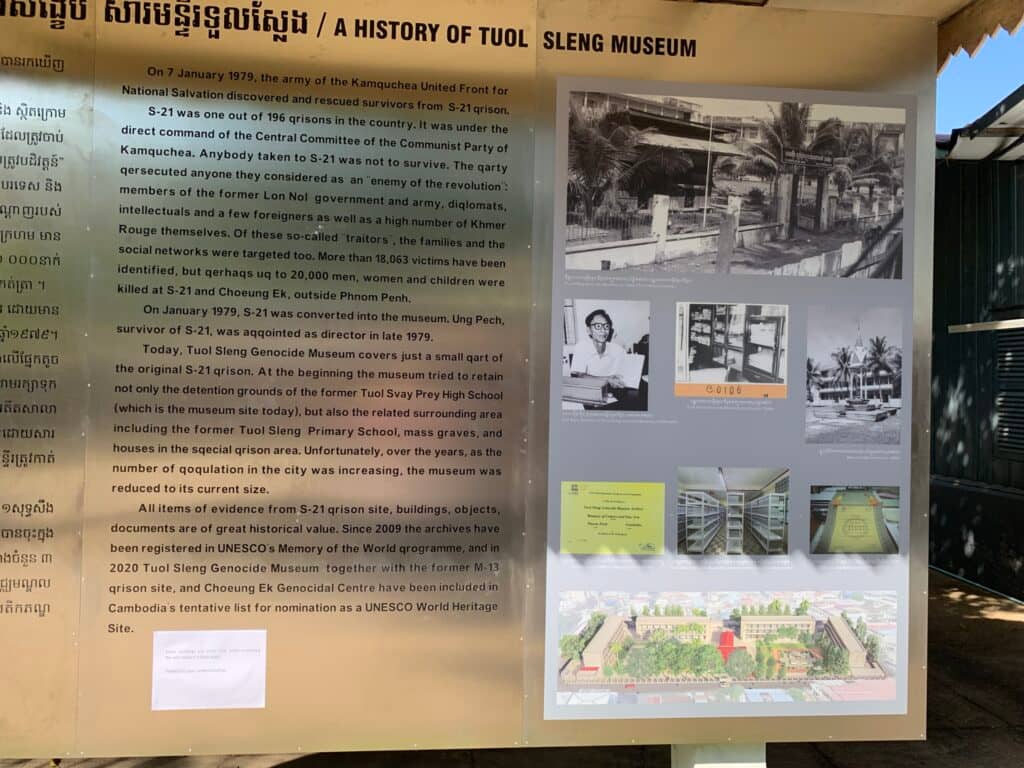
Formerly a high school inside the city of Phnom Penh, S-21 has now been turned into a museum to serve as a testament to the crimes of the Khmer Rouge.  Between 1975 to 1978, some 20,000 people held at S-21 were taken after torture and signing their ‘confession’, to the Killing Fields of Choeung Ek – about 7.5 km south of todays city limits (there were many other Killing Fields in operation around the country also).

This board inside the museum displays the rules to be observed during interrogation:

  • You must answer according to my questions.  Don’t turn them away.
  • Don’t try to hide the facts by making excuses about this or that.  You are strictly prohibited to contradict me.
  • Don’t pretend to be ignorant, for you are a chap who dares to thwart the revolution.
  • You must answer my questions immediately without wasting time to reflect.
  • Don’t go on about your minor mistakes or infringements of the moral code or on the essence of the revolution.
  • While getting lashes or electrification you must absolutely not scream or cry out.
  • Do nothing sit still and wait for my orders.  If there is no order keep quiet and when I tell you to do something you must do it right away without protesting.
  • Dont make pretext about Kampuchea Krom in order to hide your secrets or your betrayals.
  • If you do not scrupulously follow all of the above rules you shall get many lashes and electric shocks.
  • For every infringement 10 lashes or 5 shocks
Tuol Sleng (S21) genocide museum

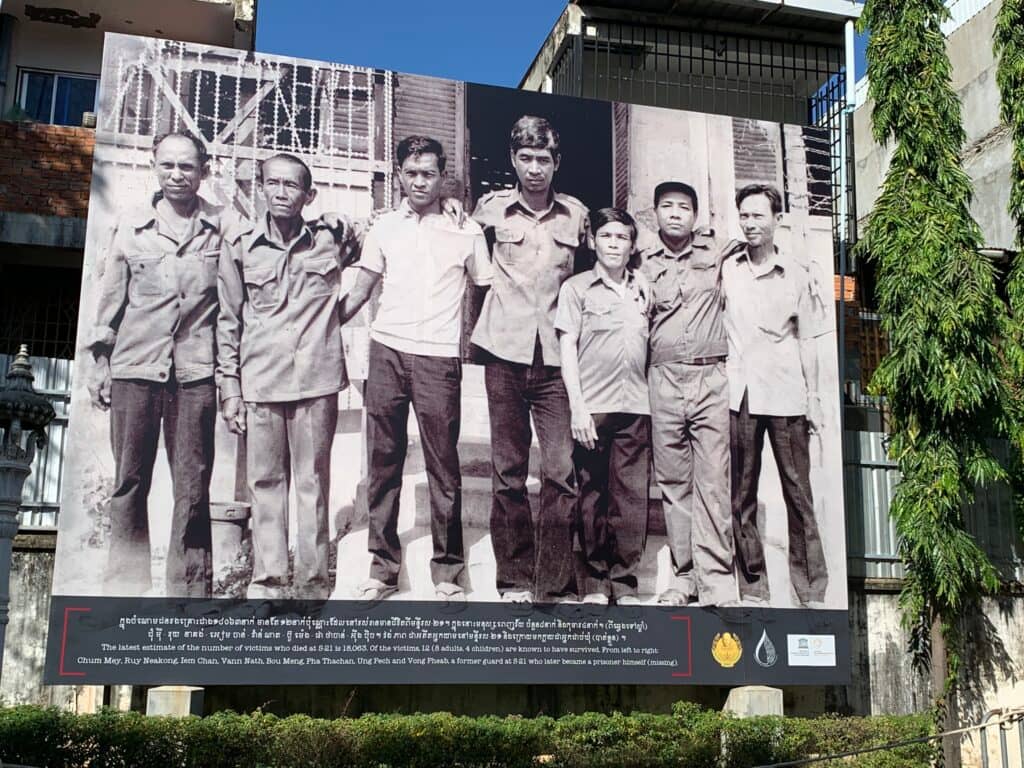
This is a picture in the museum of the only 8 adults and 4 children known to have survived out of the 18,063 victims.

Tuol Sleng (S21) genocide museum

Like the Nazis, the Khmer Rouge leaders were meticulous in keeping records of their barbarism. 

Every prisoner had to be photographed along with detailed records of his or her ‘confession’.  One prisoner managed to keep his life because it was discovered that he had the skill to mend typewriters.

Tuol Sleng (S12) genocide museum

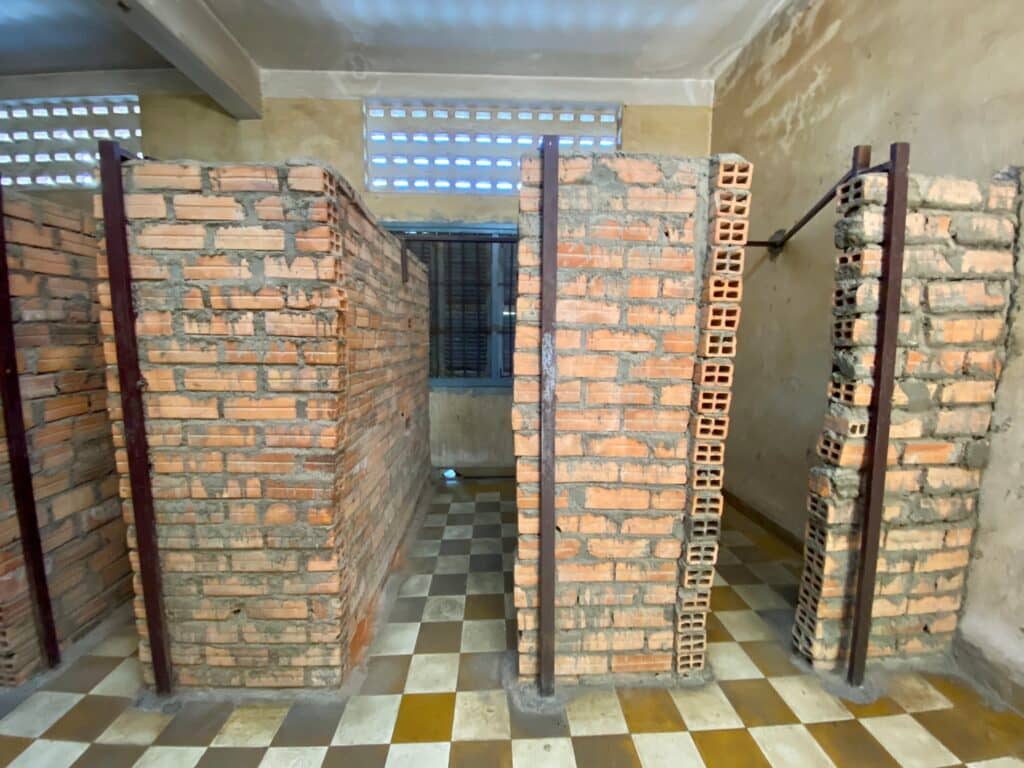
The rooms on the lower floor were where prisoners were held shackled in irons while awaiting interrogation and torture.  You can see that the ventilation holes above the door have been blocked up to make the room as airless as possible. 

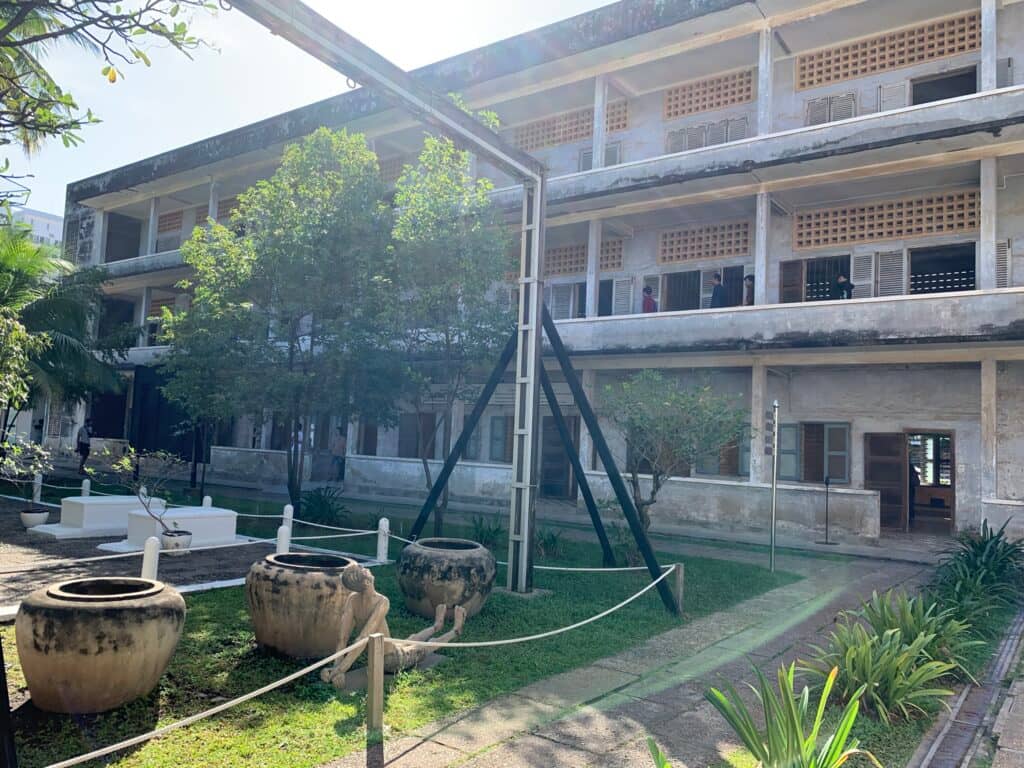
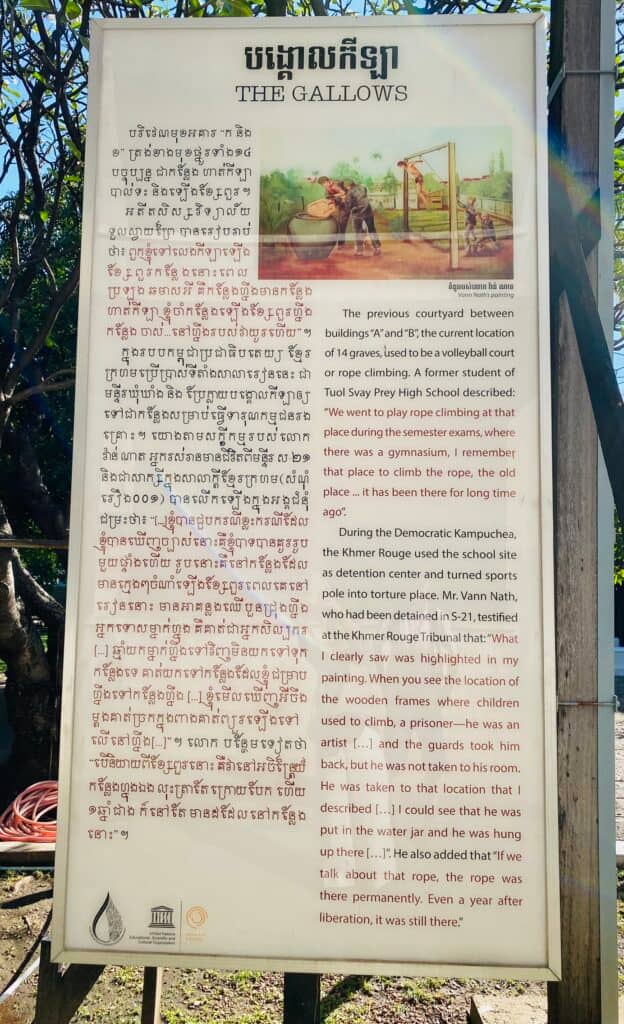
The bar in the picture was where students could do rope climbing in the days when this was part of the school gymnasium.  The Khmer Rouge turned this into a torture place known as ‘the gallows’ where prisoners were hoisted up by their arms which were tied behind their back.  They would then be lowered into the pots underneath headfirst into filthy water and excrement.

Tuol Sleng
Tuol Sleng genocide museum

It was strictly not allowed to die while at S-21 because this was reserved for the formal execution later at Choeung Ek.  After one prisoner managed to commit suicide by jumping from the top balcony they put this grilling up to stop this happening again.  If a prisoner died under torture then often the guard responsible would himself become a prisoner. 

A prisoner in danger of dieing would be revived with injections so that the torture could continue.  Because they had killed all the doctors, the injections had to be done ad-hoc with dubious substances.

Tuol Sleng genocide museum

This is a view of cells where prisoners would be held shackled to the wall while awaiting interrogation.

Tuol Sleng Museum
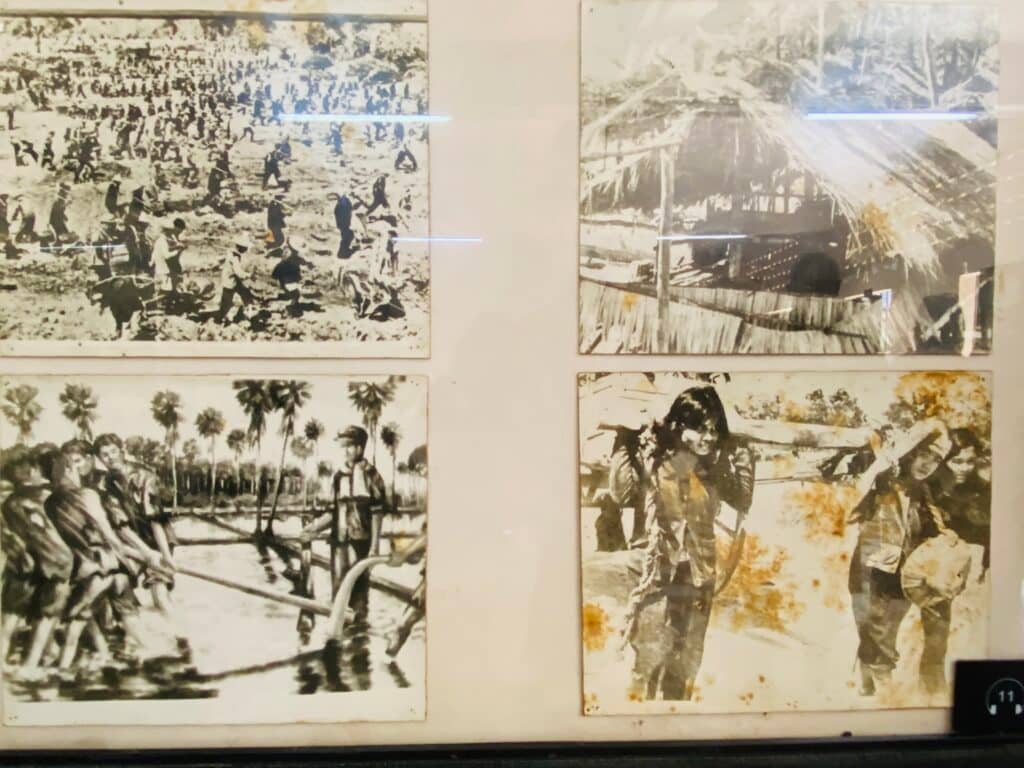
Forced labour in the fields
Tuol Sleng genocide museum

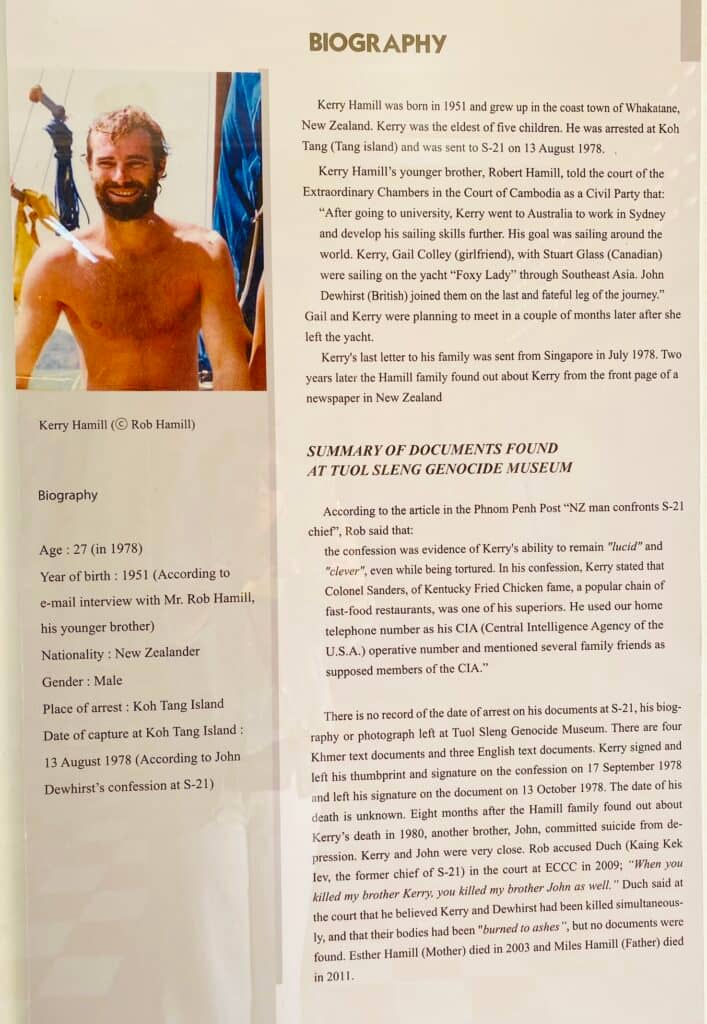
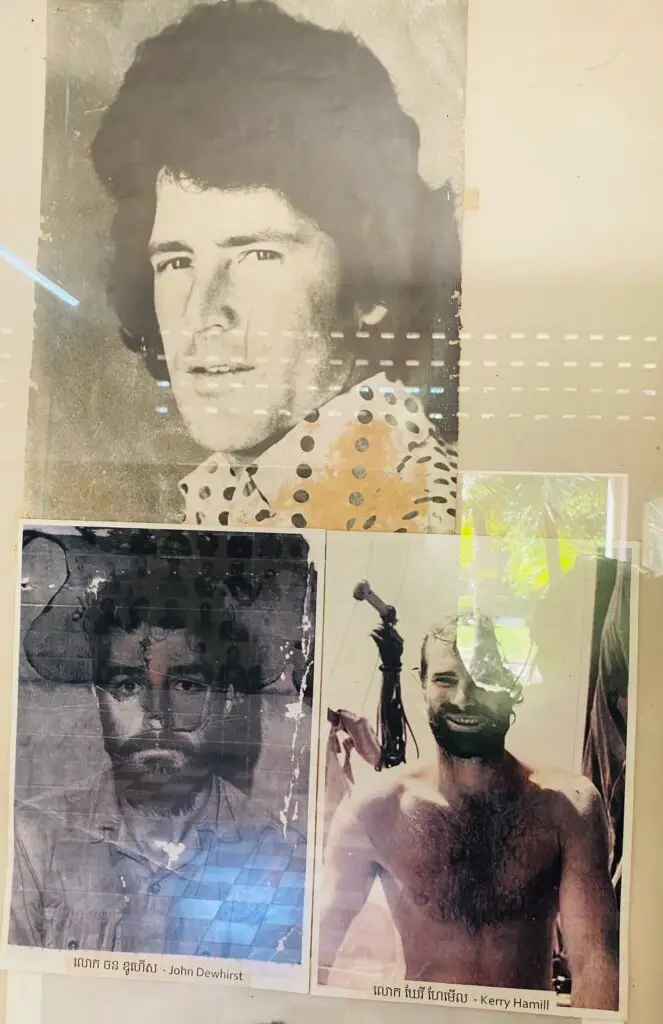
Not all S-21 detainees were Cambodian.  This is New Zealander Kerry Hamill who was fulfilling a life time dream of sailing around the world when he just happened to have the bad luck to be stopped by a Cambodian gunboat.

This is Kerry Hamill with John Dewhirst - another Westerner to die at S-21
Tuol Sleng Museum
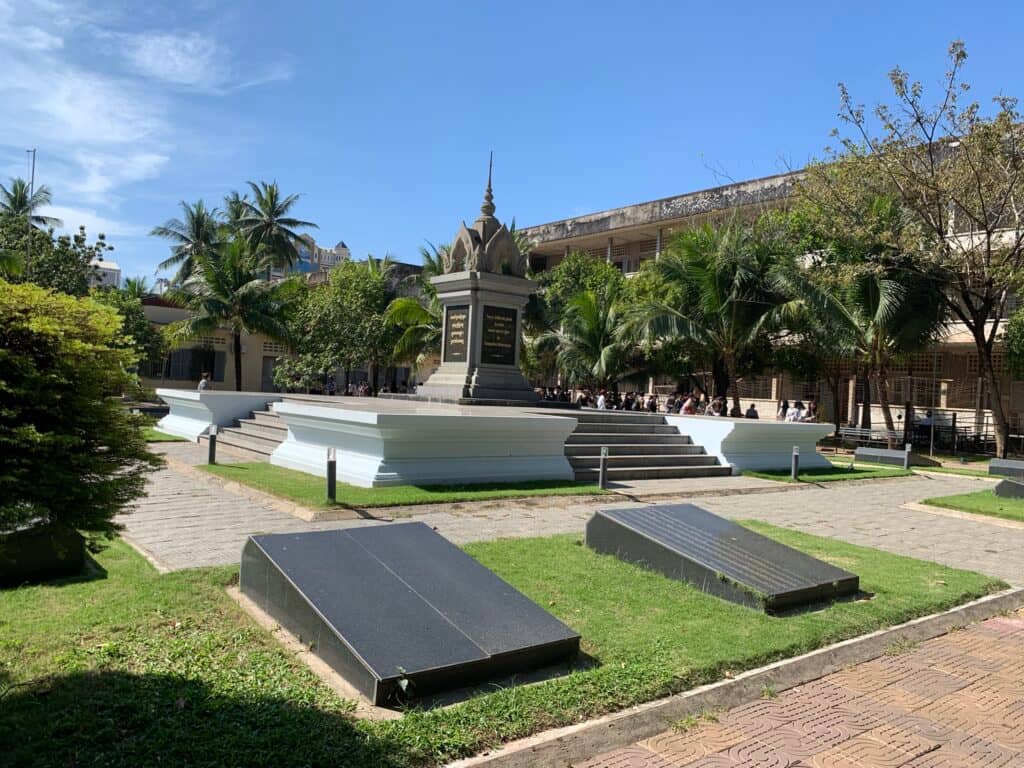
Memorial at Tuol Sleng Museum

Choeung Ek

After the genocide museum visit, it was back in the bus and onwards to the killing fields of Choeung Ek for the next stage in this grim journey.

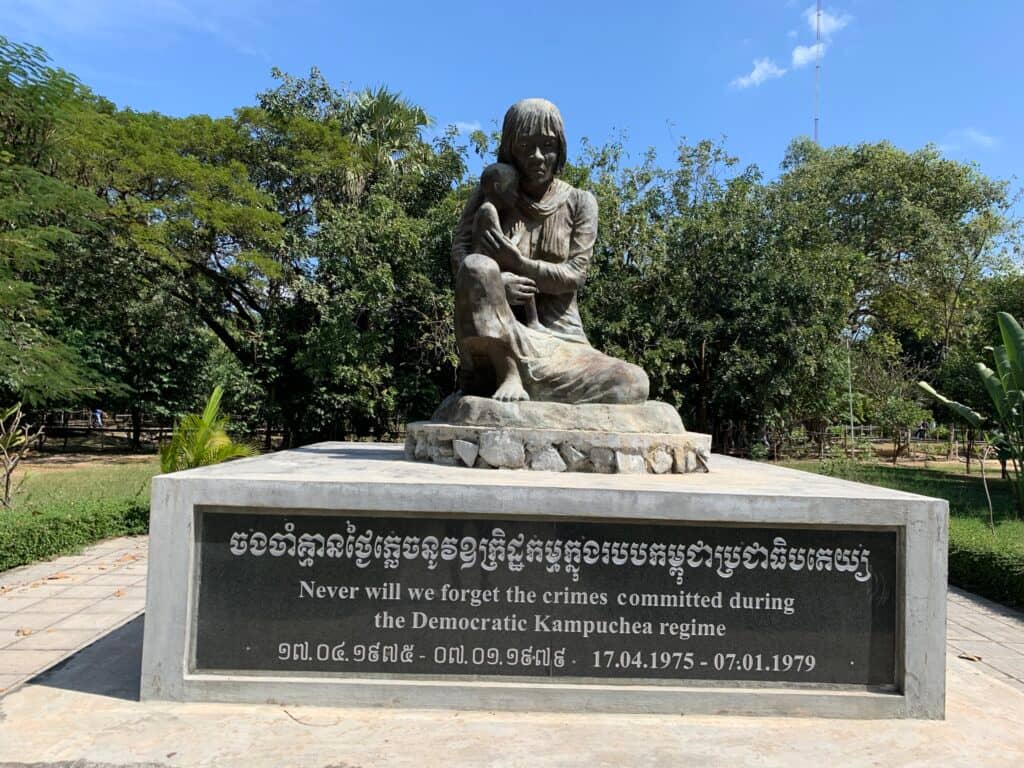
The place is peaceful today, which belies the the horrors that unfolded here decades ago. 

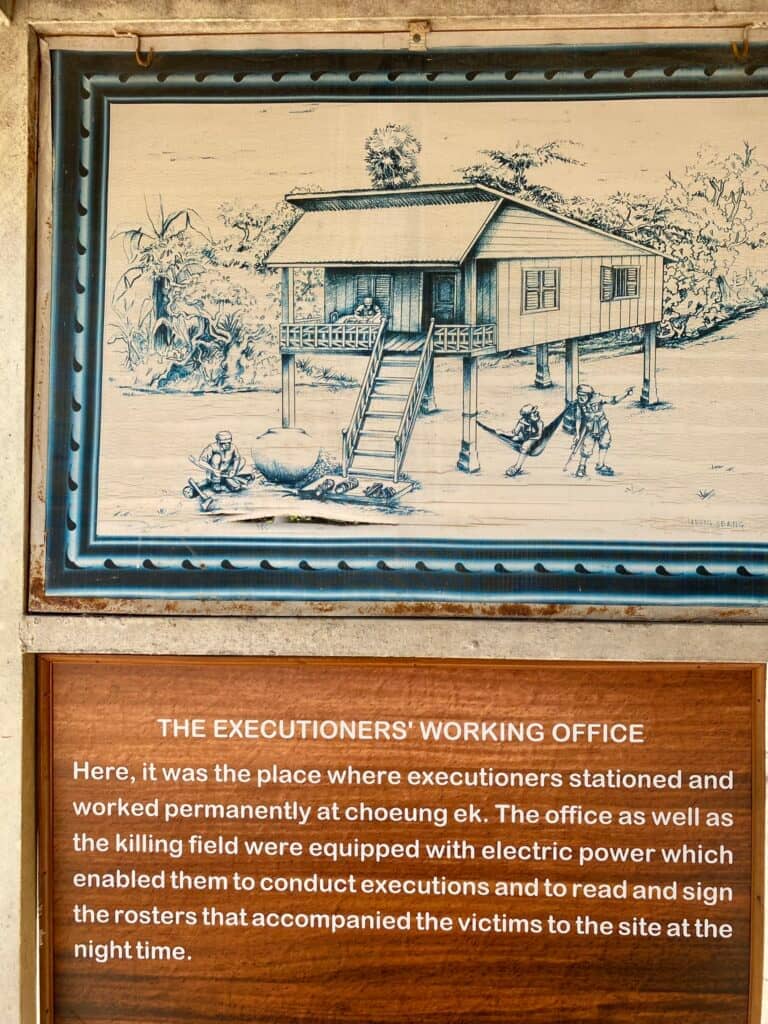
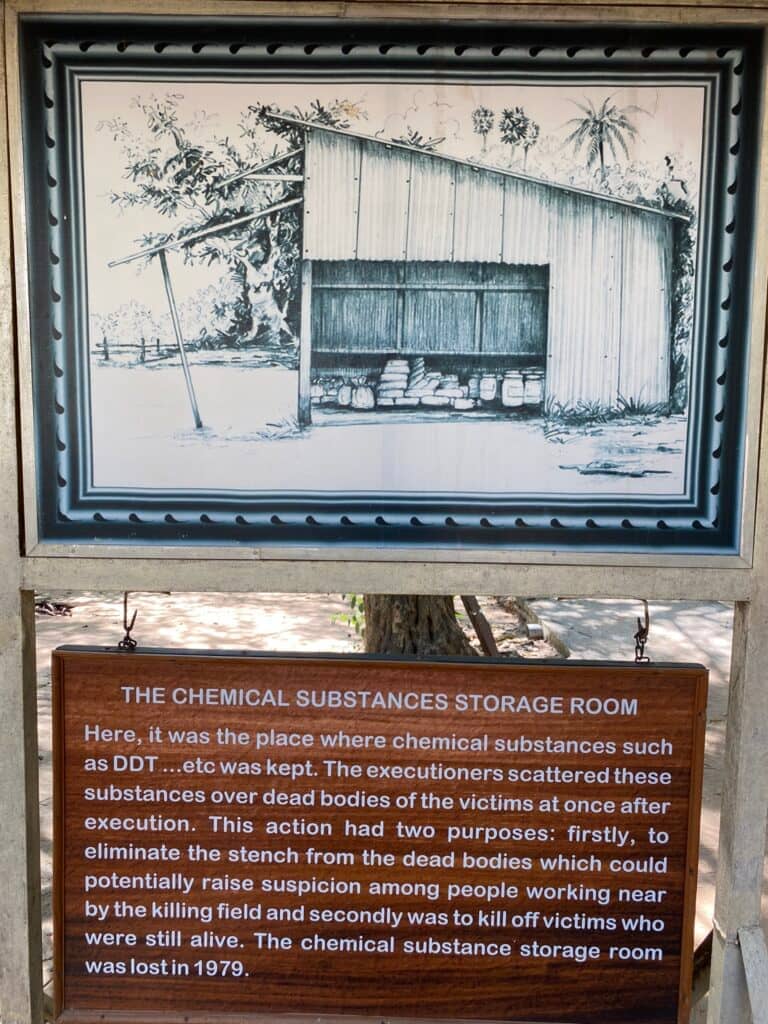
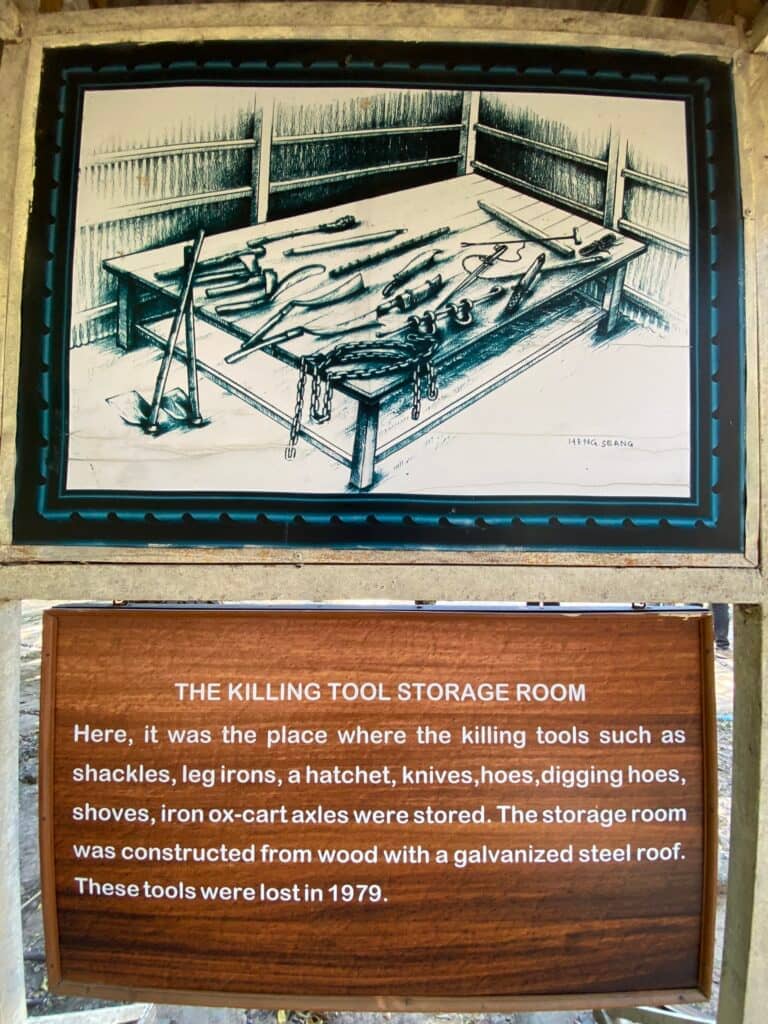
Between 1975 and 1978 about 20,000 men, women, and children were brought here for execution after detention and torture at S-21.  The remains of about 9000 people many of whom were bound and blind folded, were exhumed in 1980 from mass graves. 

43 of the 129 comunal graves have been left untouched, and after every heavy rain bone fragments are brought to the surface.  At the time of operation is was described how there were so many in the mass pits that the surface of the ground would swell up due to the decomposition gases from the buried bodies.

Choeung Ek - the killing fields

The tour of Choeung Ek involves an audio guide which takes you around a series of stops explaining what particular atrocities happened. 

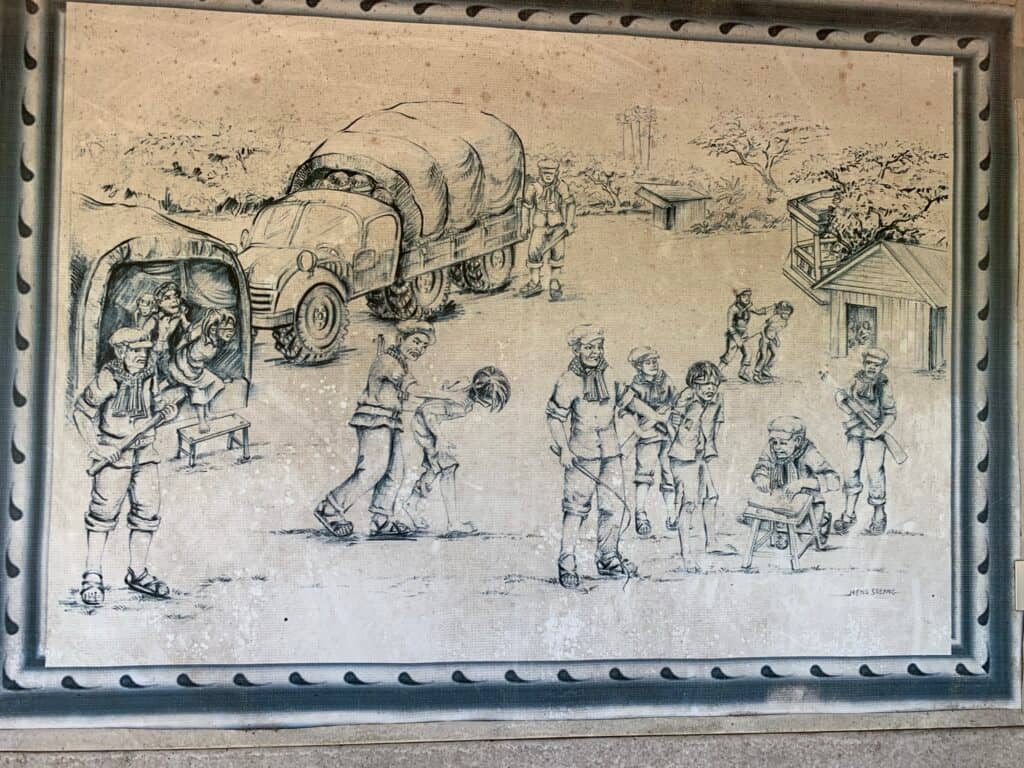
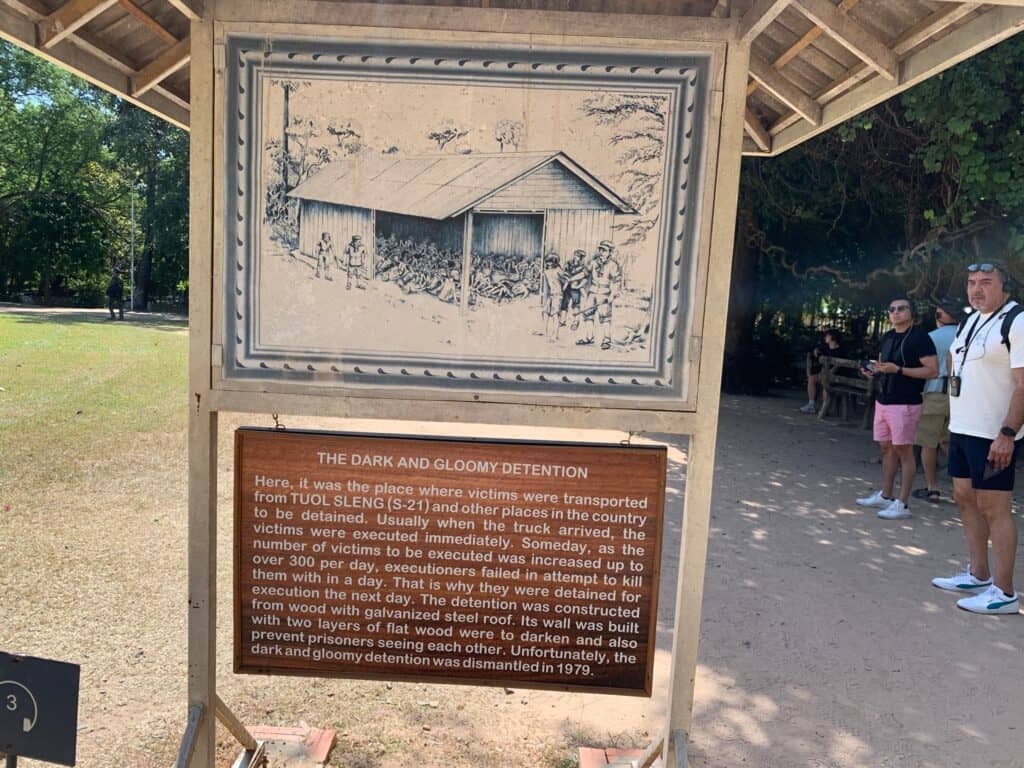
This stop is the first, and is labelled ‘the truck stop’.  It explains how 2 or 3 times a month a truck holding 20 to 30 blindfolded prisoners would be unloaded here.  The victims were then directly led to be executed at the pits or detained in the dark and gloomy prison nearby.

Choeung Ek
Choeung Ek
Choeung Ek
Choeung Ek
Mass grave of 450 victims
Choeung Ek
Choeung Ek
Choeung Ek - the killing fields

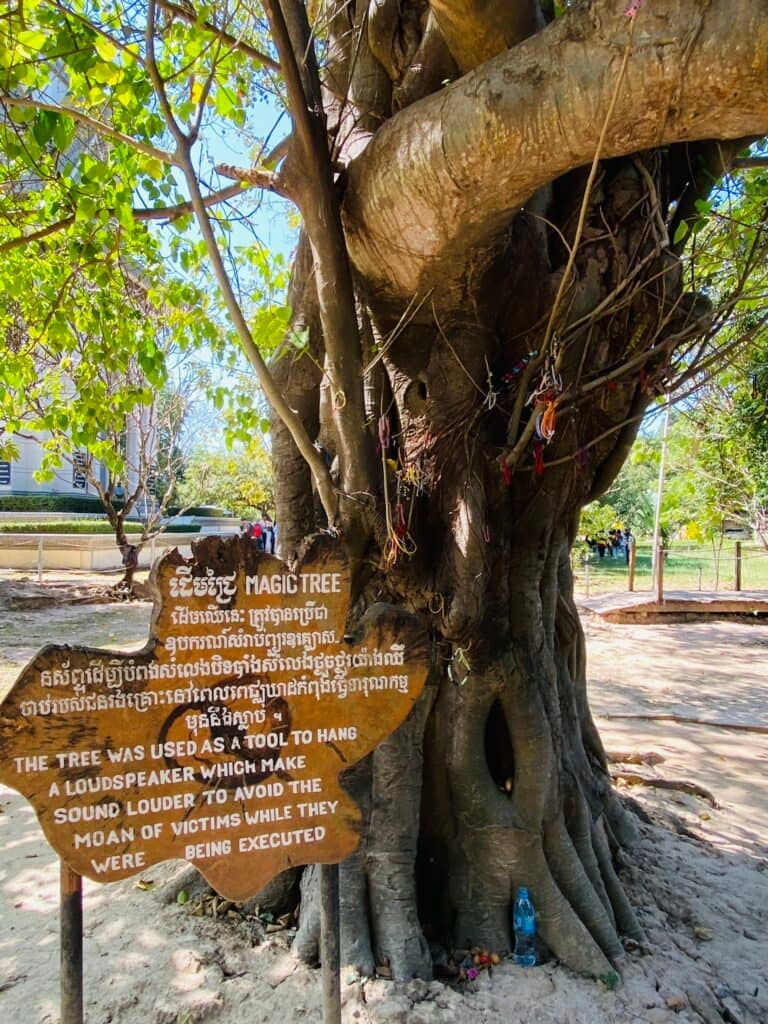
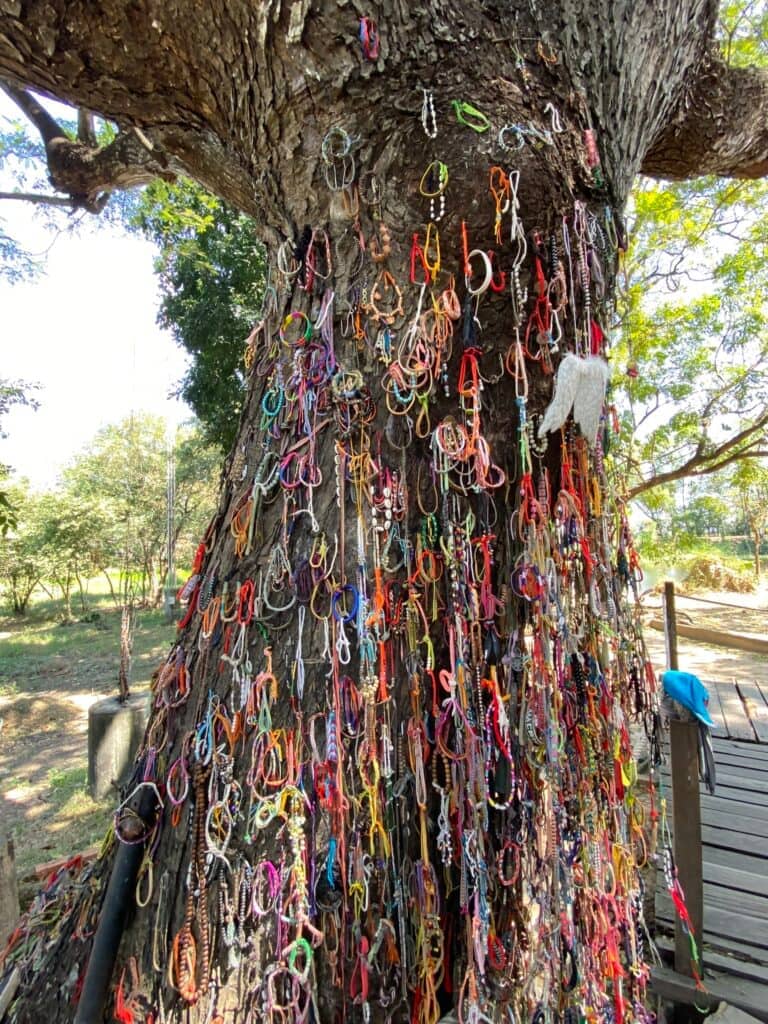
This was a particularly grim stop on the Choeung Ek tour. 

Called ‘the killing tree’ it was used to bash in the heads of babies before they were thrown into the pit.  Because the Khmer Rouge were afraid of revenge in the future from surviving family members, they had a policy of entire family extermination according to their slogan “to dig up the grass one must dig up the roots”. 

Today it is covered with remberance bracelets which people have left.

The National Museum

Phnom Penh national museum

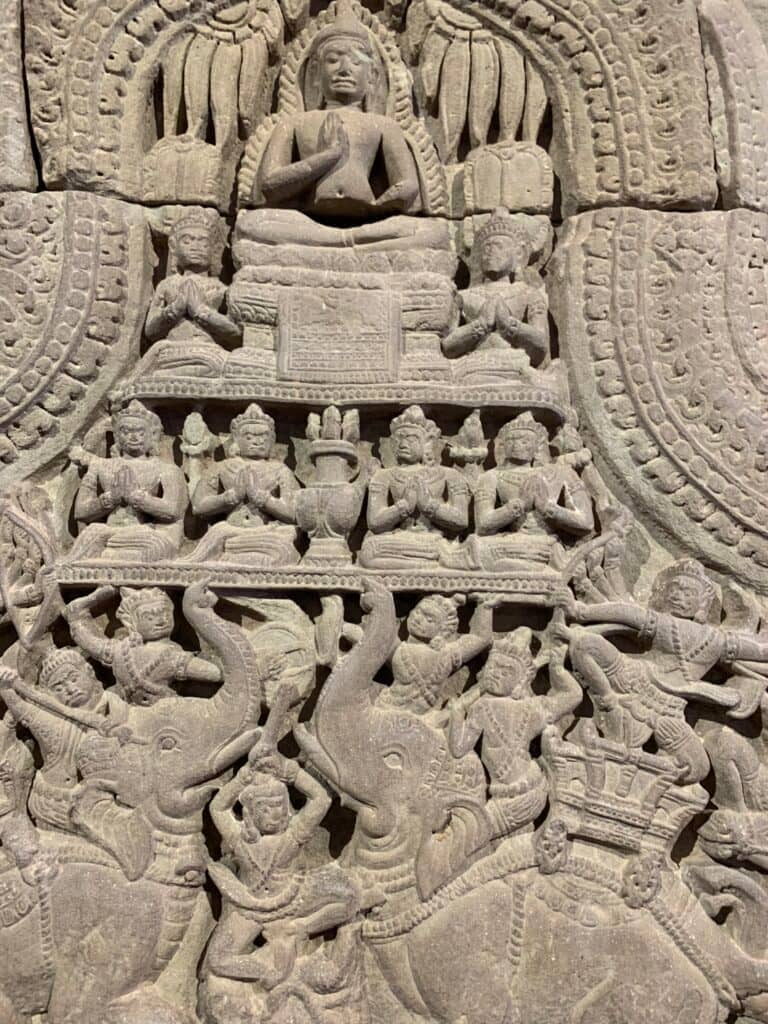
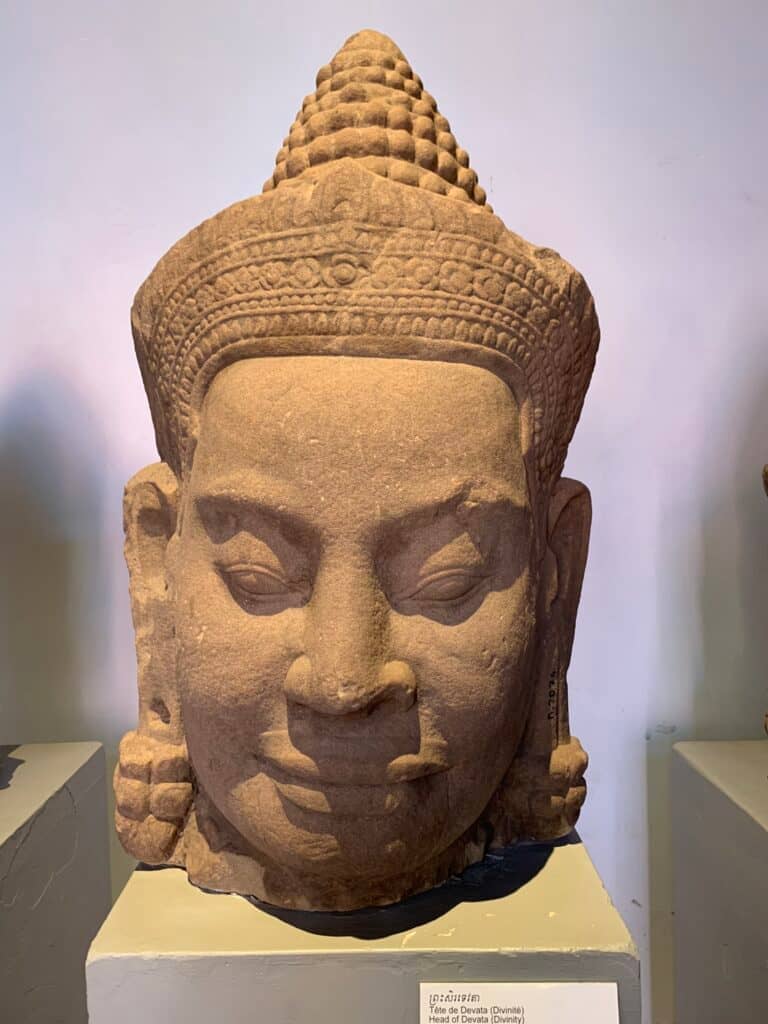
The National museum in Phnom Penh is home to the world’s finest collection of Khmer sculpture.  This is a 12th-century stele inscribed with scenes from the life of Shiva.

National museum of Cambodia

The Royal Palace

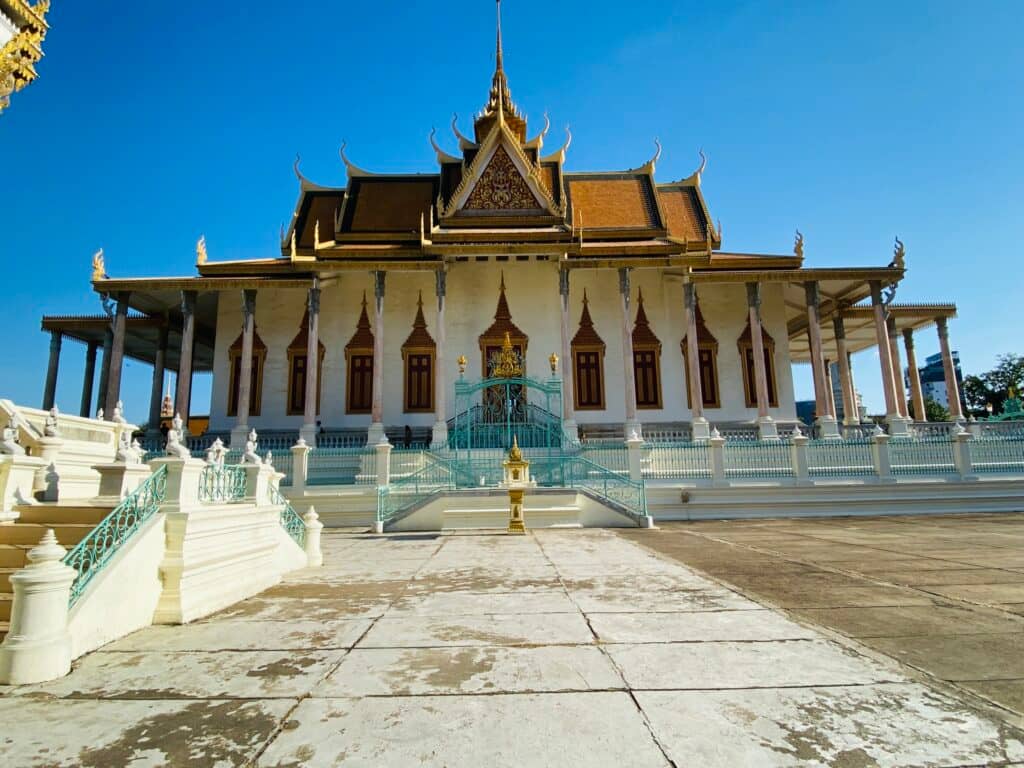
The Silver Pagoda

The Royal Palace is the official residence of King Sihamoni and comprises a large area of buildings on the Mekong riverfront, and a part is open to tourists. 

This picture was taken inside the courtyard housing the Silver Pagoda, a sacred Khmer Buddhist temple containing the so-called Emerald Buddha – actually made by French glassmaker Lalique.

White Stupa

The picture shows one of the four ornately carved white stupas containing the ashes of dead kings.

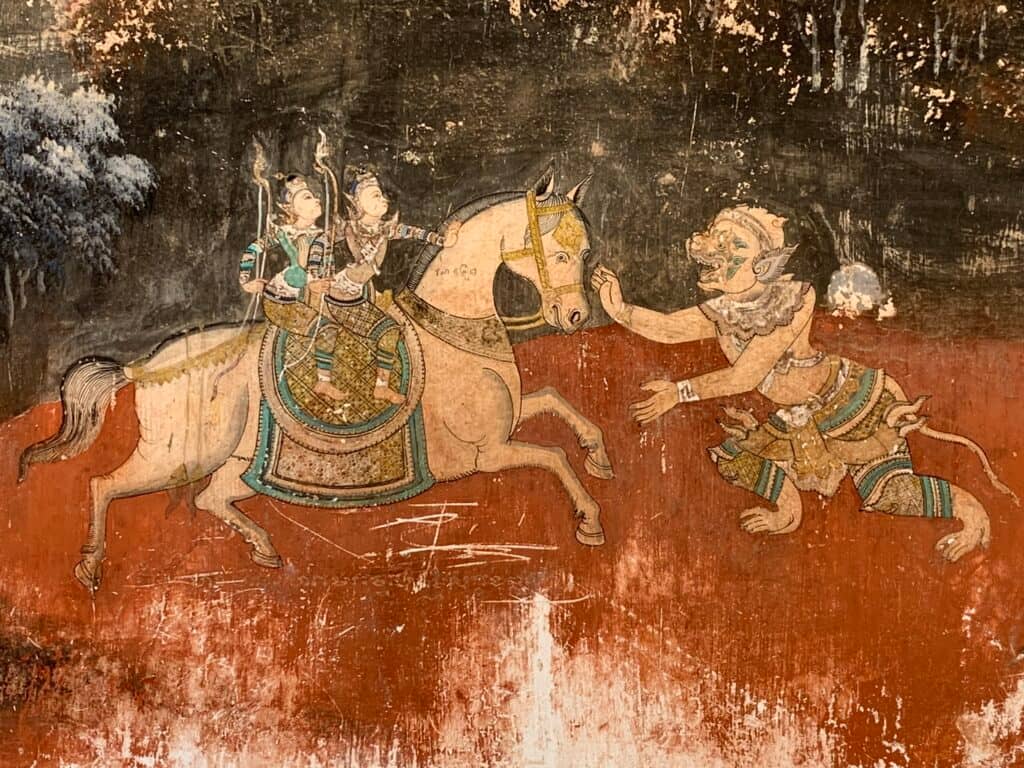
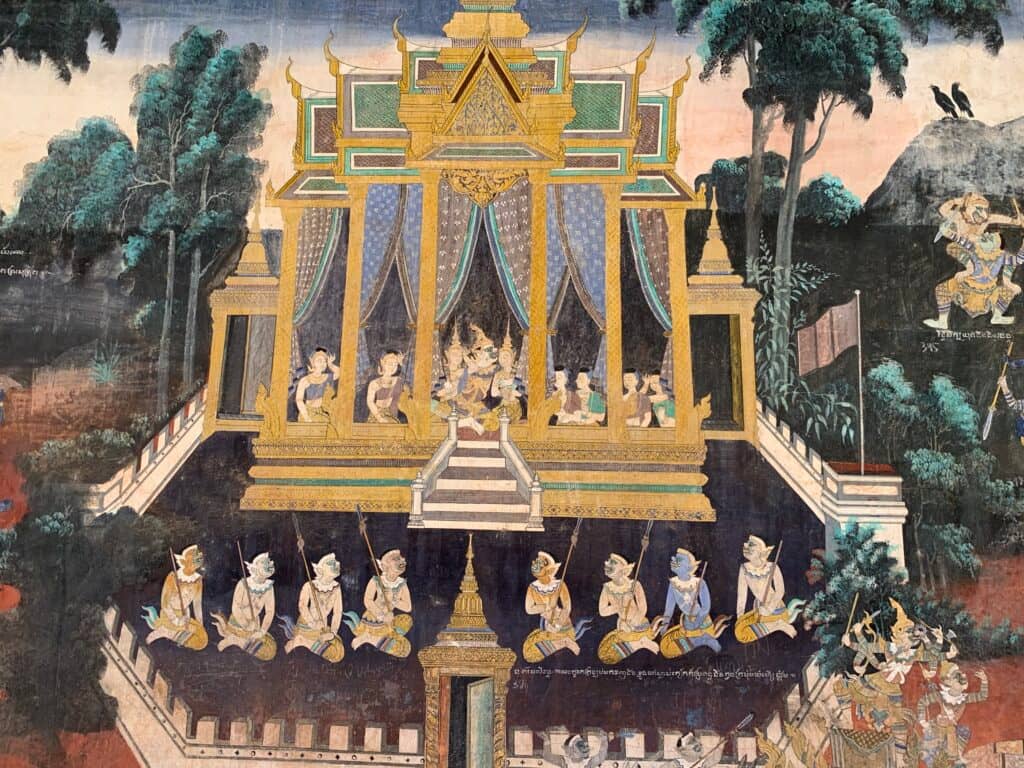
Behind the stupa, part of the covered gallery can be seen, which surrounds the area. It is 600 yards long and decorated with frescoes depicting the Reamker, the Khmer version of the Ramayana- an epic tragedy of war between the forces of good and evil.

Reamker Frescoes

They are in the process of restoring the Reamker frescoes – this is one of the best preserved.

Reamker frescoe
Reamker frescoe
Reamker frescoe
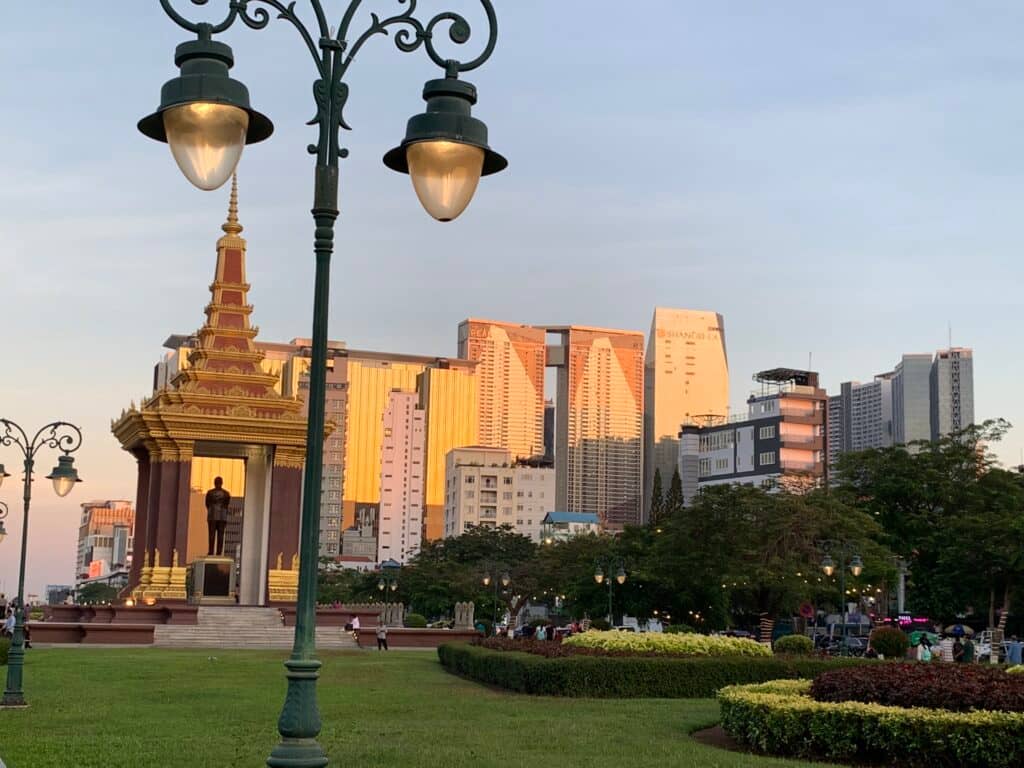
Phnom Penh

Phnom Penh today is unrecognisable from when the first foreigners were allowed back in in 1980 after the fall of the Khmer Rouge, when the whole city had been reduced to torn down rubble.

Battambang

Samraong Knong

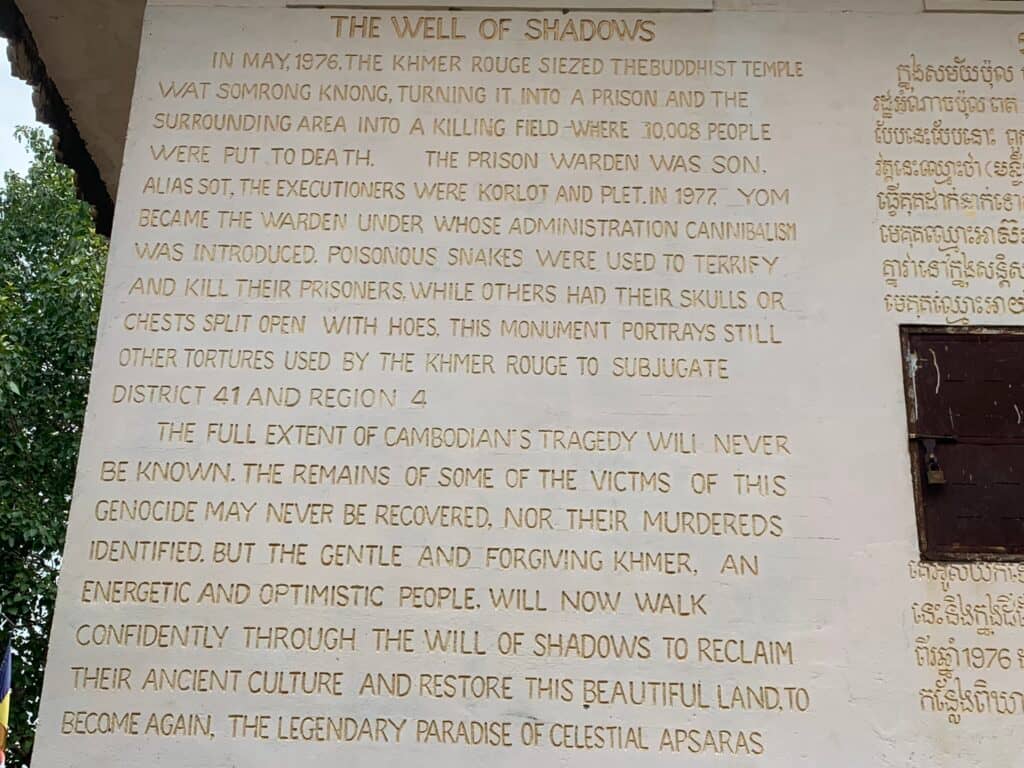
We travelled further into Cambodia to Battambang.  There are killing fields all over Cambodia, but another main one is the Wat Samraong Knong just a few kilometers out of town.  This is also where the notorius well of shadows is located.

Samraong Knong

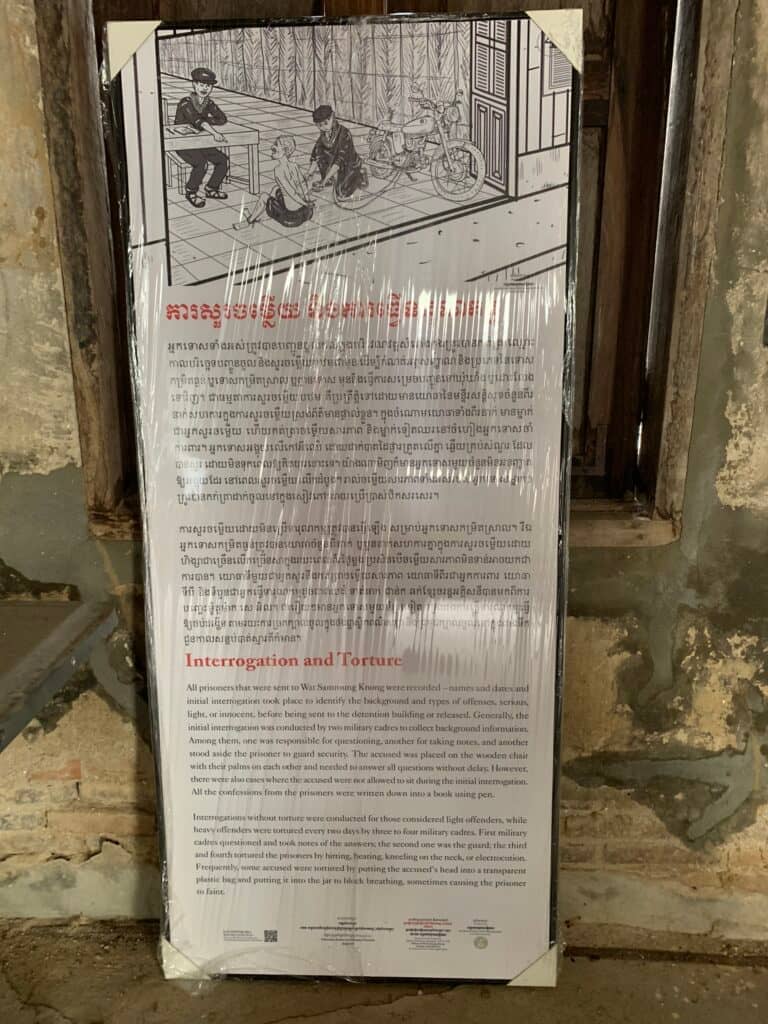
Samraong Knong is slightly smaller than S-21 in Phnom Penh, but no less harrowing.  There is a small museum where prisoners were tortured.

Samraong Knong detention center

Samraong Knong detention center

Samraong Knong - Well of Shadows
Samraong Knong - Well of shadows

An estimated 10,000 people were killed at Samraong Knong. 

The most notorious pit is the well of shadows where the children were killed.  The pit has been excavated today and now is filled with rain water.

Samraong Knong - Well of shadows

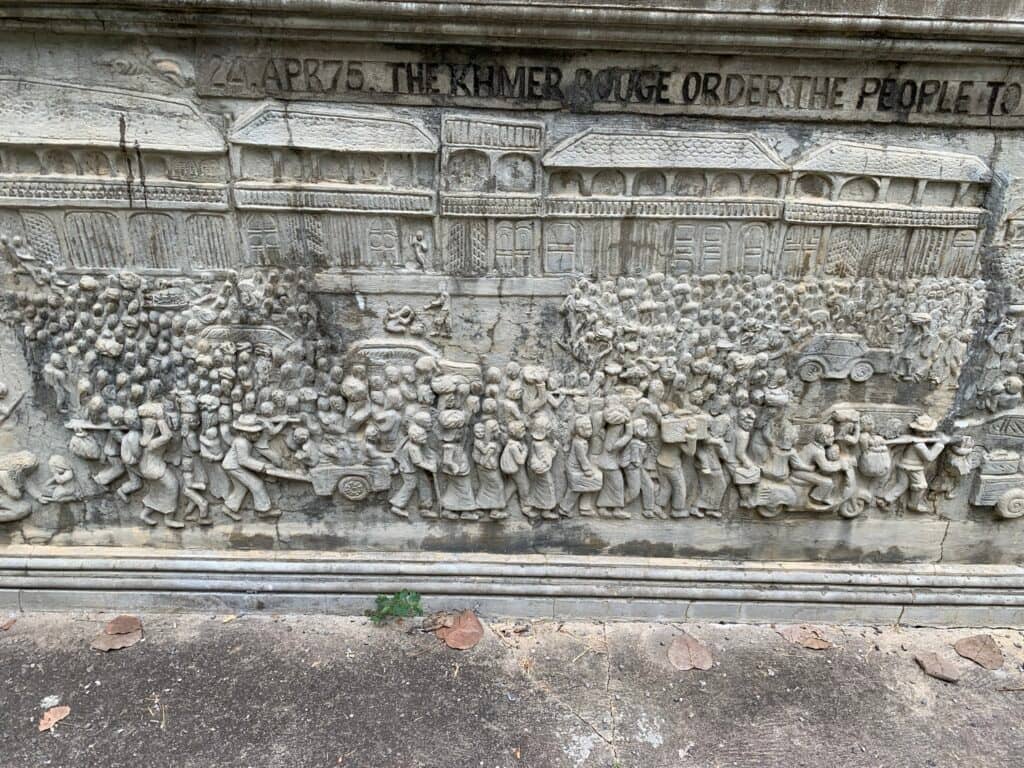
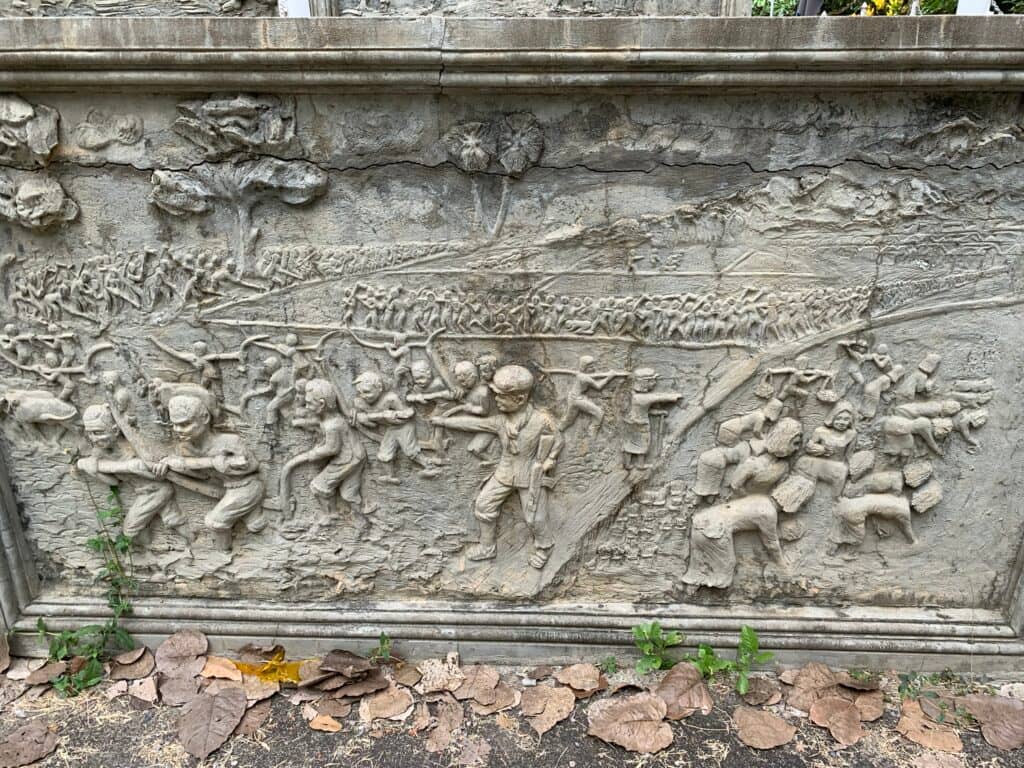
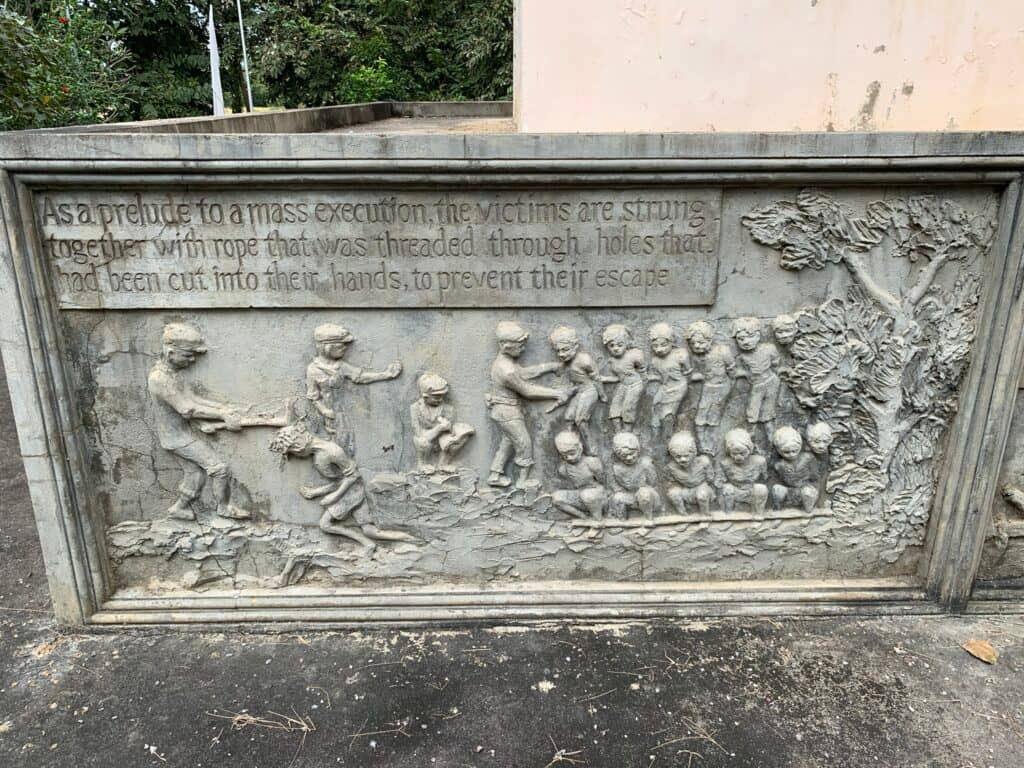
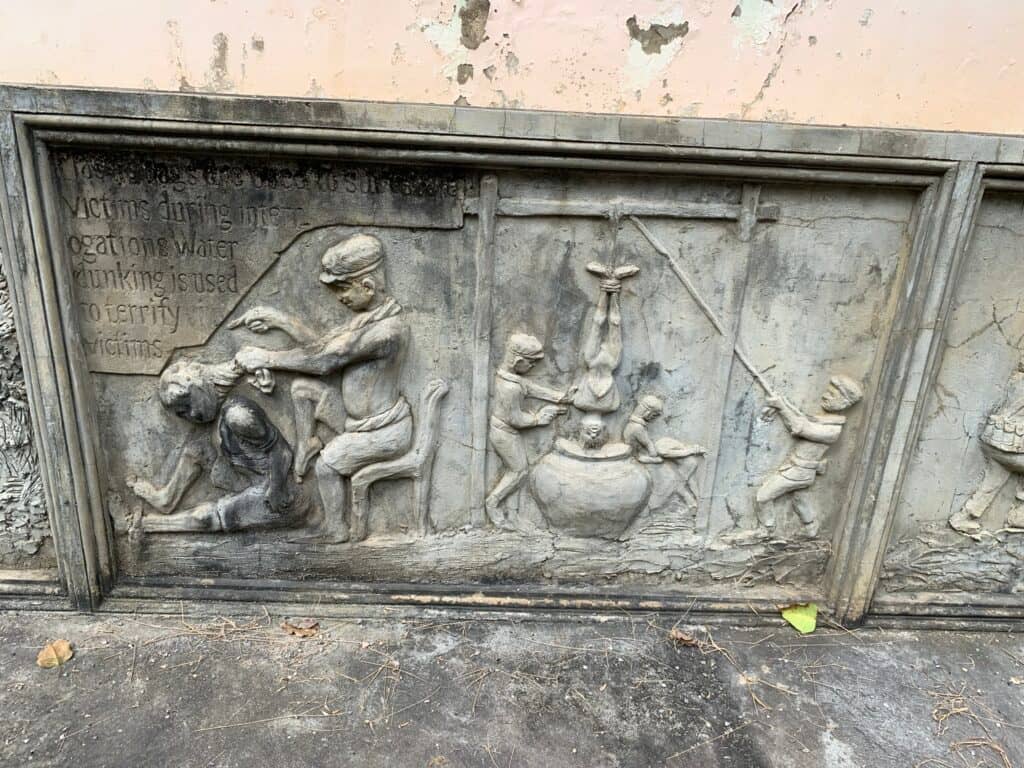
This Pagoda next to the well of shadows contains the bones that have been excavated – they can be seen behind the glass.  The base of the pagoda has a series of metal castings mounted on it portraying the horror of what happened here on this site.

Samraong Knong

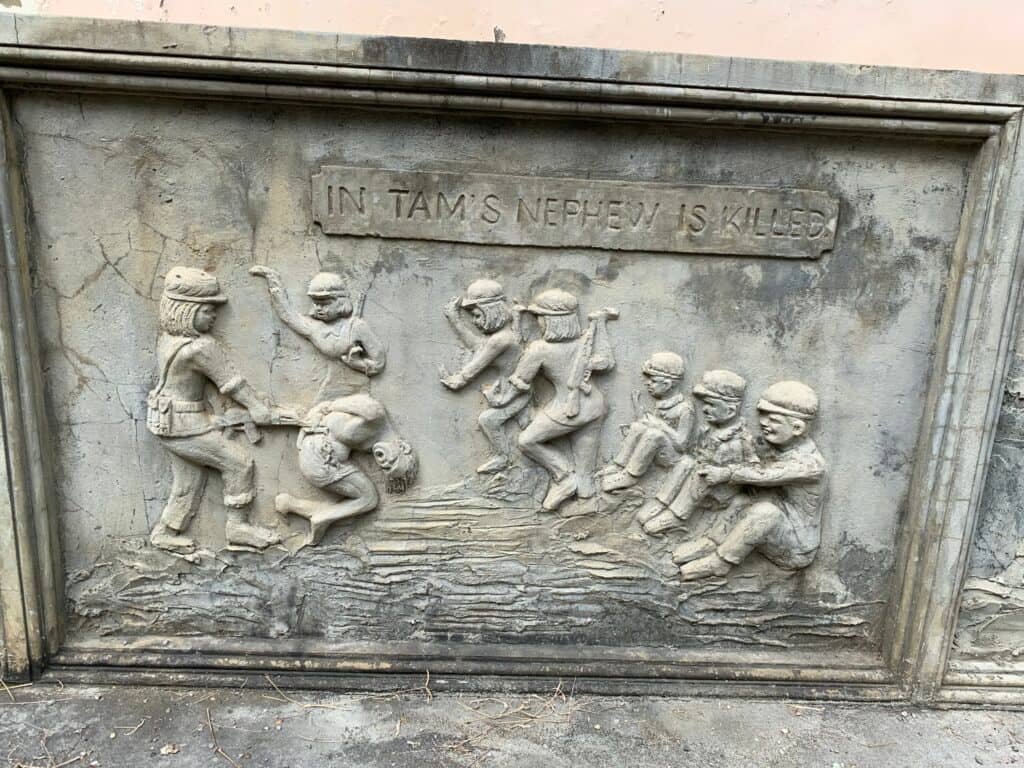
This picture portrays the forced evacuation of the city.  You can see the french architecture balconies.  The people are carrying their belongings and many even cleaned their houses because they thought they would be returning.

Samraong Knong

This shows the reality of what they were soon confronted with – forced labour in the fields.

Samraong Knong

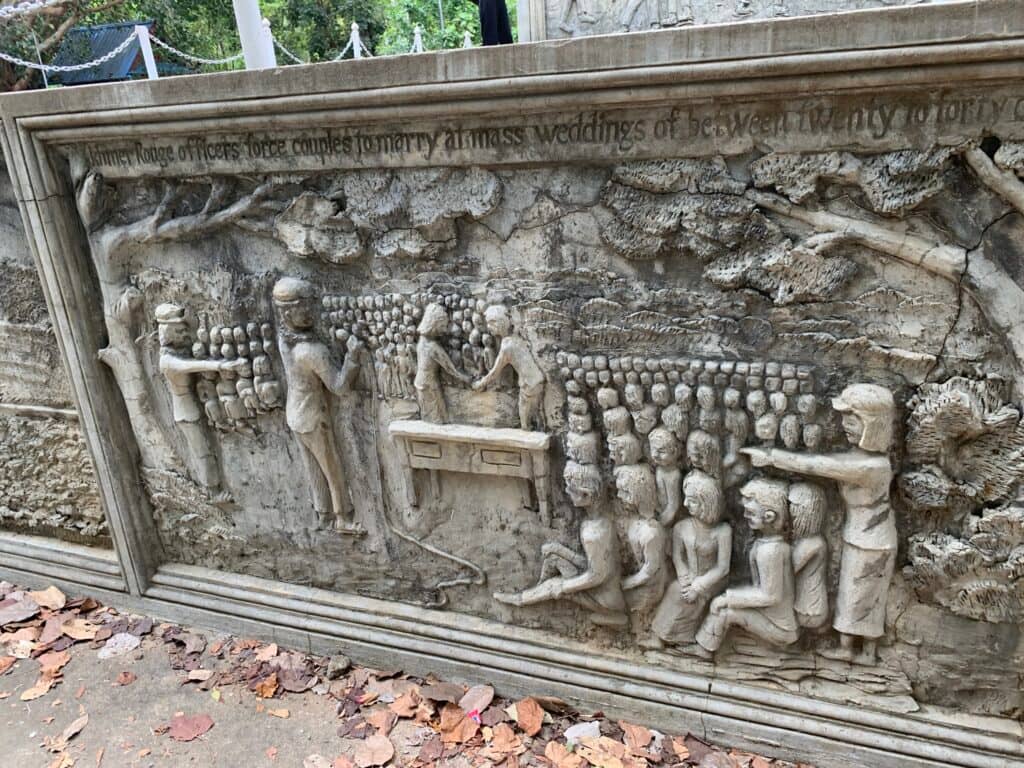
This shows a Khmer Rouge mass wedding – ratified by a simple shaking of hands.  If the couple did not get on they would just be executed.

Samraong Knong

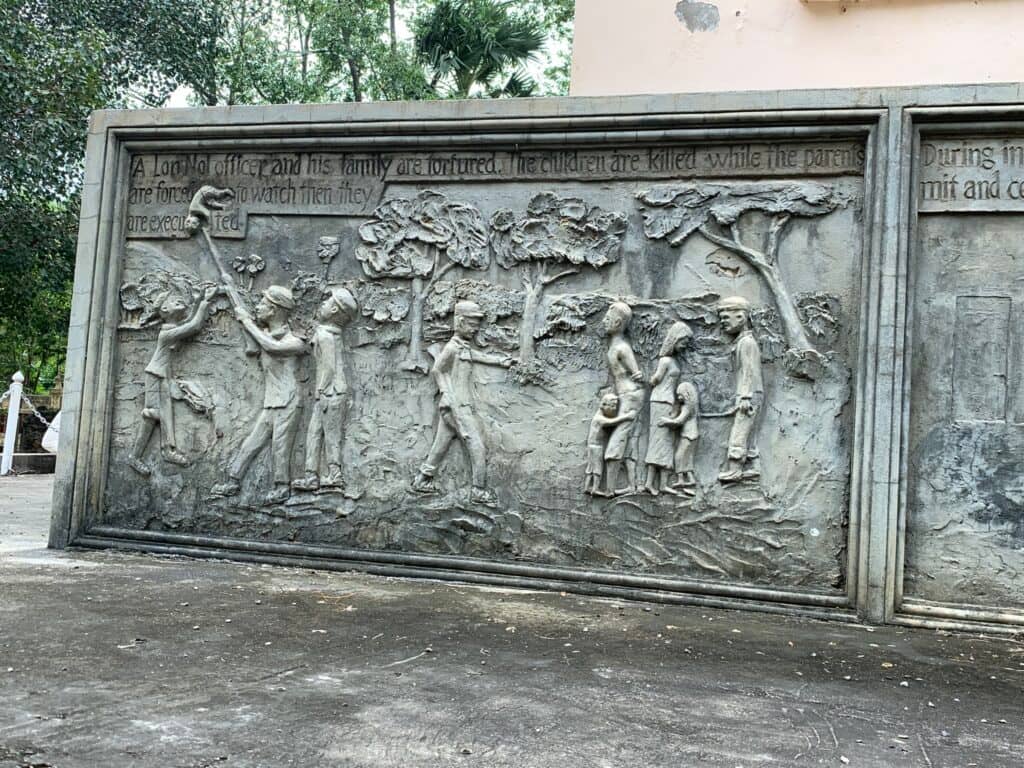
A Lon Nol officer and his family are tortured.  The children are killed while the parents watch before they themselves are excuted

Well of Shadows - Samraong Knong

Phnom Sampeau

Every day at dusk (around 5.30pm) people gather to watch the spectacle of a thick column of bats exiting from a cave high up on the cliff face of Phnom Sampeau – just a few kilometers south of Battambang. 

The display starts quite suddenly as if by a trigger and millions of bats pour out for over half an hour towards their feeding grounds near Tonle Sap lake.

Battambang bamboo train

This is a sanitised version for the tourists of the original bamboo train, left by the French, and built for the purpose of transporting up to 3 tonnes of rice out of the rice fields for eventual destination in Phnom Penh. 

While the track has been made safer with new bridges and straight tracks, it still retains the original concept of a light bamboo platform resting on two barbell like bogies and driven by a small gasoline engine attached with a rubber drive belt.

The genius of the system is that it is so light that two people can easily lift it off the track and back on again as shown here.  This allows another train to pass in the opposite direction or simply to turn around to go back again.

Battambang to Siem Reap by boat

There is a daily boat service to Siem Reap which takes about 5 hours with one stop on the way at one of the floating villages for lunch.  The boat navigates all kinds of waterways during the trip from the wide open Tonle Sap lake to tight shallow marshes,  We spent most of the trip sat on the roof.

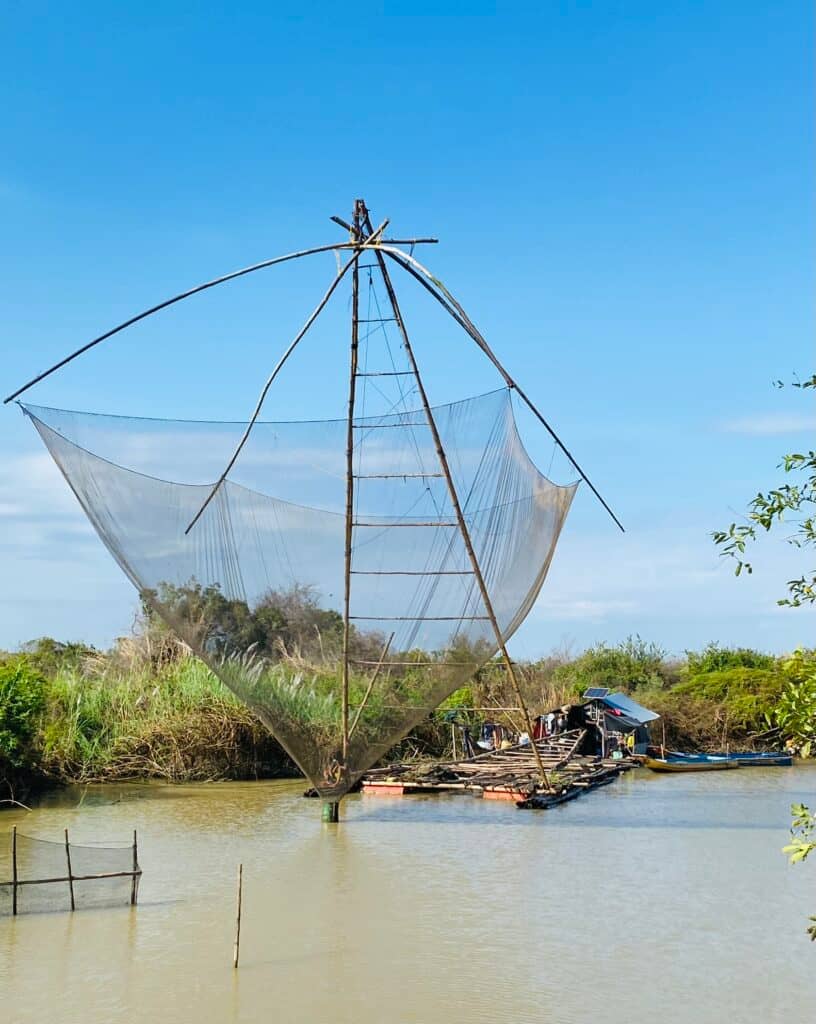
On the river after leaving Battambang we saw several of these fishing familys who live on their boats.  The boats have this net attached which they first submerge under the water and then raise with a counterweight system in order to move the catch down to the bottom of the net.

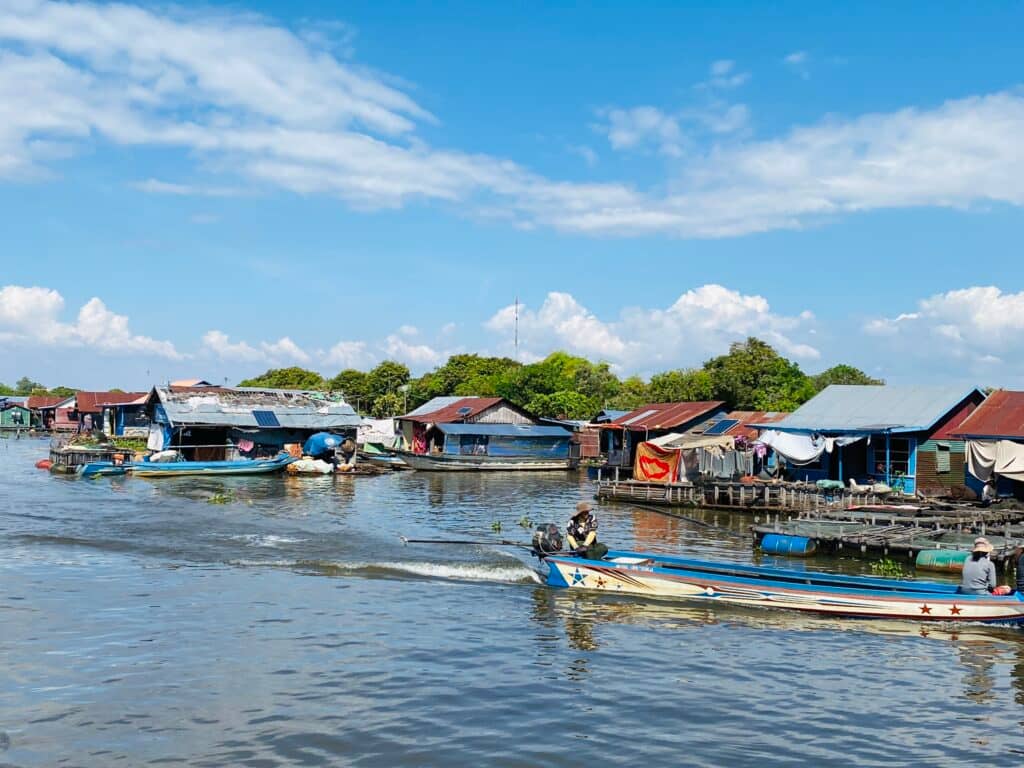
We passed several of these ‘floating villages’.  These communities are only accessible from the river, and during our journey we made stops to deliver things like a bed mattress, boat engine spare parts, and food supplies.

Lunch stop

Siem Reap

Siem Reap

As the gateway to the famous Angkor Wat, Siem Reap has reinvented itself as the epicenter of Cambodia, with world class wining and dining, backpacker party pads, and much more. 

We were there during new year when their was an all night party going on out in the street which was rammed with thousands of people.

Angkor

We spent a full day at Angkor. You need to buy a pass first of all at the Siem Reap Convention Center. We purchased the one-day pass for $37 on the day before. For our visit, we hired a tuk-tuk for the day to take us between the various sites, which is the only way as the place is much too big to walk.

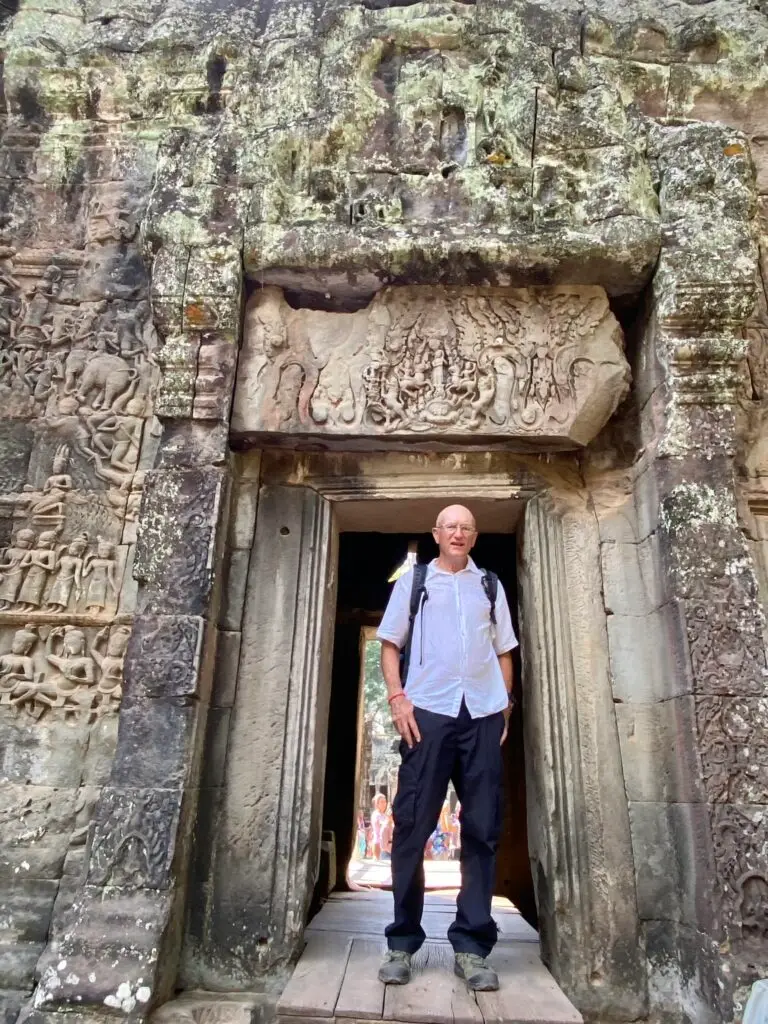
Our driver took us to Angkor Wat, Bayon, Ta Prohm, and Sra Srang, which are just some of the most visited sites amongst many more. He would just take us to the entrance, and then we would find him after amongst all the other tuk-tuks, cars, and buses to take us on to the next one. Once we came back after several hours to find him asleep in a hammock he had rigged up in his tuk-tuk!

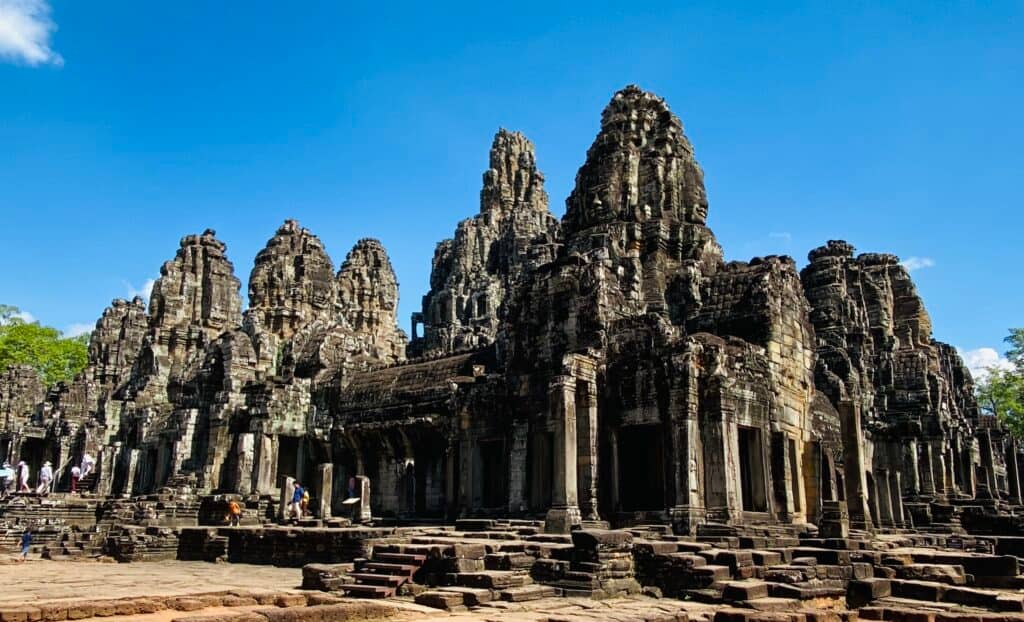
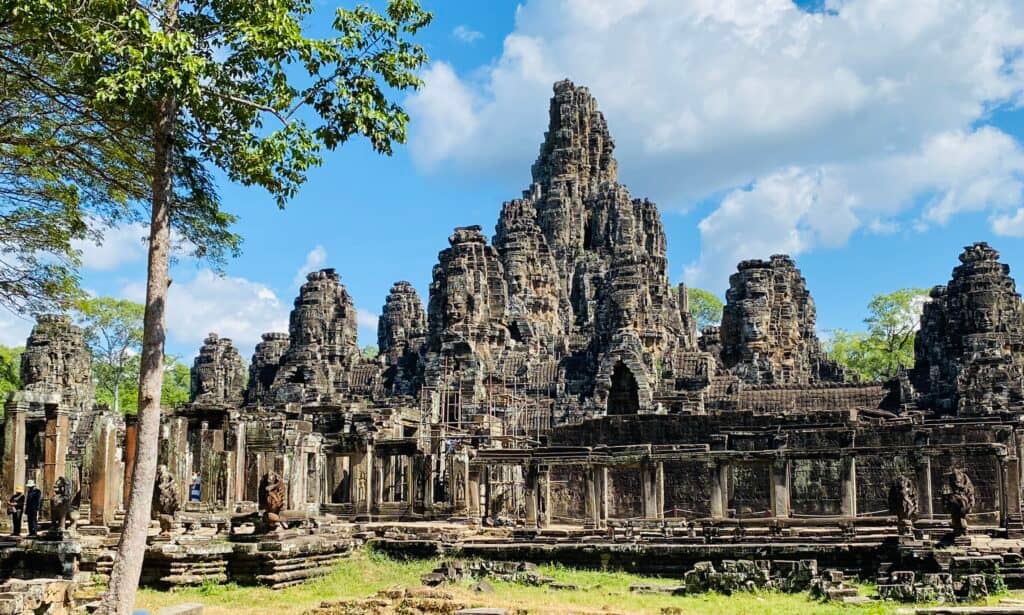
The ancient metropolis of Angkor contained between 800,000 to one million inhabitants at the height of the Khmer empire in the 12th century. The Cambodian ‘god-kings’ of the Khmer civilization, which lasted between the 9th and 15th centuries, each strove to surpass their ancestors with their own temple legacy, culminating in Bayon – the greatest temple of all in terms of the wealth and resources that were harnessed – built by Jayavarman VII. Although other temples were built after Bayon, this was the last one of great importance.

Bayon is, figuratively, heaven on earth – being the earthly representation of Mt Meru, the abode of the ancient gods and the center of the universe. It was at the heart of Angkor Thom – the royal city at the time.

The second great temple on the Angkor site is the moat-surrounded Angkor Wat, just a few kilometers to the south of Bayon. Angkor Wat was built by Suryavarman II also in the 12th century as a vast funerary temple within which his remains were to be deposited. Construction is believed to have spanned some three decades.

Bayon
Bayon
Bayon
Bayon

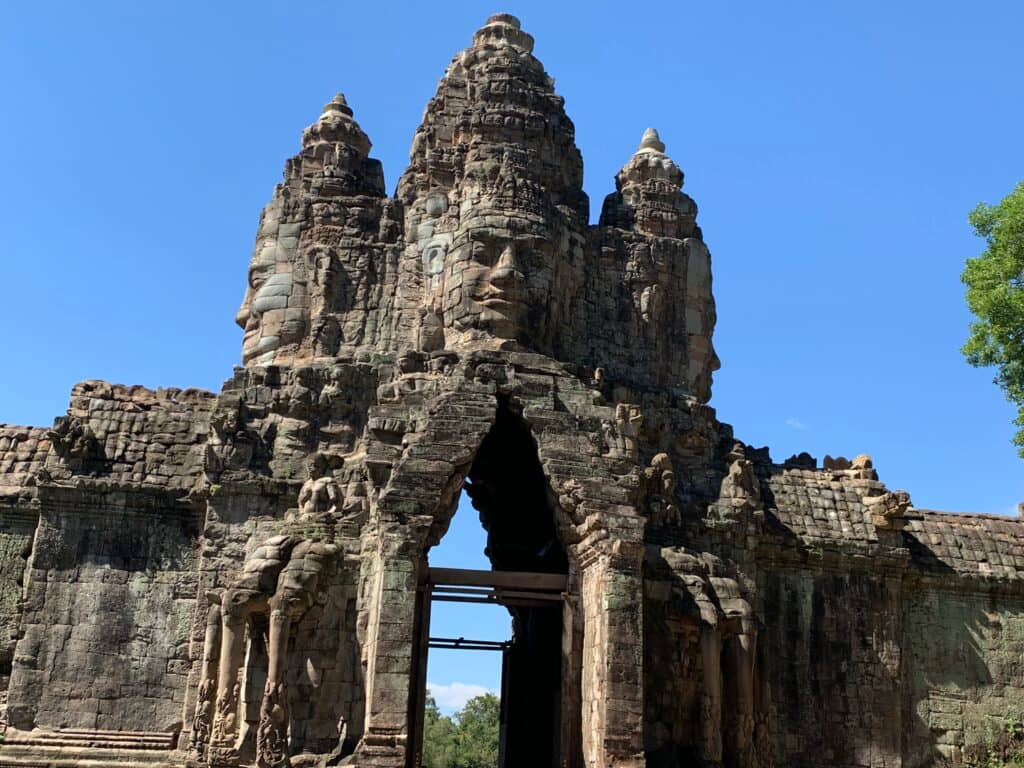
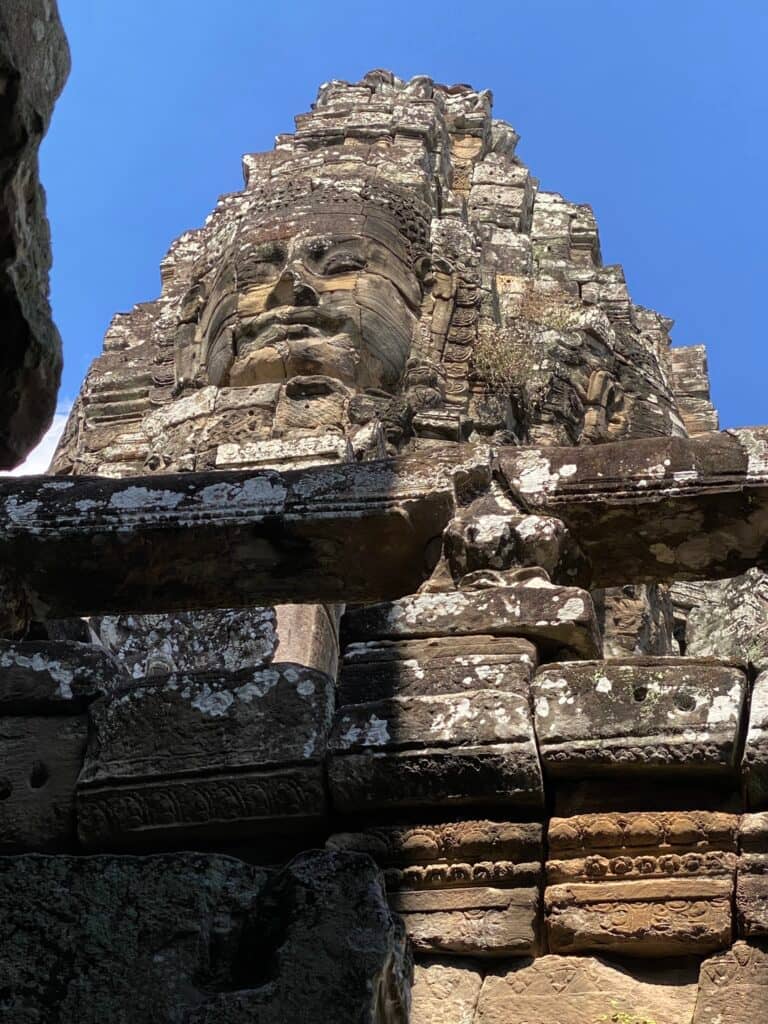
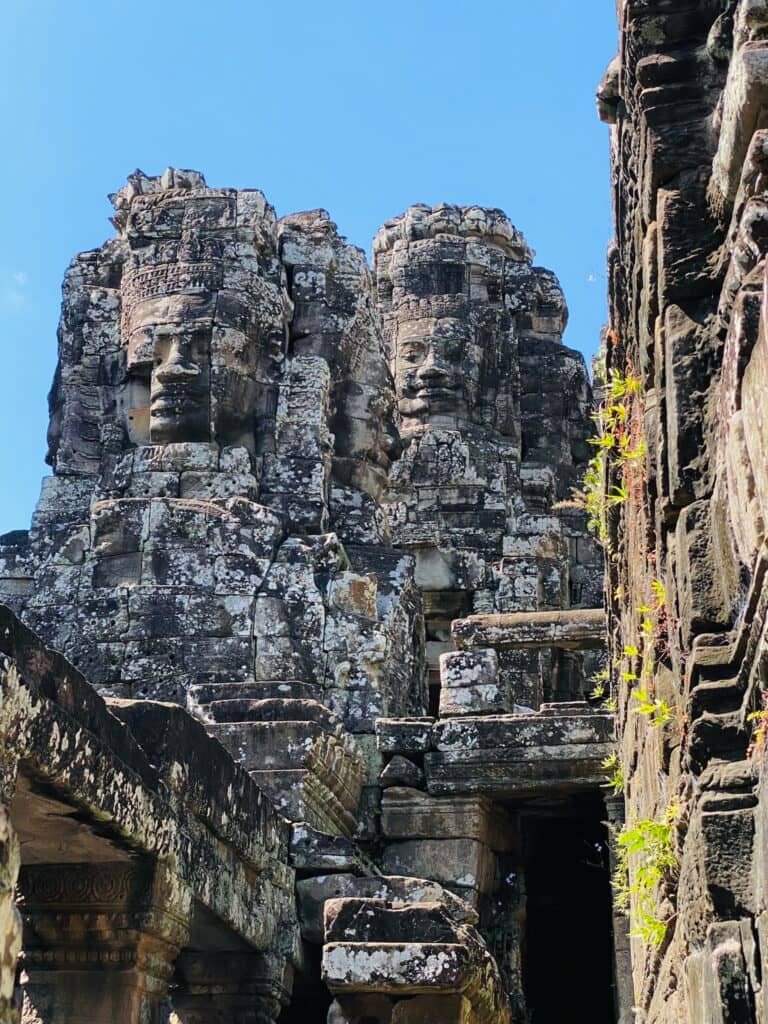
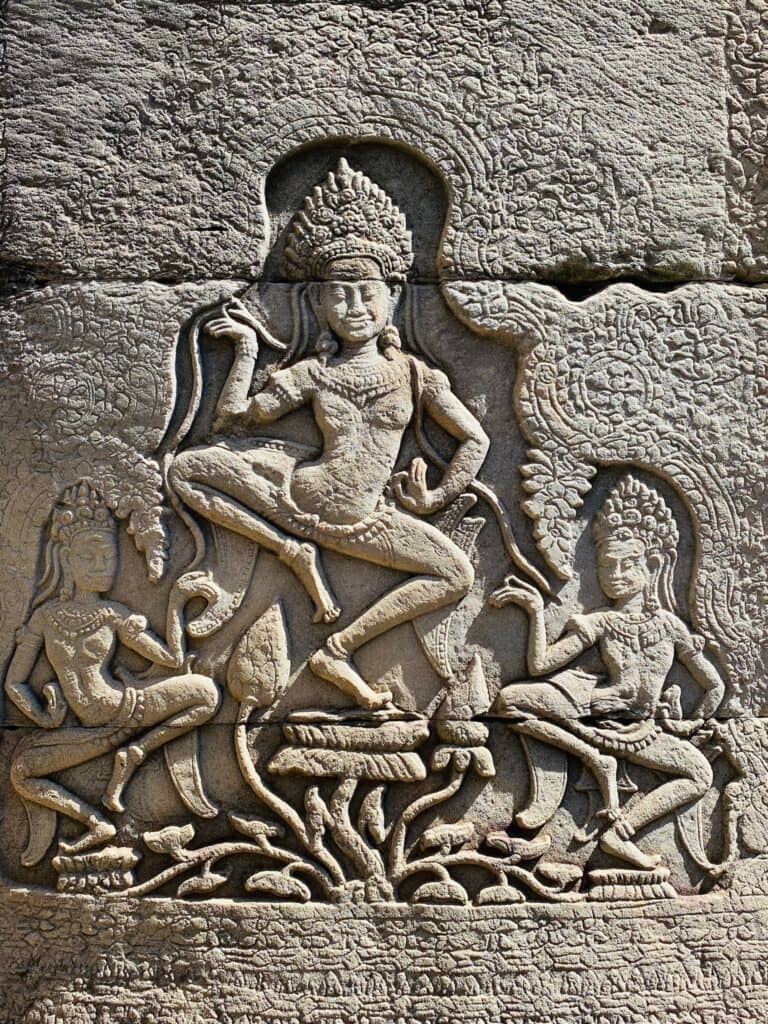
The 54 Gothic towers of Bayon are decorated with 216 gargantuan identical smiling faces of Buddha. There is speculation that the features of the faces were modeled on King Jayavarman VII himself.

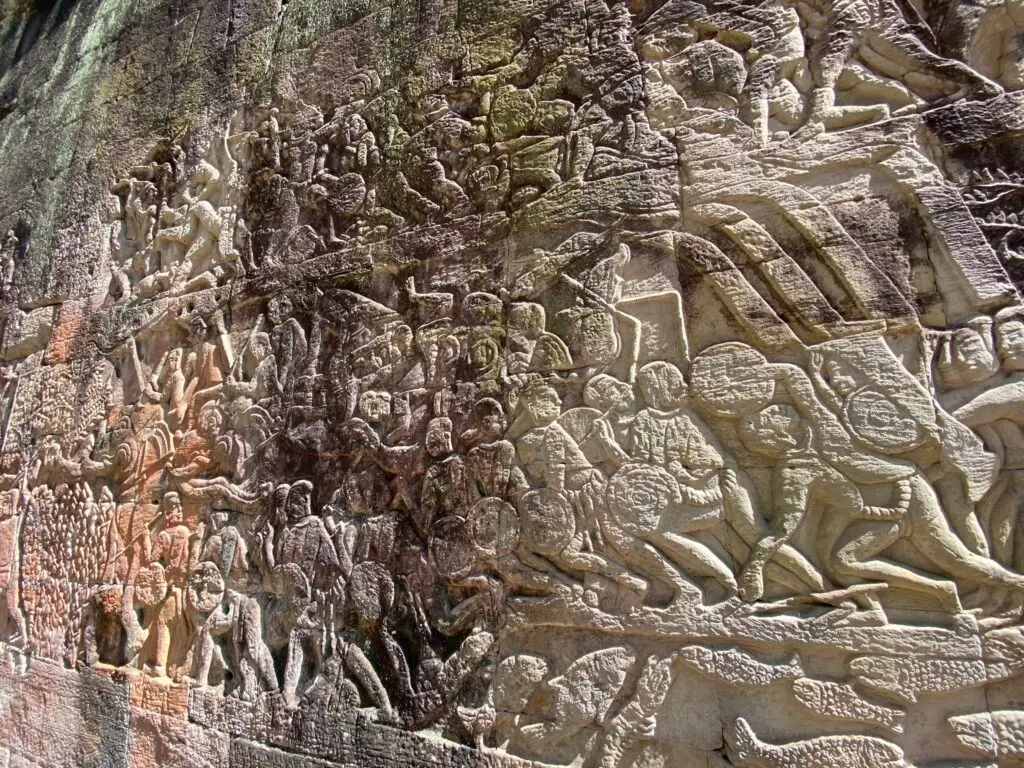
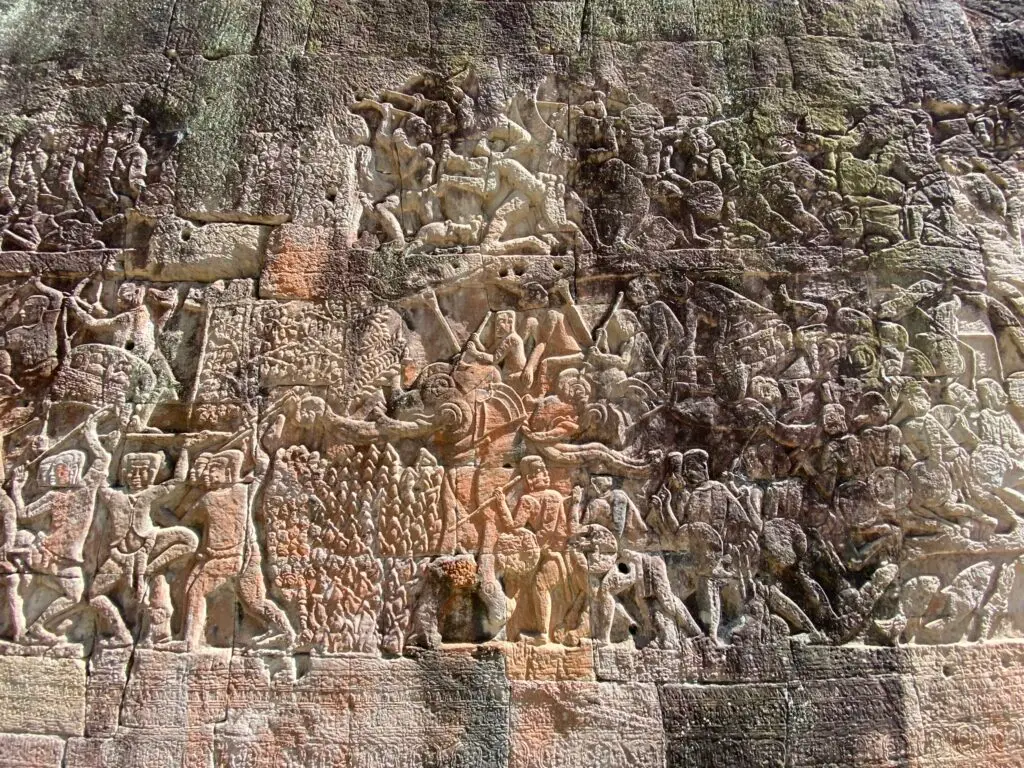
Bayon is also famous for its Bas Reliefs which depict scenes of daily life as well as battles with their Vietnamese enemies the Cham
Bas reliefs depicting battle scenes
Bas reliefs
Angkor
Angkor - Ta Prohm
Angkor - Ta Prohm
Angkor - Ta Prohm
Angkor

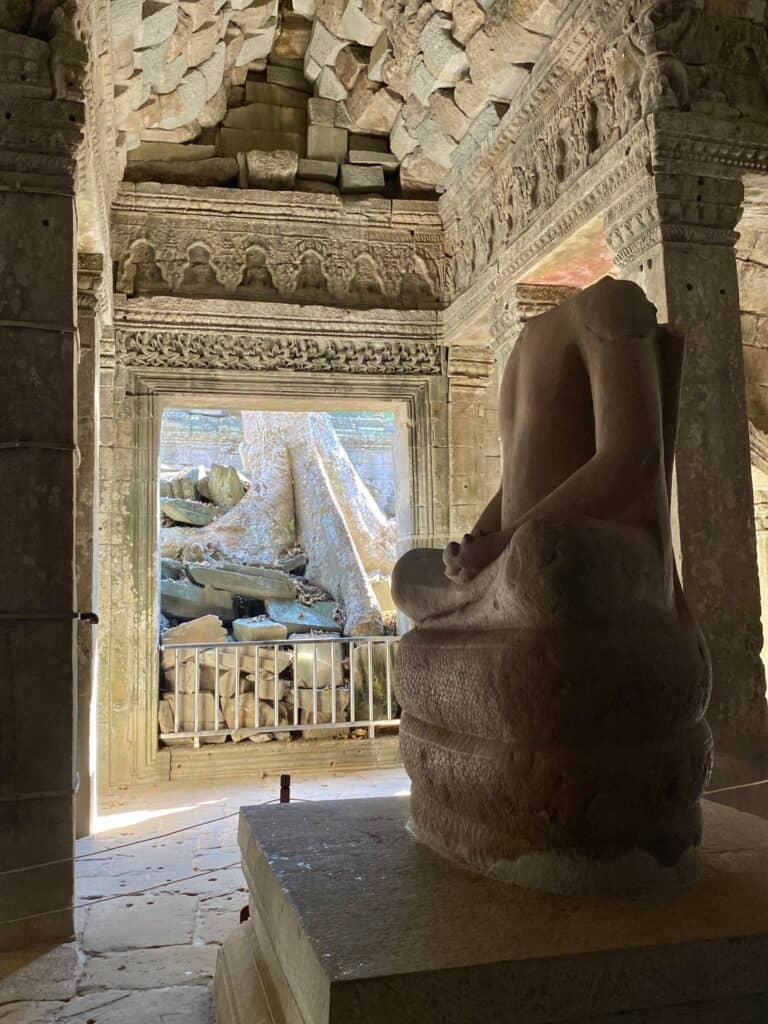
Most of the statues had been ‘decapitated’.  This was a legacy of the Khmer Rouge who desecrated these priceless artefacts to sell them to buy weapons.

Angkor

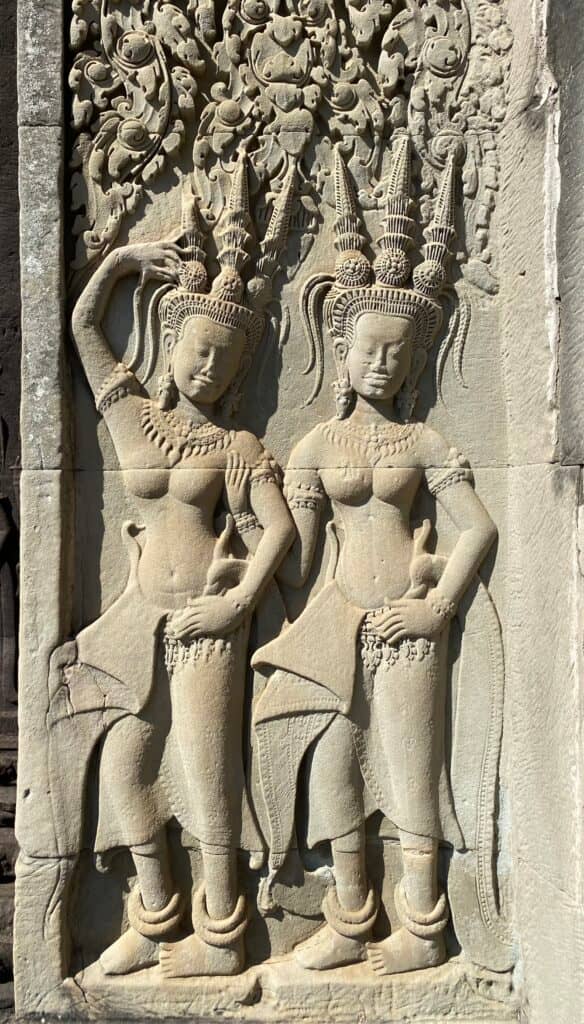
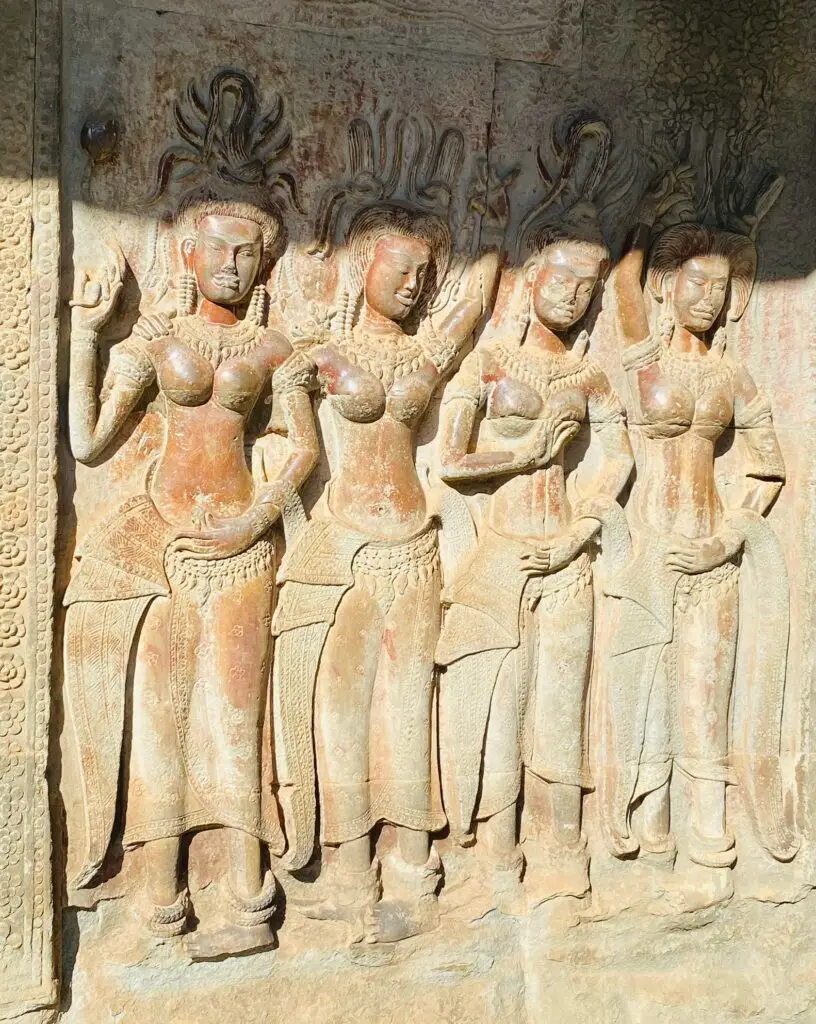
Angkor Wat is famous for its ‘apsaras’ or heavenly nymphs. There are almost 2000 carved into the walls, each of them unique and with 37 different hairstyles.  These carvings are being restored after damage by centuries of bat droppings and urine.

apsaras
Apsaras
Apsaras
Sra Srang

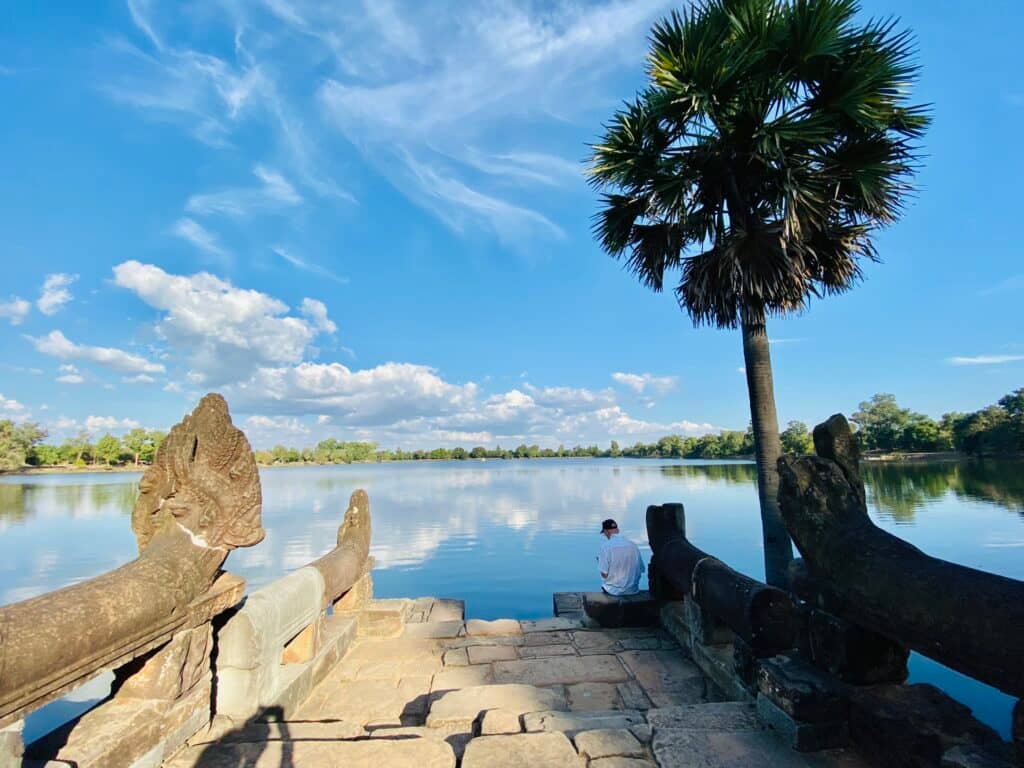
This is Sra Srang. This vast rectangular lake was excavated by countless slaves to be the royal bathing pond.

Siem Reap APOPO center

Cambodia is one of the most landmine-affected countries in the world, following over three decades of war – about 4 to 6 million of them according to surveys. 

More than 64,000 explosives-related casualties have been recorded since 1979. With over 25,000 amputees largely due to landmines, Cambodia has the highest number of amputees per capita of any country in the world.

Landmines and unexploded ordenance (UXO) are still killing indiscriminately, and 40% of landmine accidents involve children.

APOPO was established in 1997 as a Belgian humanitarian non-profit NGO and its translation in English is “Anti-Personnel Landmine Removal Product Development”.  It seeks to help vulnerable groups in different countries using its scent detection animals (dogs and rats) to “sniff out” the scent of TNT in UXO.  

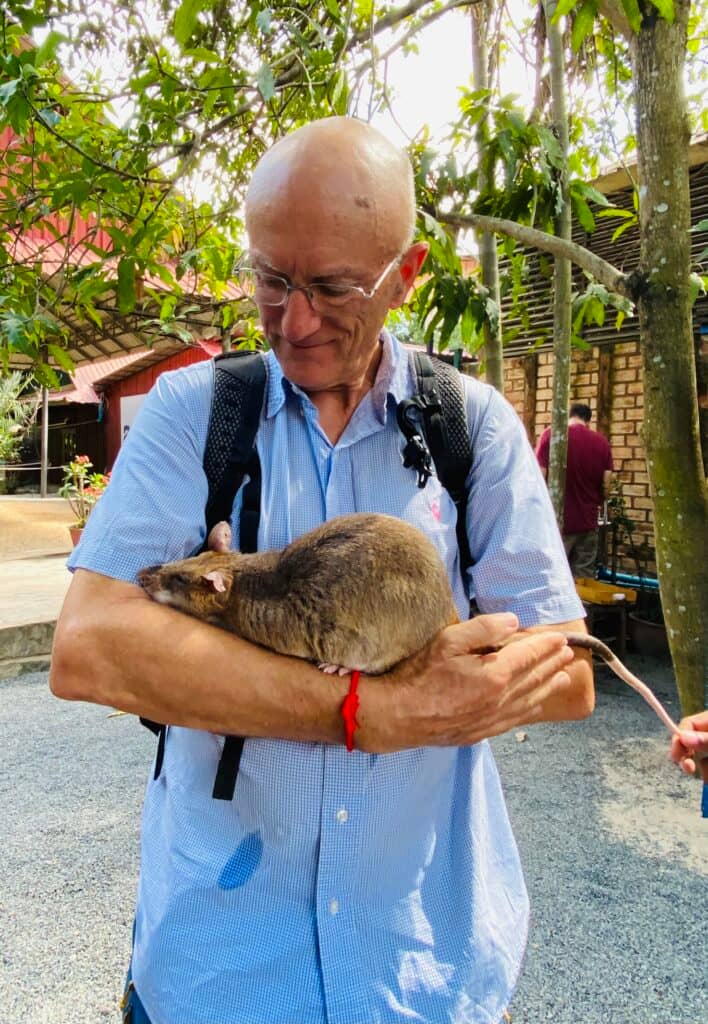
The rat that is used is called the African giant pouched rat, and they come from Tanzania where they are trained over a period of 9 months to a year before being sent out to work with colleagues in minefields arond the world.  Their value is that they do not weigh enough to trigger the pressure detector of the mine, and they can clear an area the size of a tennis court in 30 minutes which could take 4 days for a person with a metal detector.

Not all the rats are the same and some are better than others.  Also some rats turn out to be better at detecting diseases such as tuberculosis.

APOPO sent out the first rats to Cambodia in April 2015 to Siem Reap province.  The Cambodian program will be expanded in years to come to cover more provinces.

APOPO center
Luang Prabang - Laos
Luang Prabang

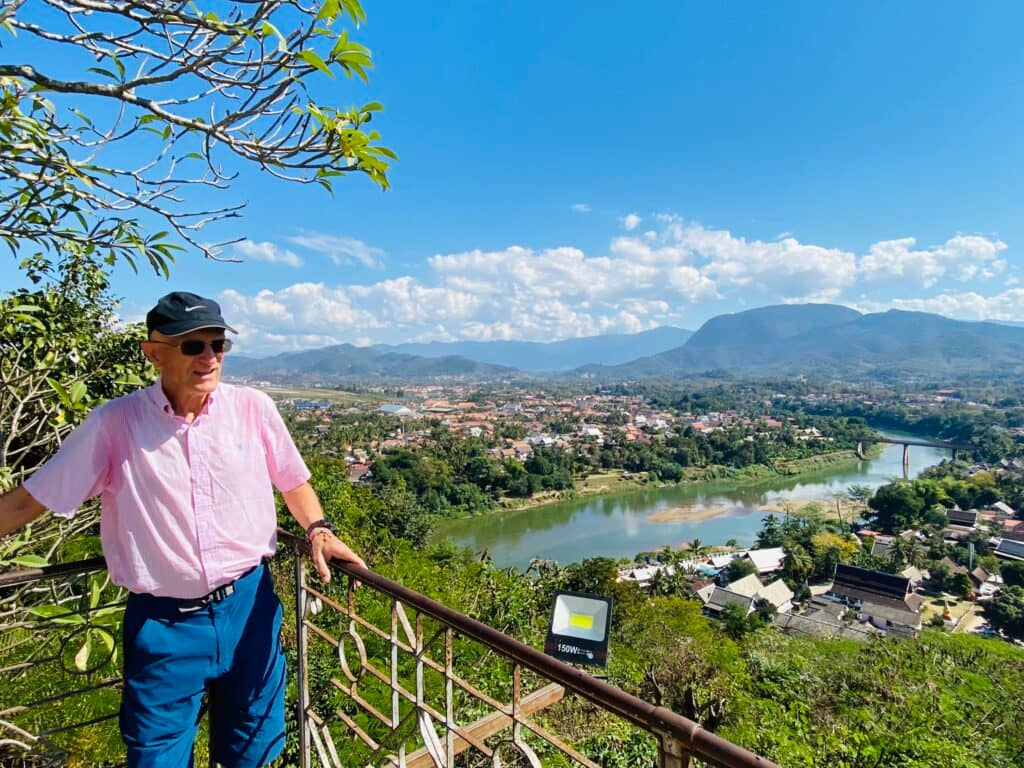
This is a view of Luang Prabang from Wat Phu Si, which is a temple built on a 100m tall hill in the center of town.  The town is situated on the Mekong river.

Luang Prabang

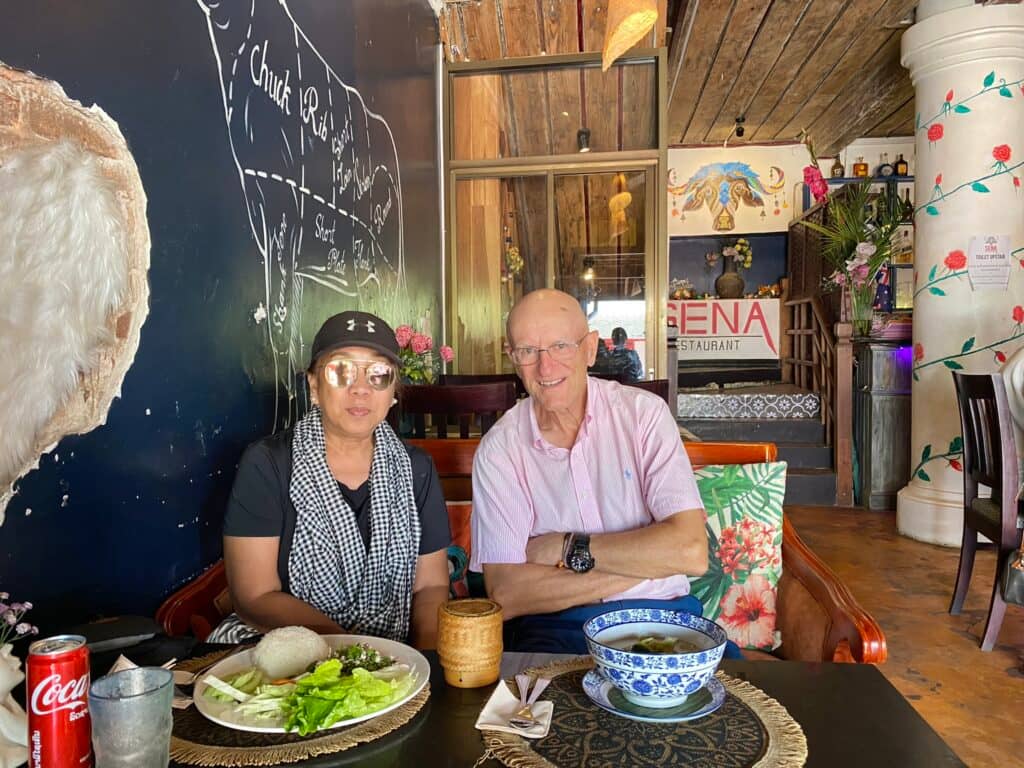
All over Indochina the food is outstanding and the goto noodle dish is called Pho (in Vietnam).

Elephant Village

Laos used to be known as ‘the land of a million elephants’, and were used in the logging industry where they were often very badly treated. When logging was banned in Thailand in 1990 2,000 elephants lost their jobs, however.  Now their numbers are greatly depleted with a world-wide population of the Asian elephant estimated to be only around 30,000, and their future is mainly in tourism. 

Elephant village in Luang Prabang is a private business funded by tourism and their business model is validated by the International Ecotourism Society (TIES) .  The elephants are cared for by vet and get as much food as they can eat.  Tourists can come to learn about the work they do and also learn generally about elephants.

Luang Prabang

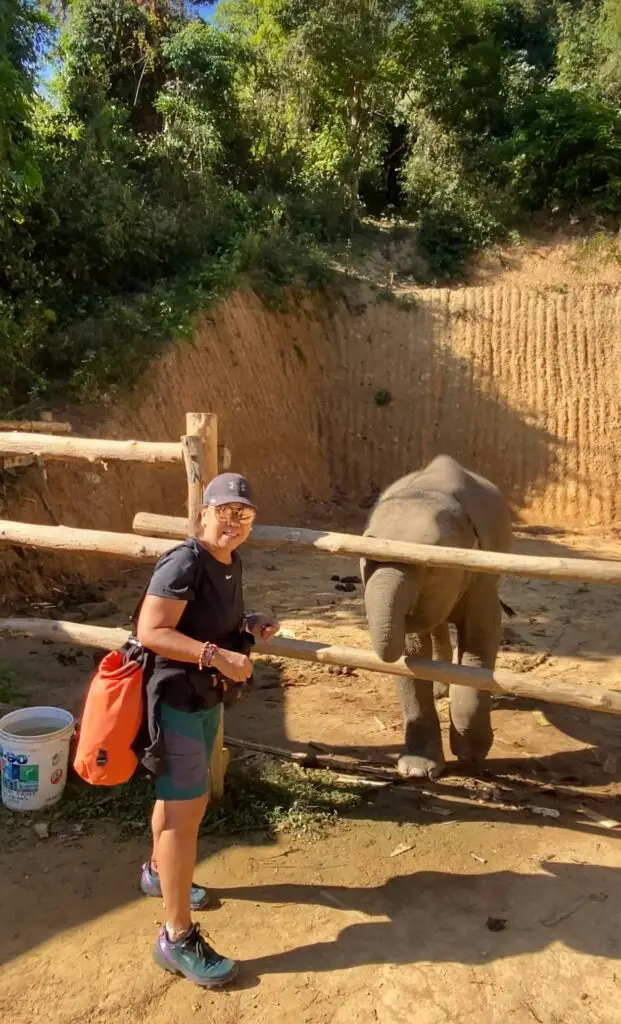
The elephants kept in the village are female so that tourists can get close without getting injured.  They have male elephants but they are kept elsewhere.  They eat for 20 hours a day and they give the tourists bananas to feed the elephants.  The other 4 hours they sleep when they lie on their side like a cat.  The food in the picture here is sugar cane – they also give them corn stalk and pineapples plus other vegetation.

Some facts about Elephants are:

  • There are only 10 locations in Asia where the population is at least 1,000 elephants.
  • They can drink 300 litres of water a day
  • They can eat 200kg of food a day
  • Elephants are good swimmers – they can even use their trunk as a snorkel
  • They have strong hearts but very slow pulses
  • Their tusks continue to grow throughout their lives
  • They can learn up to 60 commands and act on them consistently
  • They communicate by way of a slow rumbling purr
  • They are the only mamal which cannot jump
They have a successful breeding program
Elephant village

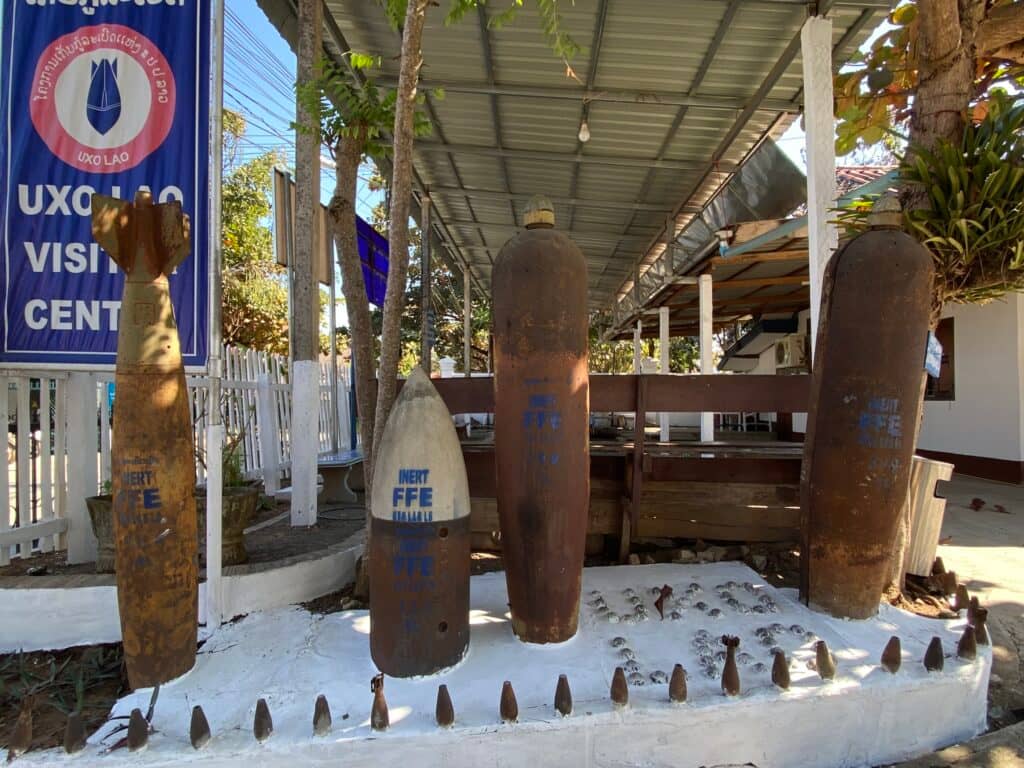
UXO Lao visitor center

As well as landmines, south eastern and central Laos still suffers from the legacy of the American bombing campaign of the early 1970’s in the form of unexploded ordenance (UXO).

The UXO Lao visitor center was opened in 2009 to educate people about UXO – particularly they go out into schools in the provinces to tell the children to beware of these objects and not pick them up but to alert the authorities instead.  The center also trains and employs people to defuse and clear these deadly objects that are still killing and maiming 50 years after the Americans have left.

Luang Prabang

A particular problem is that the people are so poor that they view collecting and selling the scrap metal of UXO as a way to get a few extra pennies. In the centre, they have made a harrowing film to warn people about the injuries that can be sustained while doing this.

Luang Prabang

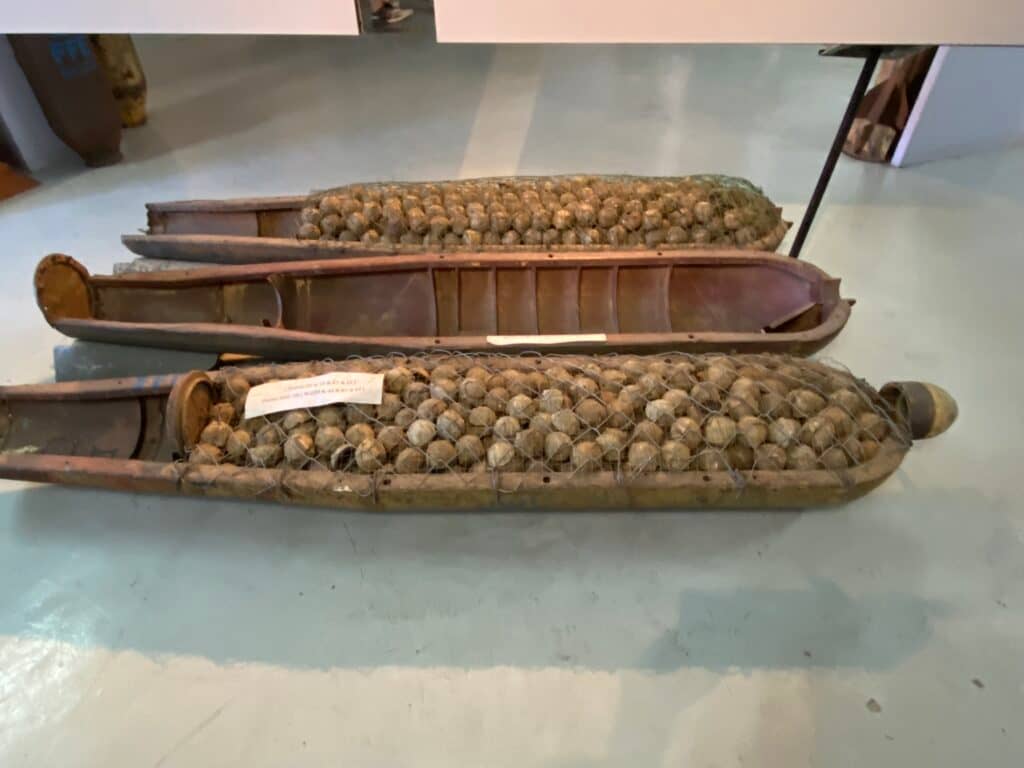
The nastiest of all are cluster bombs which, as can be seen in this model, are canisters filled with many smaller bombs or ‘bombies’.  When dropped from an aircraft, the canister breaks open in mid-air in order to scatter the bombies over an area of two to three football fields.  Anyone within the area is likely to be killed or injured and a single bombie alone has a killing radius of 30 meters.

Additionally, around 30 percent of bombies fail to detonate on impact. Tragically this poses a particular problem for children who pick them up decades later because they think they are toys and are killed or maimed.

Lao is the most bombie-contaminated country in the world.  The most common cluster bomb dropped was the BLU-26 containing 680 bombies.

It is estimated that there are 80 million unexploded bombies in Lao, and it will take at least 100 years to clear the bombies alone, which figure does not even account for all the other UXO.

Between 2008 and 2017, one person was killed every two weeks by UXO in Lao, mostly by bombies.

The center shows an archive film of an American briefing before a bombing run over Laos.  Incredibly, they actually finish the briefing with a prayer to ask God to bless their mission.

Vang Vieng

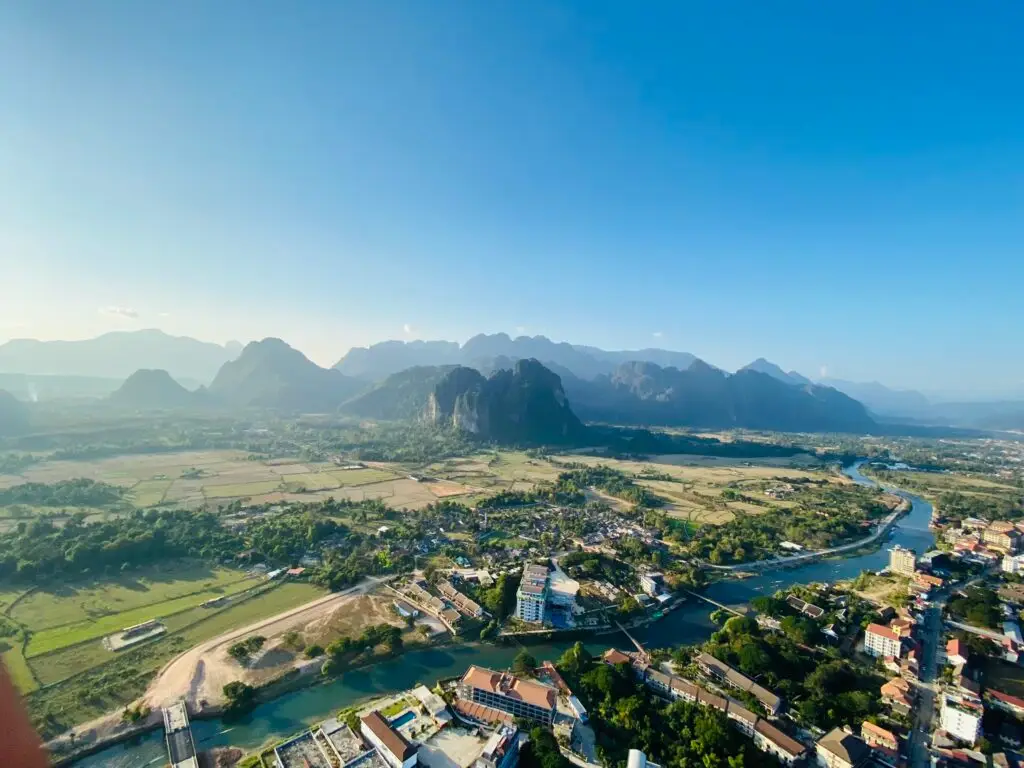
Vang Vieng is an hour train ride South from Luang Prabang situated in a very scenic landscape of limestone cliffs rising out of paddy fields around the Song River.  The town today is all about activities, and there is hiking, kayaking, caving, and rock climbing on offer amongst others.

Luang Prabang

The transport between Luang Prabang and Vang Vieng has been transformed by the new Laos China Railway (LCR).  Opened in December 2021, and funded by Chinese investment, this high speed railway goes from the Laotien capital Vientiane in the south all the way up to Yunan on the Chinese border in the north.

The section we did from Luang Prabang to Vang Vieng was especially impressive being composed almost entirely of tunnels and bridges through the mountains.

Local cuisine in Vang Vieng
Vang Vieng

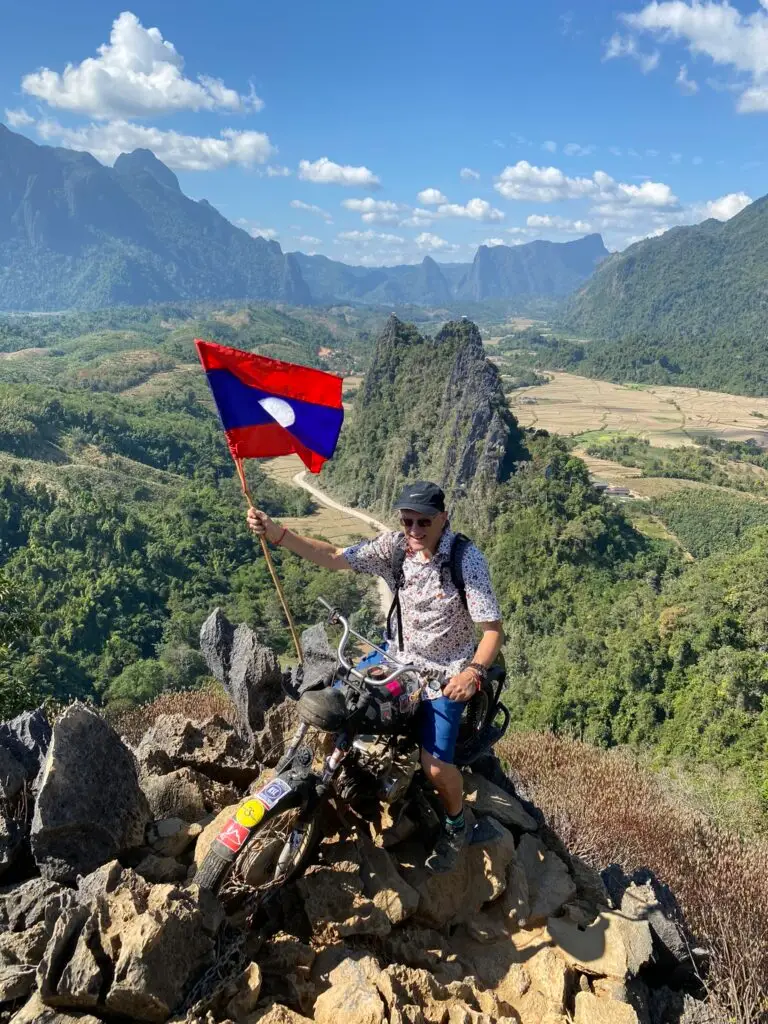
Probably the most popular hike in Vang Vieng is the Nam Xay Top View – a half scramble, half hike up a steep path to a rocky summit of 400m with an impressive viewpoint platform.  Amazingly someone has dragged a motobike up there for pictures.

Nam Xay
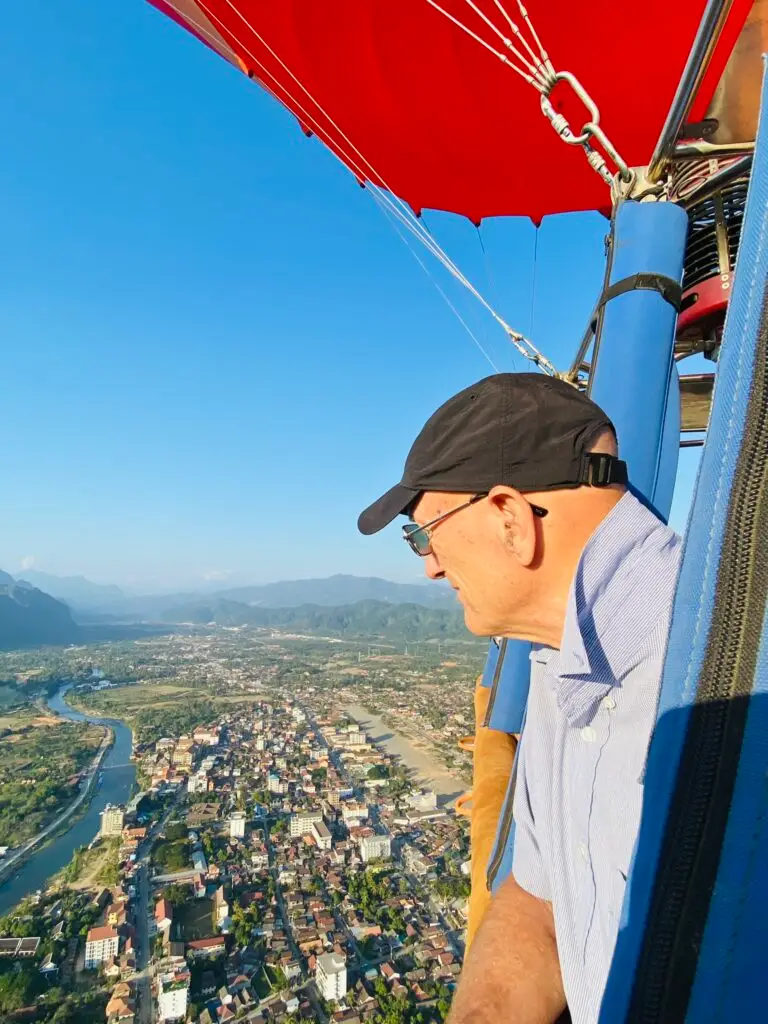
balloon rides are also an activity on offer
Vang Vieng viewed from the balloon

Vientiane

Vientiane, the capital of Laos, was the final stop on our trip, before flying back home via Hanoi.

Vientiane

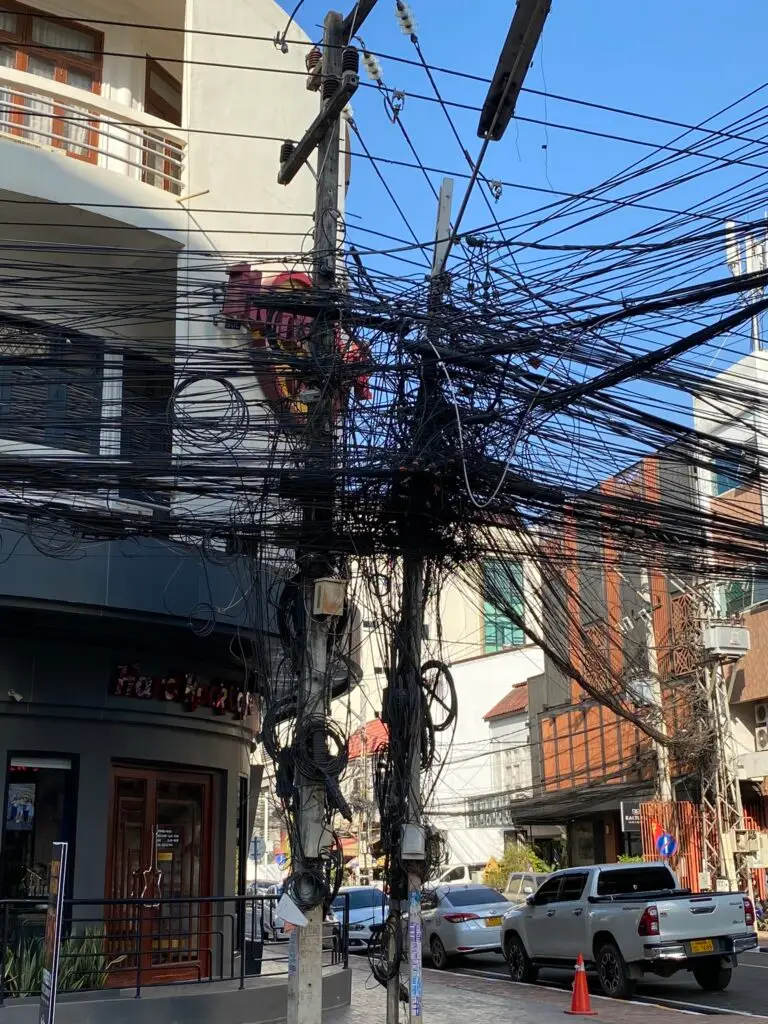
This is one of the more striking examples of telegraph wiring to be seen on most streets in Indochina.

Vientiane

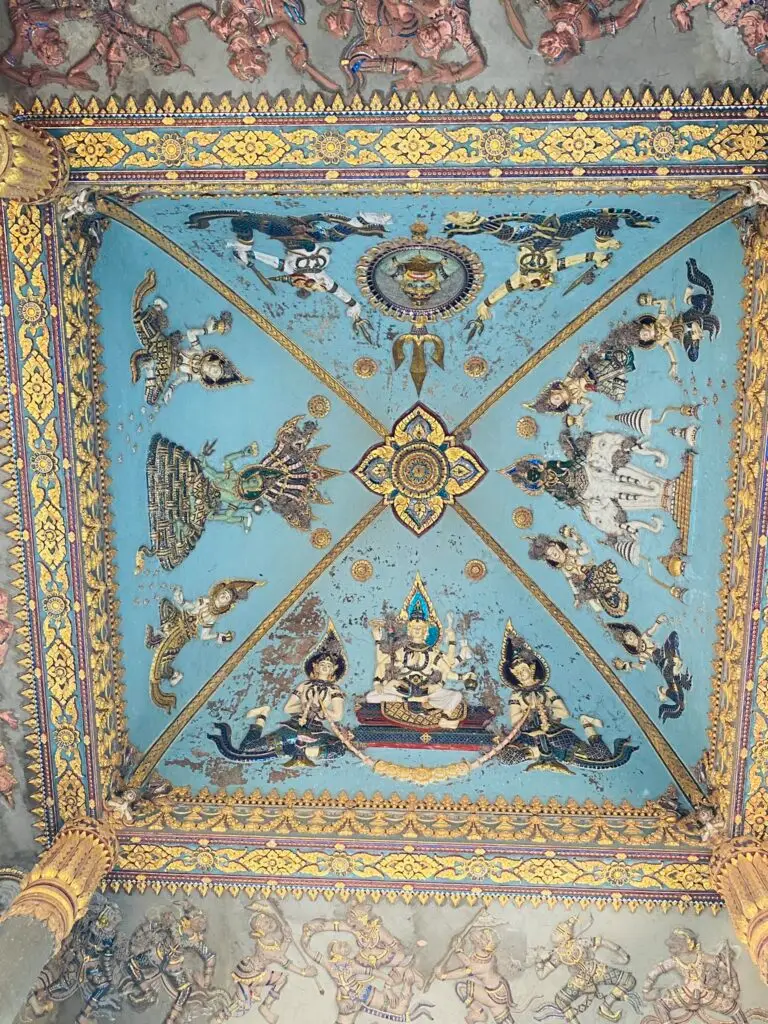
Patuxay or the ‘Victory Gate’ was built between 1957 and 1968 as a monument commemorating the independance of Lao PDR from French rule in 1953.  It is a war monument to honour the soldiers who fought against the French in the war of independence.

The construction was guided by the numerical principles of Buddhism 3-7-9 and was built from cement repurposed from plans for an American airport.

View inside of the roof of the arch

At night time the monument is illuminated with fountains

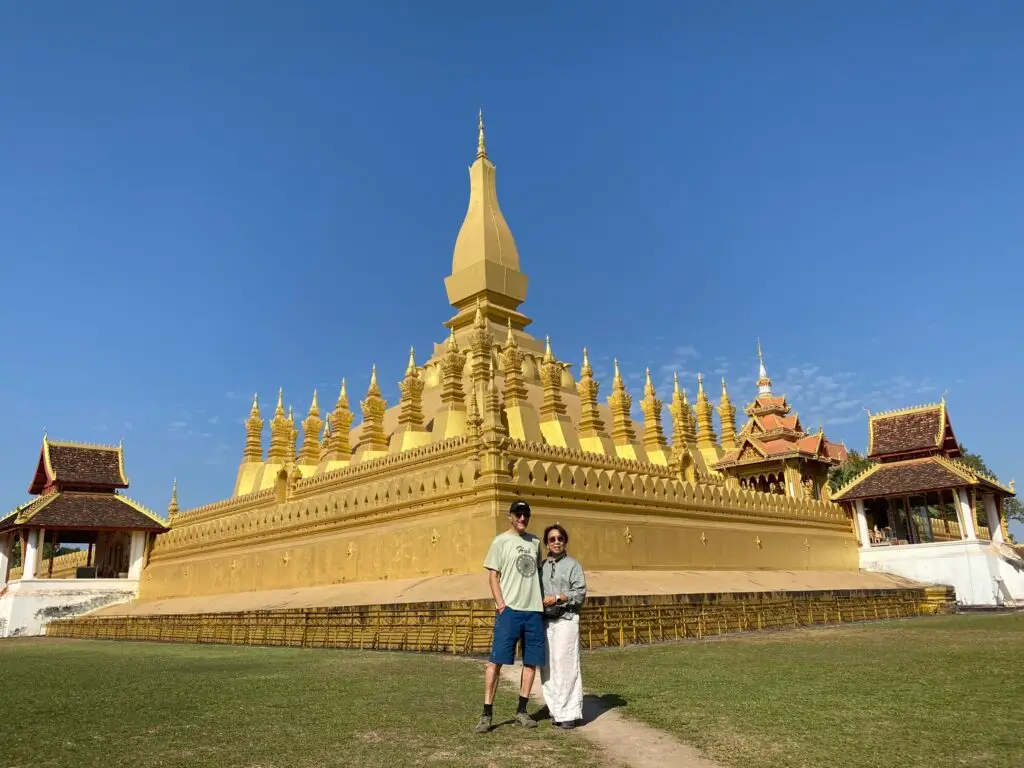
Phat That Luang, or 'the golden temple', is the most important national monument in Laos, and a symbol of Buddhist religion and Laos Sovereignty

Leave a Comment

Your email address will not be published. Required fields are marked *